MCQ
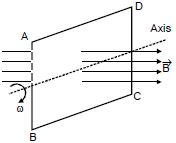
A rectangular coil $ABCD$ is rotated in uniform magnetic field with constant angular velocity about its one of the diameter as shown in figure.The induced $emf$ will be maximum, when the plane of the coil is
  • A
    Perpendicular to the magnetic field
  • B
    Making an angle of $30^o$ with the magnetic field
  • C
    making an angle of $45^o$ with the magnetic field
  • Parallel to the magnetic field

Answer

Correct option: D.
Parallel to the magnetic field
d
Let the angle between magnetic field and the line perpendicular to the surface of rectangular coil be $\theta$

Hence the flux through the coil is $\phi=\vec{B} . \vec{A}=B A \cos \theta$

Hence the induced emf $=$ Rate of change of flux $=-\frac{d \phi}{d t}=B A \sin \theta \frac{d \theta}{d t}=B A \omega \sin \theta$

Hence it is minimum when $\theta=0^{\circ}, 180^{\circ}$

Which means when the plane of coil is at right angle to the magnetic field.

Need a full question paper?

Generate a complete, print-ready paper with questions like this in minutes — across 16+ boards, with answer keys.

Start Generating Free

Similar questions

In a Young 's double slit experiment  sources of equal intensities are used  Distance hetween slits is $d$ and Wavelength of light used is $\lambda \left( {\lambda  <  < d} \right)$ . Angul ar separation of the nearest points on either side of central maximum where intensities becomes half of the maximum value
$X-$ rays are
An achromatic convergent doublet of two lens in contact has a power of $+ 2\, D$. The convex lens is power $+ 5\, D$. What is the ratio of the dispersive powers of the convergent and divergent lenses?
The minimum temperature of a body at which it emits light is.......$^oC$
Two light sources with equal luminous intensity are lying at a distance of $1.2\, m$ from each other. Where should a screen be placed between them such that illuminance on one of its faces is four times that on another face
If ${\lambda _{{\rm{max}}}}$ is $6563 Å$, then wave length of second line for Balmer series will be
In Young's double slit experiment, the intensity on the screen at a point where path difference is $\lambda$ is $K.$  What will be the intensity at the point where path difference is $\lambda /4$
A disk of radius $a / 4$ having a uniformly distributed charge $6 \mathrm{C}$ is placed in the $x-y$ plane with its centre at $(-a / 2,0,0)$. A rod of length $a$ carrying a uniformly distributed charge $8 \mathrm{C}$ is placed on the $x$-axis from $x=a / 4$ to $x=5 a / 4$. Two point charges $-7 \mathrm{C}$ and $3 \mathrm{C}$ are placed at $(a / 4,-a / 4,0)$ and $(-3 a / 4,3 a / 4,0)$, respectively. Consider a cubical surface formed by six surfaces $x= \pm a / 2, y= \pm a / 2$, $z= \pm a / 2$. The electric flux through this cubical surface is
If rotational velocity of a dynamo armature is doubled, then induced $e.m.f$. will become
The ratio of intensities of consecutive maxima in the diffraction pattern due to a single slit is