MCQ 11 Mark
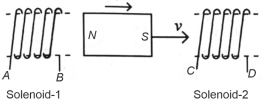
In the above diagram, a strong bar magnet is moving towards solenoid-$2$ from solenoid-$1$. The direction of induced current in solenoid-$1$ and that in solenoid-$2$, respectively, are through the directions:
- A
$B A$ and $C D$
- B
$A B$ and $C D$
- C
$B A$ and $D C$
- ✓
$A B$ and $D C$
AnswerCorrect option: D. $A B$ and $D C$
d
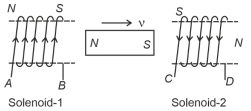
North of magnet is moving away from solenoid $1$ so end $B$ of solenoid $1$ is South and as south of magnet is approaching solenoid $2$ so end $C$ of solenoid $2$ is South.
View full question & answer→MCQ 21 Mark
In an ideal transformer, the turns ratio is $\frac{N_p}{N_S}=\frac{1}{2}$. The ratio $V_s: V_p$ is equal to (the symbols carry their usual meaning):
- ✓
$2: 1$
- B
$1: 1$
- C
$1: 4$
- D
$1: 2$
AnswerCorrect option: A. $2: 1$
a
Sol. According to transformer ratio,
View full question & answer→MCQ 31 Mark
The magnetic energy stored in an inductor of inductance $4\,\mu H$ carrying a current of $2\,A$ is :
- ✓
$8\,\mu J$
- B
$4\,\mu J$
- C
$4\,mJ$
- D
$8\,mJ$
AnswerCorrect option: A. $8\,\mu J$
a
Energy $=\frac{1}{2} Li ^2$
$=\frac{1}{2} 4 \times 10^{-6} \times 2^2$
$=8 \times 10^{-6}\,J$
energy $=8\,\mu J$
View full question & answer→MCQ 41 Mark
A $12\,V,60\,W$ lamp is connected to the secondary of a step down transformer, whose primary is connected to ac mains of $220\,V$. Assuming the transformer to be ideal, $..........\,A$ is the current in the primary winding.
- A
$0.37$
- ✓
$0.27$
- C
$2.7$
- D
$3.7$
AnswerCorrect option: B. $0.27$
b
$V _{ S } I _{ S }= V _{ P } I _{ P } \text { (ideal Transformer) }$
$\Rightarrow P _{\text {out }}= P _{ in }$
$\Rightarrow 60=220 \times I _{ P }$
$I _{ P }=\frac{60}{220}=0.27\,A$
View full question & answer→MCQ 51 Mark
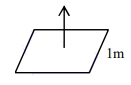
A square loop of side $1\,m$ and resistance $1\,\Omega$ is placed in a magnetic field of $0.5\,T$. If the plane of loop is perpendicular to the direction of magnetic field, the magnetic flux through the loop is $\dots\dots$ webar
Answera
$B=0.5\,T$
Angle between $\overrightarrow{ B } \& \overrightarrow{ A }$ is zero
$\phi=\text { B.A. } \cos\theta$
$=0.5 \times(1) \times 1$
$=0.5\,Wb$
View full question & answer→MCQ 61 Mark
A big circular coil of $1000$ turns and average radius $10\,m$ is rotating about its horizontal diameter at $2\,rad.s ^{-1}$. If the vertical component of earth's magnetic field at that place is $2 \times 10^{-5}\,T$ and electrical resistance of the coil is $12.56 \,\Omega$, then the maximum induced current (in $A$) in the coil will be :
Answerb
$i _{\max }=\frac{E_{\max }}{ R }=\frac{ NBA \omega}{ R }$
$i _{\max }=\frac{1000 \times 2 \times 10^{-5} \times \pi\left(10^{2}\right) \times 2}{12.56}$
$i _{\max }=1 A$
View full question & answer→MCQ 71 Mark
The magnetic flux linked to a circular coil of radius $R$ is :
$\phi=2 t^3+4 t^2+2 t+5 \;W b$
The magnitude of induced $emf$ in the coil at $t=5\; s$ is $..........\,V$.
Answerd
$\phi=2 t^3+4 t^2+2 t+5$
$e m f=\left|\frac{d \phi}{d t}\right|=6 t^2+8 t+2$
$=6 \times 5^2+8 \times 5+2$
$=192\,V$
View full question & answer→MCQ 81 Mark
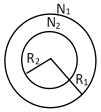
Two conducting circular loops of radii $R_{1}$ and $\mathrm{R}_{2}$ are placed in the same plane with their centres coinciding. If $R_{1}>>R_{2}$, the mutual inductance $M$ between them will be directly proportional to:
AnswerCorrect option: D. $\frac{\mathrm{R}_{2}^{2}}{\mathrm{R}_{1}}$
d
$\mathrm{M}=\frac{\mathrm{N}_{2} \phi_{2}}{\mathrm{I}_{1}}$
$\mathrm{M}=\frac{\mathrm{N}_{2} \mathrm{~B}_{1} \mathrm{~A}_{2}}{\mathrm{I}_{1}}$
$\mathrm{M} \propto \mathrm{B}_{1} \mathrm{~A}_{2}$
$\mathrm{M} \propto \frac{\mu_{0} \mathrm{I}_{1}}{2 \pi \mathrm{R}_{1}} \times \pi \mathrm{R}_{2}^{2}$
$\mathrm{M} \propto \frac{\mathrm{R}_{2}^{2}}{\mathrm{R}_{1}}$
View full question & answer→MCQ 91 Mark
A step down transformer connected to an ac mains supply of $220\, \mathrm{~V}$ is made to operate at $11 \,\mathrm{~V}, 44 \,\mathrm{~W}$ lamp. Ignoring power losses in the transformer, what is the current in the primary circuit? (In $\mathrm{~A}$)
Answera
Power loss $=0$
$\eta=100 \%$
$\mathrm{P}_{\text {in }}=\mathrm{P}_{\alpha / \mathrm{p}}$
$\mathrm{V}_{\mathrm{p} I p}=\mathrm{V}_{\mathrm{S}} \mathrm{I}_{\mathrm{s}}$
$220 \times \mathrm{Ip}=44$
$\mathrm{I}_{\mathrm{P}}=\frac{44}{220}=\frac{1}{5} \,\mathrm{~A}=.2\,\mathrm{~A}$
View full question & answer→MCQ 101 Mark
The magnetic flux linked with a coil (in $Wb$) is given by the equation $\phi=5 t^{2}+3 t+16$ The magnitude of induced emf in the coil at the fourth second will be (In $V$)
Answerc
The magnitude of induced emf is given by
$|\varepsilon|=\frac{ d \phi_{ B }}{ dt }=\frac{ d }{ dt }\left(5 t ^{2}+3 t +16\right)$
$|\varepsilon|=10 t+3+0$
at $t=4 s$
$|\varepsilon|=10 \times 4+3$
$|\varepsilon|=43 V$
View full question & answer→MCQ 111 Mark
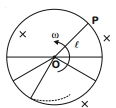
A wheel with $20$ metallic spokes each $1 \,m$ long is rotated with a speed of $120 \,rpm$ in a plane perpendicular to a magnetic field of $0.4 \,G$. The induced emf between the axle and rim of the wheel will be $\left(1 \;G =10^{-4} \;T \right)$
AnswerCorrect option: B. $2.51 \times 10^{-4} \;V$
b
Considering one spoke (OP) as given in diagram.
Induced emf across one spoke (OP),
$e=\frac{B \omega l^{2}}{2}$
$e=\frac{1}{2} \times 0.4 \times 10^{-4} \times 2 \pi \times\left(\frac{120}{60}\right) \times(1)^{2}$
$e=2.51 \times 10^{-4} V$
All spokes are parallel to each other, hence net emf
$e_{\text {Net }}=e=2.51 \times 10^{-4} V$
View full question & answer→MCQ 121 Mark
A $800$ turn coil of effective area $0.05\; \mathrm{m}^{2}$ is kept perpendicular to a magnetic fleld $5 \times 10^{-5}\; \mathrm{T}$. When the plane of the coil is rotated by $90^{\circ}$ around any of tis coplanar axis in $0.1\; \mathrm{s}$, the $emf$ induced in the coll will be.....$V$
- A
$2 $
- B
$0.2$
- C
$2 \times 10^{-3} $
- ✓
$0.02 $
AnswerCorrect option: D. $0.02 $
d
$\mathrm{N}=800, \mathrm{A}=0.05 \mathrm{m}^{2}, \mathrm{B}=5 \times 10^{-5} \mathrm{T}$
$\Delta t=0.15 \mathrm{s}$
As $e=-\frac{\left(\phi_{1}-\phi_{1}\right)}{\Delta t}=-\frac{(0-N B A)}{\Delta t}$
$=\frac{800 \times 5 \times 10^{-5} \times 5 \times 10^{-2}}{0.1}=0.02 \mathrm{V}$
View full question & answer→MCQ 131 Mark
A cycle wheel of radius $0.5 \;\mathrm{m}$ is rotated with constant angular velocity of $10 \;\mathrm{rad} / \mathrm{s}$ In a region of magnetic field of $0.1\; T$ which is perpendicular to the plane of the wheel. The $EMF$ generated between its centre and the rim is.....$V$
- A
$0.25$
- ✓
$0.125$
- C
$0.5$
- D
$0$
AnswerCorrect option: B. $0.125$
b
$\mathrm{E}=\frac{\mathrm{B} \omega \ell^{2}}{2}=\frac{0.1(10)(0.5)^{2}}{2}=0.125 \mathrm{V}$
View full question & answer→MCQ 141 Mark
Which of the following acts as a circuit protection device?
Answerd
Fuse is used for protection.
View full question & answer→MCQ 151 Mark
In which of the following devices, the eddy current effect is not used ?
- A
- B
magnetic braking in train
- C
- ✓
Answerd
Eddy current effect is not used in electric heater
View full question & answer→MCQ 161 Mark
The magnetic potential energy stored in a certain inductor is $25\,\, mJ,$ when the current in the inductor is $60\,\, mA.$ This inductor is of inductance ......$H$
- A
$0.138 $
- B
$138.88$
- ✓
$13.89 $
- D
$1.389 $
AnswerCorrect option: C. $13.89 $
c
Magnetic potential energy stored in an inductor is given by
$U=\frac{1}{2} L I^{2} $
$\Rightarrow 25 \times 10^{-3}=\frac{1}{2} \times L \times\left(60 \times 10^{-3}\right)^{2}$
$L=\frac{25 \times 2 \times 10^{6} \times 10^{-3}}{3600}=\frac{500}{36}=13.89\, \mathrm{H}$
View full question & answer→MCQ 171 Mark
A circular coil of radius $10\; cm \;,\;500$ turns and resistance $2\; \Omega$ is placed with its plane, perpendicular to the horizontal component of the earth's magnetic field. It is rotated about its vertical diameter through $180^{\circ}$ in $0.25\; s$. The induced e.m.f in the coil is (Take $H E=\left.3.0 \times 10^{-5} \;T\right)$
- A
$1.4 \times 10^{-2} \;V$
- B
$2.6 \times 10^{-2}\;V$
- ✓
$3.8 \times 10^{-3}\;V$
- D
$6.6 \times 10^{-4} \;V$
AnswerCorrect option: C. $3.8 \times 10^{-3}\;V$
c
$\varepsilon=\frac{ NBA \cos 0- NBA \cos 180}{\Delta t }$
$\varepsilon=2 \frac{ NBA }{\Delta t }$
$\varepsilon=\frac{2 \times N \times H _{ E } \times \pi r ^{2}}{\Delta t }$
$\varepsilon=3.8 \times 10^{-3} V$
View full question & answer→MCQ 181 Mark
Inside a parallel plate capacitor the electric field $E$ varies with time as $t^2$. The variation of induced magnetic field with time is given by
Answerc
$E \propto t^{2}$
$B=\frac{d E}{d t} \quad B=\frac{d}{d t}\left(t^{2}\right), B=2 t$
$B \propto t$
View full question & answer→MCQ 191 Mark
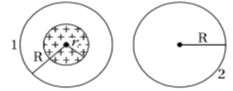
A uniform magnetic field is restricted within a region of radius $r.$ The magnetic field changes with time at a rate $\frac{{d\vec B}}{{dt}}$. Loop $1$ of radius $R > r$ encloses the region rand loop $2$ of radius $R$ is outside the region of magnetic field as shown in the figure. Then the $e.m.f.$ generated is
- A
$-\frac{{d\vec B}}{{dt}}\pi {R^2}$ in loop $1$ and zero in in loop $2$
- ✓
$ -$$\frac{{d\vec B}}{{dt}}\pi {r^2}$ in loop $1$ and $0$ in loop $2$
- C
zero in loop $1$ and zero in loop $2$
- D
$-$$\frac{{d\vec B}}{{dt}}\pi {r^2}$ in loop $1$ and $-$$\frac{{d\vec B}}{{dt}}\pi {r^2}$ in loop $2$
AnswerCorrect option: B. $ -$$\frac{{d\vec B}}{{dt}}\pi {r^2}$ in loop $1$ and $0$ in loop $2$
b
$Emf$ generated in loop $1$,
$\varepsilon_{1}=-\frac{d \phi}{d t}=-\frac{d}{d t}(\vec{B} \cdot \vec{A})=-\frac{d}{d t}(B A)=-A \times \frac{d B}{d t}$
$\varepsilon_{1}=-\left(\pi r^{2} \frac{d B}{d t}\right)$
$( \because A=\pi r^{2} \text { because } \frac{d B}{d t}$ is restricted upto radius $r.).$
$Emf$ generated in loop $2$,
$\varepsilon_{2}=-\frac{d}{d t}(B A)=-\frac{d}{d t}(0 \times A)=0$
View full question & answer→MCQ 201 Mark
A long solenoid has $1000$ turns. When a current of $4\,\, A$ flows through it, the magnetic flux linked with each tum of the solenoid is $4 \times 10^{-3}\,\, Wb.$ The self-inductance of the solenoid is......$H$
Answerc
$\text { Here, } N=1000, I=4\, \mathrm{A}, \phi_{0}=4 \times 10^{-3}\, \mathrm{Wb}$
Total flux linked with the solenoid, $\phi=N \phi_{0}$
$=1000 \times 4 \times 10^{-3}\, \mathrm{Wb}=4\, \mathrm{Wb}$
since, $\phi=L I$
$\therefore $ Self-inductance of solenoid,
$L=\frac{\phi}{I}=\frac{4\, \mathrm{Wb}}{4\, \mathrm{A}}=1\, \mathrm{H}$
View full question & answer→MCQ 211 Mark
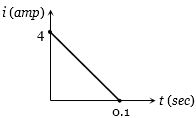
Some magnetic flux is changed from a coil of resistance $10\,\Omega$. As a result an induced current is developed in it, which varies with time as shown in figure. The magnitude of change in flux through the coil in webers is.....$Wb$
Answera
(a) $|dq| = \frac{{d\phi }}{R} = i\;dt = $ Area under $i -t$ graph
$\therefore d\phi = $($Area under i -t graph$) $R$
$ = \frac{1}{2} \times 4 \times 0.1 \times (10) = 2\;wb.$
View full question & answer→MCQ 221 Mark
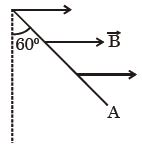
Find .......$Wb/m^2$ the magnetic flux density, if a flux of $2 \times 10^{-3}$ $weber$ passes through the slant area $A = 10\, cm^2$
- A
$2$
- ✓
$4$
- C
$2 \times 10^{-4}$
- D
$40$
Answerb
${\text{B}} = \phi /{{\text{A}}_{\text{n}}} = \frac{\phi }{{{\text{A}}\cos {{60}^\circ }}} = \frac{{2 \times {{10}^{ - 3}}}}{{\left( {10 \times {{10}^{ - 4}}} \right)\left( {\frac{1}{2}} \right)}}$
$ = 4 {\text{Wb}}/{{\text{m}}^2}$
View full question & answer→MCQ 231 Mark
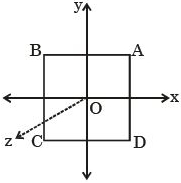
A loop, made of straight edges has four corners at $A (L, L, O)$, $B(-L, L, O)$, $C(-L, -L, O)$, $D(L, -L, O)$. A magnetic field $\vec B = {B_0}\left( {\hat i + \hat k} \right)T$ is present in the region. The magnetic flux passing through the loop $ABCD$ is
- A
$B_0L^2\, Wb$
- B
$\sqrt 2\,B_0L^2\, Wb $
- C
$2\sqrt 2\,B_0L^2\, Wb $
- ✓
$4\,B_0L^2\, Wb$
AnswerCorrect option: D. $4\,B_0L^2\, Wb$
d
Area of given loop
$\overrightarrow{\mathrm{A}}=4 \mathrm{L}^{2}(\hat{\mathrm{k}})$
$\overrightarrow{\mathrm{B}}=\mathrm{B}_{0}(\hat{\mathrm{i}}+\hat{\mathrm{k}})\, \mathrm{T}$
Now $\phi=\overrightarrow{\mathrm{B}} \cdot \overrightarrow{\mathrm{A}}=4 \mathrm{B}_{0} \mathrm{L}^{2} \,\mathrm{Wb}$
View full question & answer→MCQ 241 Mark
A square of side $x\, m$ lies in the $x-y$ plane in a region, where the magnetic field is given by $\vec B = B_0 (3\hat i + 4\hat j + 5\hat k )\,T$, where $B_0$ is constant. The magnitude of flux passing through the square is
- ✓
$5B_0x^2\,Wb$
- B
$3B_0x^2\,Wb$
- C
$2B_0x^2\,Wb$
- D
$B_0x^2\,Wb$
AnswerCorrect option: A. $5B_0x^2\,Wb$
a
Here, $\overrightarrow A = {x^2}\,\widehat k{m^2}$ and $\overrightarrow B = {B_0}(3\widehat i + 4\widehat j + 5\widehat k)T$
As $\phi = \overrightarrow {\rm{B}} \cdot \overrightarrow {\rm{A}} = {{\rm{B}}_0}(3\widehat {\rm{i}} + 4\widehat {\rm{j}} + 5\widehat {\rm{k}}) \cdot {{\rm{x}}^2}\widehat {\rm{k}}$
$\therefore \phi=5 \mathrm{B}_{0} \mathrm{x}^{2} \mathrm{\,Wb}$
View full question & answer→MCQ 251 Mark
Imagine rolling a sheet of paper into a cylinder and placing a bar magnet near its end as shown in figure. What can you say about the sign of $\vec B.d\vec A$ for every area $d\vec A$ on the surface ?

- A
- ✓
- C
- D
Can be positive or negative
Answerb
The field is entering into the surface so flux is negative.
View full question & answer→MCQ 261 Mark
A coil $10$ turns and a resistance of $20\,\Omega$ is connected in series with B.G of resistance $30\,\Omega$. The coil is placed with its plane perpendicular to the direction of a uniform magnetic field of induction $10^{-2}\,T$. If it is now turned through an angle of $60^{\circ}$ about an axis in its plane. Find the charge induced in the coil $..............\times 10^{-5} C$ (Area of a coil $=10^{-2}\,m ^2$ )
Answerc
(c)
Given : $n =10$ turns, $R _{\infty \text { il }}=20 \Omega, R _{ G }=30 \Omega$, Total resistance in the circuit $=20+30=50 \Omega$.
$A =10^{-2} m ^2, B =10^{-2} T , \phi_1=0^{\circ}, \quad \phi_2=60^{\circ}$
$q =\frac{\phi_1-\phi_2}{ R }=\frac{ BnA \cos \theta_1- BnA \cos \theta_2}{ R } $
$=\frac{ BnA (\cos 0-\cos 60)}{ R }=\frac{ BnA (1-0.5)}{ R }$
$=\frac{0.5 \times 10^{-2} \times 10 \times 10^{-2}}{50}=\frac{50 \times 10^{-5}}{50}=1 \times 10^{-5}\,C$
(Charge induced in a coil)
View full question & answer→MCQ 271 Mark
The magnetic flux linked with a coil is given by an equation $\phi $ (in webers) = $8{t^2} + 3t + 5$. The induced $e.m.f$. in the coil at the fourth second will be.......$units$
- A
$-16$
- B
$-39$
- ✓
$-67$
- D
$-145$
Answerc
(c) $e = - \frac{{d\phi }}{{dt}} = - \left( {16t + 3} \right) = - 67\,units$
View full question & answer→MCQ 281 Mark
In a coil of area $10\;c{m^2}$ and $10$ turns with a magnetic field directed perpendicular to the plane and is changing at the rate of ${10^8}$gauss/second. The resistance of the coil is $20\, ohm$. The current in the coil will be........$amp$
- ✓
$5$
- B
$0.5$
- C
$0.05$
- D
$5 \times {10^8}$
Answera
(a) $I = \frac{e}{R} = \frac{{ - N\left( {d\phi /dt} \right)}}{R} = \frac{{10 \times {{10}^8} \times {{10}^{ - 4}} \times {{10}^{ - 4}} \times 10}}{{20}}$= $5 \,A$
View full question & answer→MCQ 291 Mark
A coil having $500$ square loops each of side $10\, cm$ is placed normal to a magnetic flux which increases at the rate of $1.0$ tesla/second. The induced $e.m.f.$ in volts is
Answerd
(d) $|e|\, = N\left( {\frac{{\Delta B}}{{\Delta t}}} \right).A\cos \theta$ $= 500 \times 1 \times {(10 \times {10^{ - 2}})^2}\cos 0 = 5V.$
View full question & answer→MCQ 301 Mark
When a magnet is pushed in and out of a circular coil $C$ connected to a very sensitive galvanometer $G$ as shown in the adjoining diagram with a frequency $\nu $, then
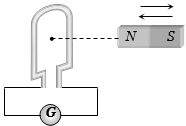
- A
Constant deflection is observed in the galvanometer
- B
Visible small oscillations will be observed in the galvanometer if $\nu $is about $50 \,Hz$
- ✓
Oscillations in the deflection will be observed clearly if $\nu = 1$ or $2\,Hz$
- D
No variation in the deflection will be seen if $\nu = 1$ or $2 \,Hz$
AnswerCorrect option: C. Oscillations in the deflection will be observed clearly if $\nu = 1$ or $2\,Hz$
c
(c) When frequency is high, the galvanometer will not show deflection.
View full question & answer→MCQ 311 Mark
A coil of area $100\,c{m^2}$ has $500$ turns. Magnetic field of $0.1\;weber/metr{e^2}$ is perpendicular to the coil. The field is reduced to zero in $0.1$ second. The induced $e.m.f$. in the coil is......$V$
Answerb
(b) $e = - \frac{{N({B_2} - {B_1})A\cos \theta }}{{\Delta t}}$
$ = - \frac{{500 \times (0 - 0.1) \times 100 \times {{10}^{ - 4}}\cos 0}}{{0.1}} = 5\,V$
View full question & answer→MCQ 321 Mark
A $50$ turns circular coil has a radius of $3\;cm$, it is kept in a magnetic field acting normal to the area of the coil. The magnetic field $B$ increased from $0.10$ tesla to $0.35$ tesla in $2$ milliseconds. The average induced $e.m.f$. in the coil is.......$V$
- A
$1.77$
- ✓
$17.7$
- C
$177$
- D
$0.177$
AnswerCorrect option: B. $17.7$
b
(b) $e = - \frac{{N({B_2} - {B_1})A\cos \theta }}{{\Delta t}}$
$ = - \frac{{50(0.35 - 0.10) \times \pi {{(3 \times {{10}^{ - 2}})}^2} \times \cos {0^o}}}{{2 \times {{10}^{ - 3}}}}$$\, = 17.7\;V$.
View full question & answer→MCQ 331 Mark
The magnetic field in a coil of $100$ turns and $40$ square cm area is increased from $1$ Tesla to $6$ Tesla in $2$ second. The magnetic field is perpendicular to the coil. The $e.m.f$. generated in it is......$V$
- A
$10000$
- B
$1.2 $
- ✓
$1$
- D
${10^{ - 2}}\,V$
Answerc
(c) $e = - N\left( {\frac{{\Delta B}}{{\Delta t}}} \right).A\cos \theta $$ = - 100 \times \frac{{(6 - 1)}}{2} \times (40 \times {10^{ - 4}})\cos 0$
$ \Rightarrow \,|e|\, = 1\;V$
View full question & answer→MCQ 341 Mark
The north pole of a bar magnet is moved swiftly downward towards a closed coil and then second time it is raised upwards slowly. The magnitude and direction of the induced currents in the two cases will be of
First case Second case
- A
Low value clockwise Higher value anticlockwise
- B
Low value clockwise Equal value anticlockwise
- C
Higher value clockwise Low value clockwise
- ✓
Higher value anticlockwise Low value clockwise
AnswerCorrect option: D. Higher value anticlockwise Low value clockwise
View full question & answer→MCQ 351 Mark
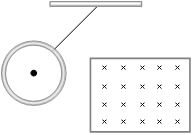
A metallic ring connected to a rod oscillates freely like a pendulum. If now a magnetic field is applied in horizontal direction so that the pendulum now swings through the field, the pendulum will
- A
Keep oscillating with the old time period
- B
Keep oscillating with a smaller time period
- C
Keep oscillating with a larger time period
- ✓
Answerd
(d)Emf induces in ring and it will opposes the motion. Hence due to the resistance of the ring all energy dissipates.
View full question & answer→MCQ 361 Mark
A circular coil of $500$ turns of wire has an enclosed area of $0.1\,{m^2}$ per turn. It is kept perpendicular to a magnetic field of induction $0.2\, T$ and rotated by $180^o$ about a diameter perpendicular to the field in $0.1\,sec$. How much charge will pass when the coil is connected to a galvanometer with a combined resistance of $50\, ohms$......$C$
Answerb
(b) $\Delta Q = \frac{{NBA}}{R}\left( {\cos {\theta _1} - \cos {\theta _2}} \right)$
$ = \frac{{500 \times 0.2 \times 0.1\left( {\cos 0 - \cos 180} \right)}}{{50}} = 0.4\;C$
View full question & answer→MCQ 371 Mark
A coil of $40$ $\Omega$ resistance has $100$ turns and radius $6\, mm$ is connected to ammeter of resistance of $160 ohms$. Coil is placed perpendicular to the magnetic field. When coil is taken out of the field, $32$ ? $C$ charge flows through it. The intensity of magnetic field will be
- A
$6.55\,T$
- B
$5.66\,T$
- C
$0.655\,T$
- ✓
$0.566\,T $
AnswerCorrect option: D. $0.566\,T $
d
(d) $q = - \frac{N}{R}\left( {{B_2} - {B_1}} \right)A\cos \theta $
$32 \times {10^{ - 6}}$$ = - \frac{{100}}{{\left( {160 + 40} \right)}}\left( {0 - B} \right) \times \pi \times {\left( {6 \times {{10}^{ - 3}}} \right)^2} \times \cos {0^o}$
$ \Rightarrow B = 0.565\;T$
View full question & answer→MCQ 381 Mark
A coil has an area of $0.05\, m^2$ and it has $800$ turns. It is placed perpendicularly in a magnetic field of strength $4 \times {10^{ - 5}}\,Wb/{m^2},$ it is rotated through ${90^o}$ in $0.1\, sec$. The average $e.m.f$. induced in the coil is
- A
$0.056 \,V$
- B
$0.046\, V$
- C
$0.026\, V$
- ✓
$0.016\,V$
AnswerCorrect option: D. $0.016\,V$
d
(d) $e = - \frac{{NBA(\cos {\theta _2} - \cos {\theta _1})}}{{\Delta t}}$
$ = - \frac{{800 \times 4 \times {{10}^{ - 5}} \times 0.05\,(\cos {{90}^o} - \cos {0^o})}}{{0.1}}$= $0.016 \,V$
View full question & answer→MCQ 391 Mark
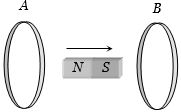
In the diagram shown if a bar magnet is moved along the common axis of two single turn coils $A$ and $B$ in the direction of arrow
- A
Current is induced only in $A$ & not in $B$
- B
Induced currents in $A$ & $B$ are in the same direction
- C
Current is induced only in $B$ and not in $A$
- ✓
Induced currents in $A$ & $B$ are in opposite directions
AnswerCorrect option: D. Induced currents in $A$ & $B$ are in opposite directions
View full question & answer→MCQ 401 Mark
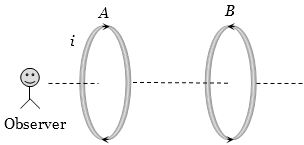
An aluminium ring $B$ faces an electromagnet $A$. The current I through $A$ can be altered
- A
Whether $I$ increases or decreases, $B$ will not experience any force
- B
If $I$ decrease, $A$ will repel $B$
- C
If $I$ increases, $A$ will attract $B$
- ✓
If $I$ increases, $A$ will repel $B$
AnswerCorrect option: D. If $I$ increases, $A$ will repel $B$
d
(d) If current through $A$ increases, crosses $(X)$ linked with coil $B$ increases, hence anticlockwise current induces in coil $B$. As shown in figure both the current produces repulsive effect.
View full question & answer→MCQ 411 Mark
A coil has $1,000$ turns and $500\, cm^2$ as its area. The plane of the coil is placed at right angles to a magnetic induction field of $2 \times {10^{ - 5}}\,Wb/{m^2}$. The coil is rotated through ${180^o}$ in $0.2$ seconds. The average $e.m.f$. induced in the coil, in milli-volts, is
Answerb
(b) By using $e = - \frac{{NBA\left( {\cos {\theta _2} - \cos {\theta _1}} \right)}}{{\Delta t}}$
$e = - \frac{{1000 \times 2 \times {{10}^{ - 5}} \times 500 \times {{10}^{ - 4}}\left( {\cos {{180}^o} - \cos {0^o}} \right)}}{{0.2}}$
$ = {10^{ - 2}}volt = 10\,mV$
View full question & answer→MCQ 421 Mark
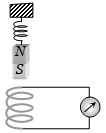
A magnet $NS$ is suspended from a spring and while it oscillates, the magnet moves in and out of the coil $C$. The coil is connected to a galvanometer $G$. Then as the magnet oscillates,
- A
$G$ shows deflection to the left and right with constant amplitude
- B
$G$ shows deflection on one side
- C
$G$ shows no deflection.
- ✓
$G$ shows deflection to the left and right but the amplitude steadily decreases.
AnswerCorrect option: D. $G$ shows deflection to the left and right but the amplitude steadily decreases.
d
(d) Polarity and magnitude of induced $e.m.f.$ changes.
View full question & answer→MCQ 431 Mark
The magnetic flux linked with coil, in weber is given by the equation, $\phi = 5{t^2} + 3t + 16$. The induced emf in the coil in the fourth second is.....$V$
Answera
(a) $|e|\, = \frac{{d\phi }}{{dt}} = \frac{d}{{dt}}(5{t^2} + 3t + 16) = (10t + 3)$
when $t = 3\sec ,\;{e_3} = (10 \times 3 + 3) = 33\;V$
when $t = 4\sec ,\;{e_4} = (10 \times 4 + 3) = 43\;V$
Hence emf induced in fourth second
$ = {e_4} - {e_3} = 43 - 33 = 10\;V$
View full question & answer→MCQ 441 Mark
The coil of area $0.1 m^2$ has $500$ turns. After placing the coil in a magnetic field of strength $4 \times {10^{ - 4}}Wb/{m^2}$, if rotated through $90^o$ in $0.1$ s, the average emf induced in the coil is......$V$
- A
$0.012$
- B
$0.05$
- C
$0.1$
- ✓
$0.2 $
AnswerCorrect option: D. $0.2 $
d
(d) $e = \frac{{ - NBA(\cos {\theta _2} - \cos {\theta _1})}}{{\Delta t}}$
$ = - \frac{{500 \times 4 \times {{10}^{ - 4}} \times 0.1(\cos 90 - \cos 0)}}{{0.1}} = 0.2\;V$
View full question & answer→MCQ 451 Mark
In a magnetic field of $0.05\,T$, area of a coil changes from $101\,c{m^2}$ to $100\,c{m^2}$ without changing the resistance which is $2\,\Omega$. The amount of charge that flow during this period is
- ✓
$2.5 \times {10^{ - 6}}$ coulomb
- B
$2 \times {10^{ - 6}}$ coulomb
- C
${10^{ - 6}}$ coulomb
- D
$8 \times {10^{ - 6}}$ coulomb
AnswerCorrect option: A. $2.5 \times {10^{ - 6}}$ coulomb
a
(a) $\phi = BA$
==> change in flux $d\phi = B.dA$= $0.05\;(101 - 100)\;{10^{ - 4}}$
$ = {5.10^{ - 6}}$Wb.
Now, charge $dQ = \frac{{d\phi }}{R} = \frac{{5 \times {{10}^{ - 6}}}}{2} = 2.5 \times {10^{ - 6}}$C.
View full question & answer→MCQ 461 Mark
If a coil of $40$ turns and area $4.0\, cm^2$ is suddenly removed from a magnetic field, it is observed that a charge of $2.0 \times {10^{ - 4}}\,C$ flows into the coil. If the resistance of the coil is $80\Omega $, the magnetic flux density in $Wb/{m^2}$ is
Answerb
(b) $\Delta Q = \frac{{\Delta \phi }}{R} = \frac{{n \times BA}}{R}$
==> $B = \frac{{\Delta Q.R}}{{nA}}$$ = \frac{{2 \times {{10}^{ - 4}} \times 80}}{{40 \times 4 \times {{10}^{ - 4}}}}$$ = 1\;Wb/{m^2}$
View full question & answer→MCQ 471 Mark
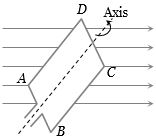
A rectangular coil $ABCD$ is rotated anticlockwise with a uniform angular velocity about the axis shown in diagram below. The axis of rotation of the coil as well as the magnetic field $B$ are horizontal. The induced $e.m.f$. in the coil would be maximum when
AnswerCorrect option: A. The plane of the coil is horizontal
a
(a) Emf = $e = {e_0}\sin \theta ;$ e will be maximum when $\theta$ is $90^o$ i.$e$. plane of the coil will be horizontal.
View full question & answer→MCQ 481 Mark
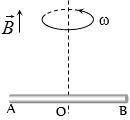
A conducting rod of length $2l$ is rotating with constant angular speed $omega$ about its perpendicular bisector. A uniform magnetic field $\overrightarrow B $ exists parallel to the axis of rotation. $The e.m.f.$ induced between two ends of the rod is
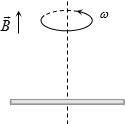
AnswerCorrect option: D. $Zero$
d
(d) Potential difference between
$O$ and $A$ is ${V_0} - {V_A} = \frac{1}{2}B{l^2}\omega $
$O$ and $B$ is
${V_0} - {V_B} = \frac{1}{2}B{l^2}\omega $
so ${V_A} - {V_B} = 0$
View full question & answer→MCQ 491 Mark
A physicist works in a laboratory where the magnetic field is $2 \,T$. She wears a necklace enclosing area $0.01$ $m_2$ in such a way that the plane of the necklace is normal to the field and is having a resistance $R = 0.01$ $\Omega$. Because of power failure, the field decays to $1 \,T$ in time $10^{-3}$ seconds. Then what is the total heat produced in her necklace ?.......$J$ ($T = Tesla$)
Answera
(a) $H = \frac{{{V^2}t}}{R}\,and\;\;V = \frac{{N({B_2} - {B_1})A\cos \theta }}{t}$
$V = \frac{{1 \times (1 - 2) \times 0.01 \times \cos {0^o}}}{{{{10}^{ - 3}}}} = 10\;V$
So, $H = \frac{{{{(10)}^2} \times {{10}^{ - 3}}}}{{0.01}} = 10\;J$
View full question & answer→MCQ 501 Mark
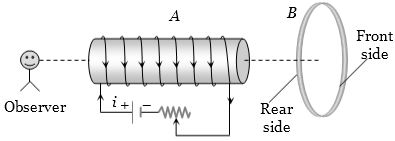
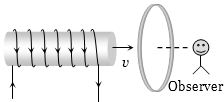
A current carrying solenoid is approaching a conducting loop as shown in the figure. The direction of induced current as observed by an observer on the other side of the loop will be
Answerb
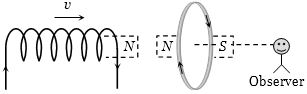
(b) The direction of current in the solenoid is anti-clockwise as seen by observer. On displacing it towards the loop a current in the loop will be induced in a direction so as to oppose the approach of solenoid. Therefore the direction of induced current as observed by the observer will be clockwise.
View full question & answer→