Question
A rectangular coil of 100 turns has length 5cm and width 4cm. It is placed with its plane parallel to a uniform magnetic field and a current of 2A is sent through the coil. Find the magnitude of the magnetic field B if the torque acting on the coil is $0.2N\ m^{-1}$.
Answer

$\tau=\text{ni}\overrightarrow{\text{A}}\times\overrightarrow{\text{B}}$
$\Rightarrow\tau=\text{ni}\text{ AB}\sin90^\circ$
$\Rightarrow0.2=100\times2\times5\times4\times10^{-4}\times\text{B}$
$\Rightarrow\text{B}=\frac{0.2}{100\times2\times5\times4\times10^{-4}}=0.5$ Tesla

Need a full question paper?

Generate a complete, print-ready paper with questions like this in minutes — across 16+ boards, with answer keys.

Start Generating Free

Similar questions

If Bohr’s quantisation postulate (angular momentum $=\text{nh}/\pi$) is a basic law of nature, it should be equally valid for the case of planetary motion also. Why then do we never speak of quantisation of orbits of planets around the sun?
Draw a p-n junction which is reverse biased.
Find the maximum wavelength of electromagnetic radiation which can create a hole-electron pair in germanium. The band gap in germanium is 0.65eV.
The temperatures of the junctions of a bismuth-silver thermocouple are maintained at 0°C and 0.001°C. Find the thermo-emf (Seebeck emf) developed. For bismuth-silver, $a = -46 \times 10^{-6}V^\circ C{-1}$ and $b = -0.48 \times 10^{-6}V^\circ C^{-2}.$
Is it necessary to have two waves of equal intensity to study interference pattern? Will there be an effect on clarity if the waves have unequal intensity?
The steam point and the ice point of a mercury thermometer are marked as $80^\circ$ and $20^\circ$. What will be the temperature on a centigrade mercury scale when this thermometer reads $32^\circ?$
A ball is thrown vertically upward with a speed of 20m/s. Draw a graph showing the velocity of the ball as a function of time as it goes up and then comes back.
Find the electric force between two protons separated by a distance of 1 fermi (1 fermi $= 10^{-15}$m). The protons in a nucleus remain at a separation of this order.
A gas is enclosed in a cylindrical vessel fitted with a frictionless piston. The gas is slowly heated for some time. During the process, 10J of heat is supplied and the piston is found to move out 10cm. Find the increase in the internal energy of the gas. The area of cross section of the cylinder $= 4cm^2$ and the atmospheric pressure = 100kPa.
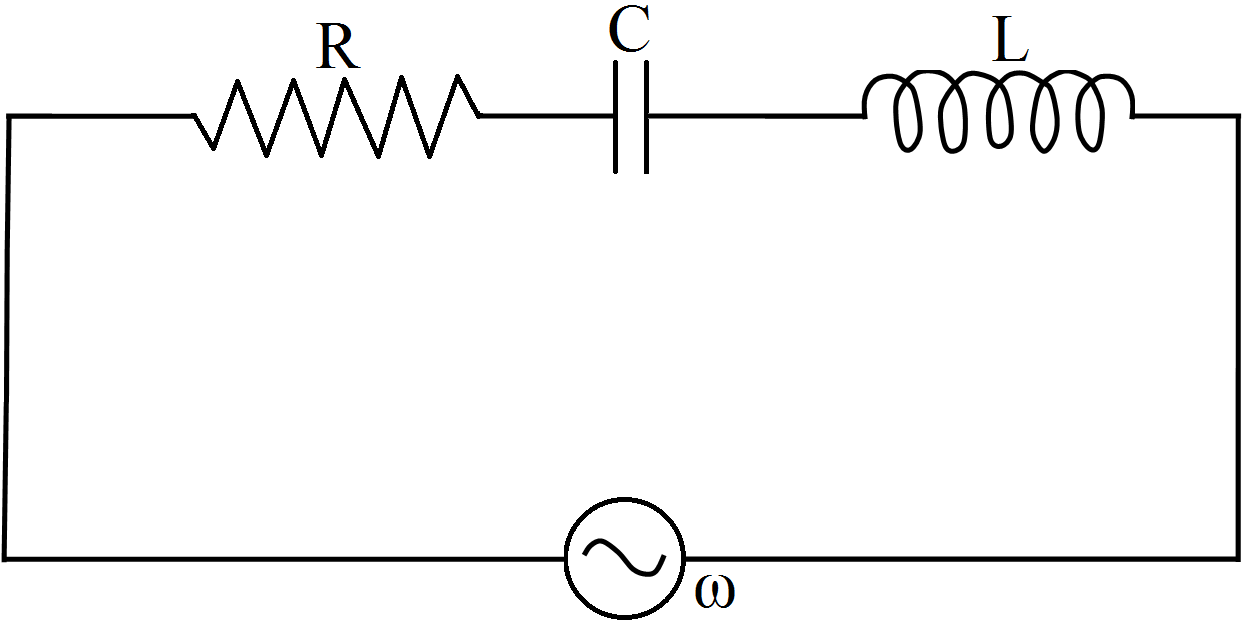
In the circuit shown below R represents an electric bulb. If the frequency $\text{v}=\Big(\frac{\omega}{2\pi}\Big)$ of the supply is doubled, how should the values of C and L be changed, so that the glow of bulb remains unchanged?