Question
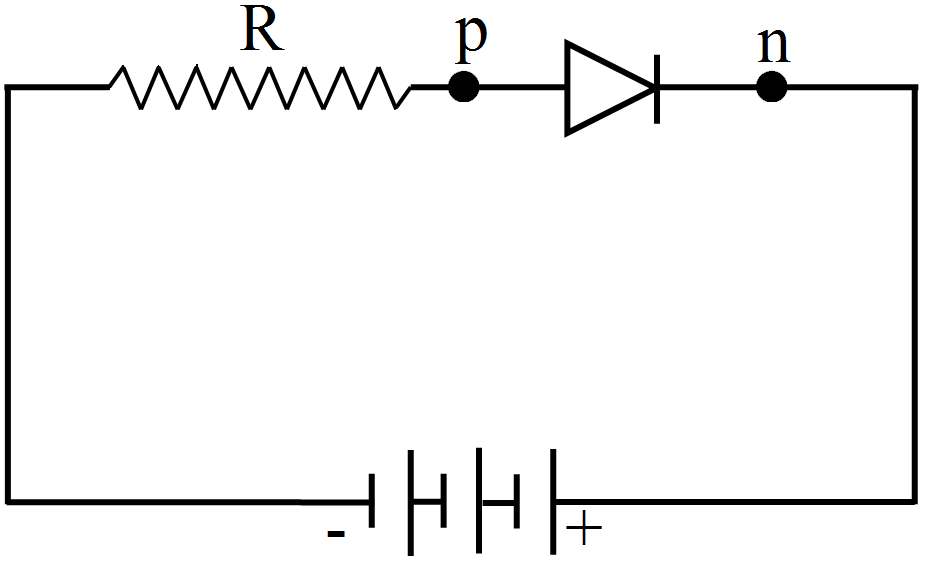
Draw a p-n junction which is reverse biased.

Answer

The p-n junction with reverse bias is shown in figure.

Need a full question paper?

Generate a complete, print-ready paper with questions like this in minutes — across 16+ boards, with answer keys.
Start Generating Free

Similar questions

Define the term ‘power loss’ in a conductor of resistance R carrying a current I. In what form does this power loss appear? Show that to minimise the power loss in the transmission cables connecting the power stations to homes; it is necessary to have the connecting wires carrying current at enormous high values of voltage.
Due to diffraction effects, the beam of ray gets focused as a spot of radius of approximately what value?
Answer the following question:
Magnifying power of a simple microscope is inversely proportional to the focal length of the lens. What then stops us from using a convex lens of smaller and smaller focal length and achieving greater and greater magnifying power?
A block of mass 5.0kg slides down an incline of inclination 30° and length 10m. Find the work done by the force of gravity.
An iron ring of relative permeability $\mu_{\text{r}}$ has windings of insulated copper wire of n turns per metre. When the current in the windings is I, find the expression for the magnetic field in the ring.
Suppose the tube in the previous problem is kept vertical with A upward but the other conditions remain the same. The separation between the cross- sections at A and B is $\frac{15}{16}\text{cm}.$ Repeat parts (a), (b) and (c) of the previous problem. Take $g = 10m/s^2$.
It is heard sometime that mercury is used in defining the temperature scale because it expands uniformly with temperature. If the temperature scale is not yet defined, is it logical to say that a substance expands uniformly with temperature?
Provide the classification of semi-conductors with example.
At noon, the sun and the earth pull the objects on the earth's surface in opposite directions. At midnight the sun and the earth pull these objects in same direction. Is the weight of an object, as measured by a spring balance on the earth's surface, more at midnight as compared to its weight at noon?
A boy standing on a long railroad car throws a ball straight upwards. The car is moving on the horizontal road with an acceleration of $1m/s^2$ and the projection velocity in the vertical direction is 9.8m/s. How far behind the boy will the ball fall on the car?