MCQ
$A$ rectangular coil of single turn, having area $A$, rotates in a uniform magnetic field $B$ an angular velocity $\omega$ about an axis perpendicular to the field. If initially the plane of coil is perpendicular to the field, then the average induced $e.m.f.$ when it has rotated through $90^o$ is
  • A
    $\frac{{\omega BA}}{\pi }$
  • B
    $\frac{{\omega BA}}{{2\pi }}$
  • C
    $\frac{{\omega BA}}{{4\pi }}$
  • $\frac{{2\omega BA}}{\pi }$

Answer

Correct option: D.
$\frac{{2\omega BA}}{\pi }$
d
Initially flux, $\phi=B A \cos 0=B A$

After rotating through an angle $90^{\circ} .$

Flux through the coil is zero.

So, $\Delta \phi=B A$

Angular speed $=w,$ so, time period $=\frac{2 \pi}{\omega}=T$

$\frac{T}{4}$ is time taken to rotate $90^{\circ}$

So, $\frac{\Delta \phi}{\Delta t}=\frac{B A}{T / 4}=\frac{2 B A \omega}{\pi}$

Need a full question paper?

Generate a complete, print-ready paper with questions like this in minutes — across 16+ boards, with answer keys.

Start Generating Free

Similar questions

Mass is distributed uniformly over a thin rectangular plate and positions of two vertices are given by $(1, 3)$ and $(2, -4)$. What is the position of $3^{rd}$ vertex if centre of mass of the plate lies at the origin ?
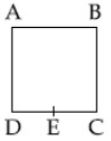
A wire of resistance $R$ is bent to form a square $ABCD$ as shown in the figure. The effective resistance between $E$ and $C$ is ( $E$ is mid-point of arm $CD$ )
The ends of stretched wire of length $L$ are fixed at $x\, = 0$ and $x \,= L$. In one experiment, the displacement of the wire is ${y_1} = A\sin\, \left( {\pi x/L} \right)\sin \,\omega t$ and energy is $E_1$. and in another experiment its displacement is ${y_2} = A\sin \,\left( {2\pi x/L} \right)\sin 2\omega t$ and energy is $E_2$, Then
Assertion : Goggles have zero power.

Reason : Radius of curvature of both sides of lens is same.

In sample of pure silicon,$10^{13}\,atom/cm^3$ is mixed of phosphorus. If all donor atoms are active then what will be resistivity at $20\,^oC$ if mobility of electron is $1200\,cm^2/volt-s$ ?.......$ohm\,cm$
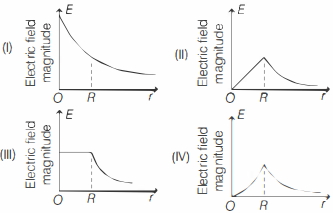
An isolated sphere of radius $R$ contains uniform volume distribution of positive charge. Which of the curve shown below, correctly illustrates the dependence of the magnitude of the electric field of the sphere as a function of the distance $r$ from its centre?
In the previous question, if the current is $i$ and the magnetic field at $D$ has magnitude $B$,
The threshold frequency of a metal with work function $6.63\  \mathrm{eV}$ is:
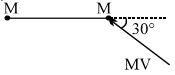
Two equal masses each of mass $M$ are joined by a massless rod of length $L$. Now an impulse $MV$ is given to the mass $M$ making an angle of $30^o$ with the length of the rod. The angular veloctiy of the rod just after imparting the impulse is
Best neutron moderator is