MCQ
The threshold frequency of a metal with work function $6.63\  \mathrm{eV}$ is:
  • A
     $16 \times 10^{1 \mathrm{~s}} \mathrm{~Hz}$
  • B
     $16 \times 10^{12} \mathrm{~Hz}$
  • C
     $1.6 \times 10^{12} \mathrm{~Hz}$
  •  $1.6 \times 10^{15} \mathrm{~Hz}$

Answer

Correct option: D.
 $1.6 \times 10^{15} \mathrm{~Hz}$
d
$ \phi_0=h v_0 $

$ 6.63 \times 1.6 \times 10^{-19}=6.63 \times 10^{-34} v_0 $

$ v_0=\frac{1.6 \times 10^{-19}}{10^{-34}} $

$ v_0=1.6 \times 10^{15} \mathrm{~Hz}$

Need a full question paper?

Generate a complete, print-ready paper with questions like this in minutes — across 16+ boards, with answer keys.
Start Generating Free

Similar questions

 A uniform metal rod of  $2\,\,mm^2$ cross section fixed between two walls is heated from $0\,^oC$ to $20\,^oC$ . The coefficient of linear expansion of rod is $12\,\,\times\,\,10^{-6}\,/^oC$ . Its Young's modulus of elasticity is $10^{11}\,\,N/m^2$ . The energy stored per unit volume of rod will be  ....... $J/m^3$
Two closed containers of equal volume filled with air at pressure $P_0$ and temperature $T_0$. Both are connected by a narrow tube. If one of the container is maintained at temperature $T_0$ and other at temperature $T$, then new pressure in the containers will be
On heating a uniform metallic cylinder length increases by $3 \%$. The area of cross-section of its base will increase by ........... $\%$
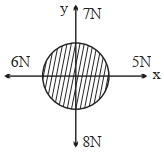
For a free body diagram shown in the figure, the four forces are applied in the ' $x$ ' and ' $y$ ' directions. What additional force must be applied and at what angle with positive $x$-axis so that the net acceleration of body is zero?
Find the change in the entropy in the following process $100 \,gm$ of ice at $0°C$ melts when dropped in a bucket of water at $50°C$ (Assume temperature of water does not change) ..... $ cal/K$
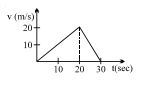
$v-t$ graph of an object of mass $1\,\, kg$ is shown
Asteroids are
The specific heat relation for ideal gas is
A wire of length $L$ $metre$ carrying a current of $I$ $ampere$ is bent in the form of a circle. Its magnitude of magnetic moment will be
The angular momentum of an electron in a hydrogen atom is proportional to $: ($Where $r$ is the radius of orbit of electron$)$