Question
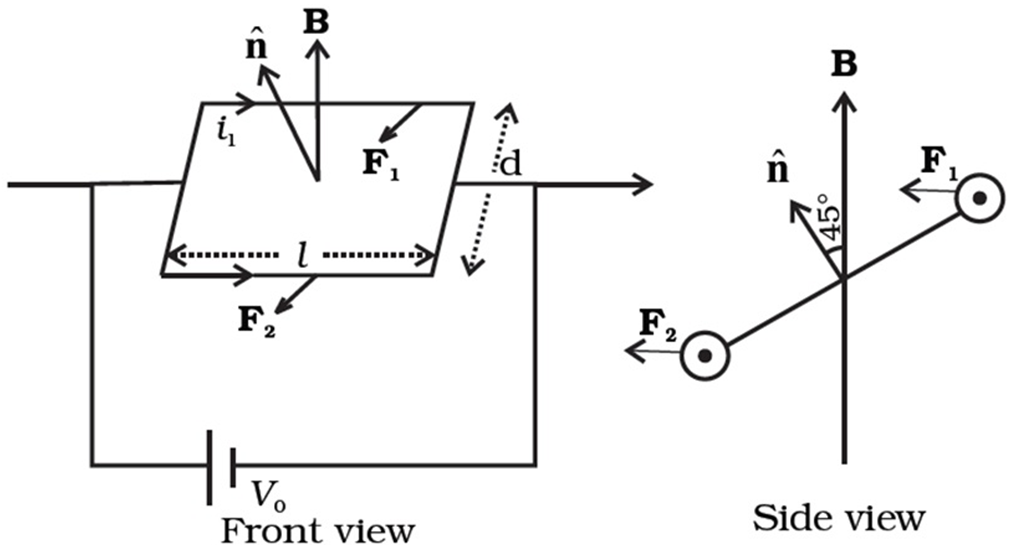
A rectangular conducting loop consists of two wires on two opposite sides of length l joined together by rods of length d. The wires are each of the same material but with cross-sections differing by a factor of 2. The thicker wire has a resistance R and the rods are of low resistance, which in turn are connected to a constant voltage source $V_0.$ The loop is placed in uniform a magnetic field B at 45° to its plane. Find $\tau$, the torque exerted by the magnetic field on the loop about an axis through the centres of rods.
Answer


Torque on the first wire is given by,
$\text{F}_1=\text{i}_1\text{lB}=\frac{\text{V}_0}{\text{R}}\text{lB},\tau_1=\frac{\text{d}}{2\sqrt{2}}\text{F}_1=\frac{\text{V}_0\text{ldB}}{4\sqrt{2}\text{R}}$
Torque on the second wire is given by,
$\text{F}_2=\text{i}_2\text{lB}=\frac{\text{V}_0}{2\text{R}}\text{lB},\tau_2=\frac{\text{d}}{2\sqrt{2}}\text{F}_2=\frac{\text{V}_0\text{ldB}}{4\sqrt{2}\text{R}}$
Net torque, $\tau=\tau_1-\tau_2$
$\Rightarrow\ \tau=\frac{1}{4\sqrt{2}}\frac{\text{V}_0\text{AB}}{\text{R}}.$

Need a full question paper?

Generate a complete, print-ready paper with questions like this in minutes — across 16+ boards, with answer keys.

Start Generating Free

Similar questions

A capacitor of capacitance $8.0\mu\text{F}$ is connected to a battery of emf 6.0V through a resistance of $24\Omega.$ Find the current in the circuit (a) just after the connections are made and (b) one time constant after the connections are made.
A thin prism of angle $6.0^\circ,\omega=0.07$ and $\mu_\text{y}=1.50$ is combined with another thin prism having $\omega=0.08$ and $\mu_\text{y}=1.60.$ The combination produces no deviation in the mean ray.
  1. Find the angle of the second prism.
  2. Find the net angular dispersion produced by the combination when a beam of white light passes through it.
  3. If the prisms are similarly directed, what will be the deviation in the mean ray
  4. Find the angular dispersion in the situation described in (c).
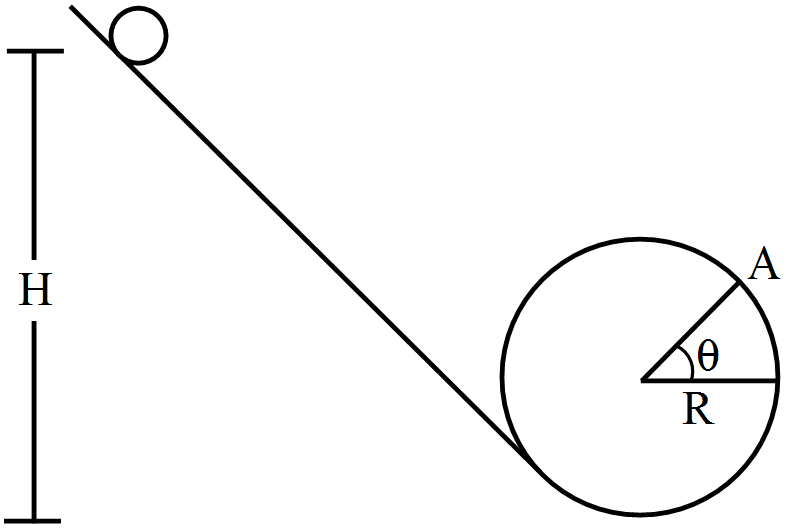
Figure shows a small spherical ball of mass m rolling down the loop track. The ball is released on the linear portion at a vertical height H from the lowest point. The circular part shown has a radius R.
  1. Find the kinetic energy of the ball when it is at a point A where the radius makes an angle $\theta$ with the horizontal.
  2. Find the radial and the tangential accelerations of the centre when the ball is at A.
  3. Find the normal force and the frictional force acting on the ball if H = 60cm, R = 10cm, $\theta=0 $ and m = 70g.
A source emitting sound at frequency 4000Hz, is moving along the Y-axis with a speed of 22m/s. A listener is situated on the ground at the position (660m, 0). Find the frequency of the sound received by the listener at the instant the source the origin. Speed of sound in air = 330m/s.
Three photo diodes D1, D2 and D3 are made of semiconductors having band gaps of 2.5eV, 2eV and 3eV, respectively. Which ones will be able to detect light of wavelength $6000\mathring{\text{A}}$?
Water at 50°C is filled in a closed cylindrical vessel of height 10cm and cross sectional area $10cm^2$. The walls of the vessel are adiabatic but the flat parts are made of 1mm thick aluminium $(\text{K}=200\text{Js}^{-1}\text{m}^{-1}{^{\circ}}\text{C}^{-1}).$ Assume that the outside temperature is 20°C. The density of water is $1000kgm^{-3}$, and the specific heat capacity of water $= 4200\text{Jkg}^{-1}{^{\circ}}\text{C}^{-1}.$ Estimate the time taken for the temperature to fall by 1.0°C. Make any simplifying assumptions you need but specify them.
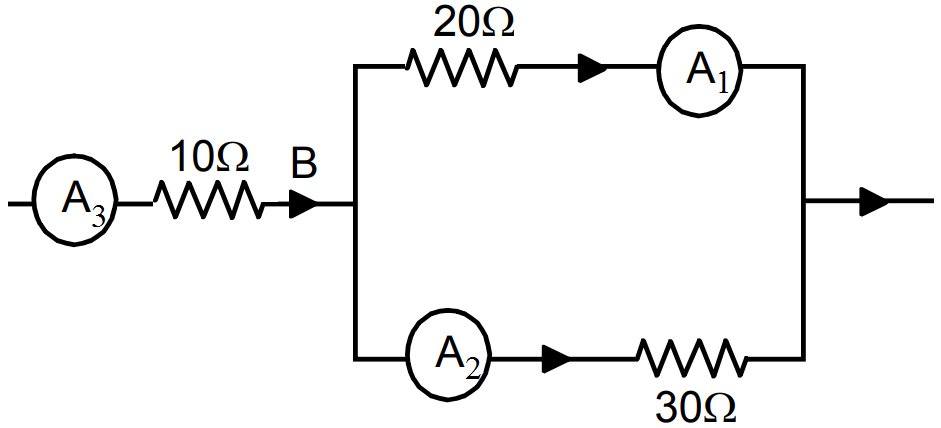
If the reading of the ammeter, $A_1$ in the figure. is $2.4A$, what will be the readings of ammeters $A_2$ and $A_3?$ Neglect the resistances of the ammeters.
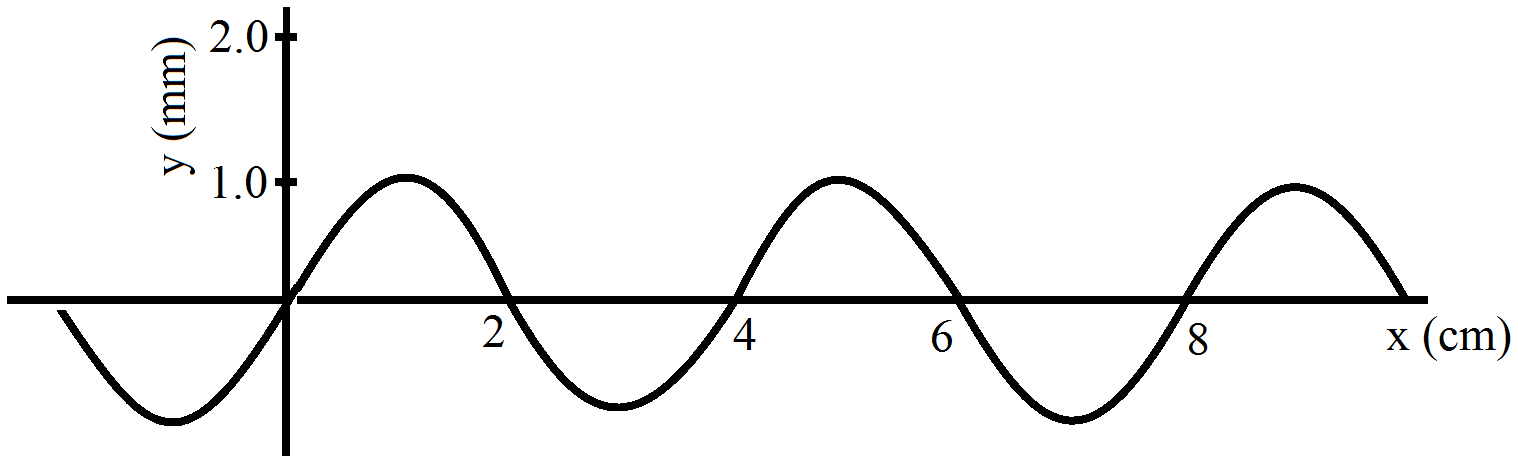
Figure shows a plot of the transverse displacements of the particles of a string at t = 0 through which a travelling wave is passing in the positive x-direction. The wave speed is 20cm/s. Find-
  1. The amplitude
  2. The wavelength
  3. The wave number
  4. The frequency of the wave.
Exlplain ac voltage applied on a series LCR circuit. Explain its solution by phasor diagram.
Are the nucleons fundamental particles, or do they consist of still smaller parts? One way to find out is to probe a nucleon just as Rutherford probed an atom. What should be the kinetic energy of an electron for it to be able to probe a nucleon? Assume the diameter of a nucleon to be approximately $10^{-15}m.$