Questions · Page 1 of 3

5 Marks Questions

🎯

Test yourself on this topic

50 questions · timed · auto-graded

Question 15 Marks
  1. Deduce an expression for the frequency of revolution of a charged particle in a magnetic field and show that it is independent of velocity or energy of the particle.
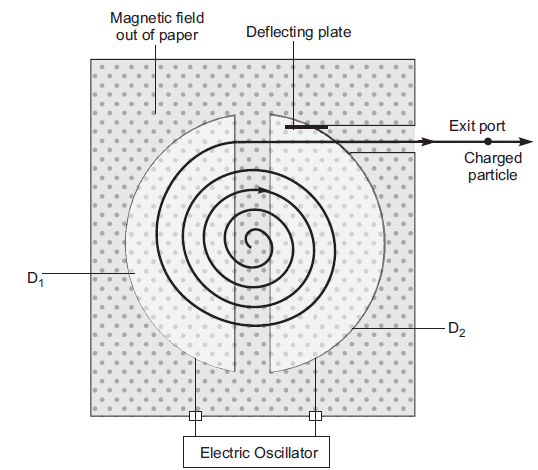
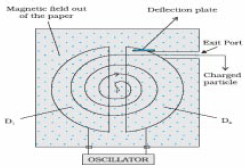
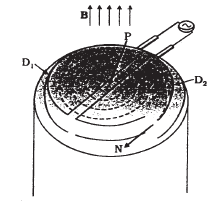
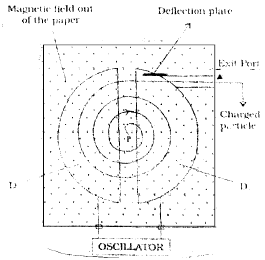
  2. Draw a schematic sketch of a cyclotron. Explain, giving the essential details of its construction, how it is used to accelerate the charged particles.
Answer
  1. When a particle of mass ‘m’ and charge ‘q’, moves with a velocity V, in a uniform magnetic field B, it experiences a force F where
$\overrightarrow{\text{F}} = \text{q}(\overrightarrow{\text{v}}\times\overrightarrow{\text{B})}$
$\therefore\text{Centripetal force }\frac{\text{mv}^{2}}{\text{r}}= 2\text{v B}_\bot$
$\therefore\text{r} = \frac{\text{mv}}{\text{qB}_{\bot}}$
$\therefore\text{frequency =}\frac{\text{v}}{2\pi\text{r}} = \frac{\text{qB}_{\bot}}{2\pi\text{m}}$
$\therefore$ It is independent of the velocity or the energy of the particle.
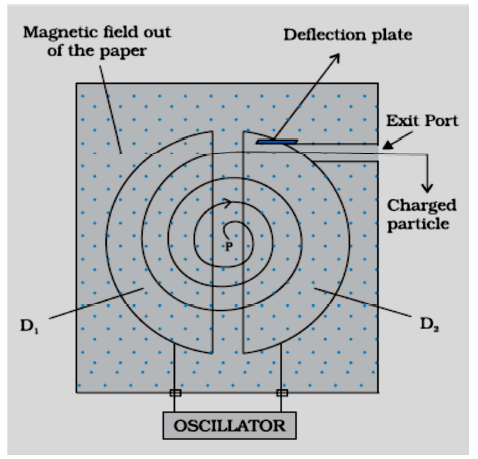


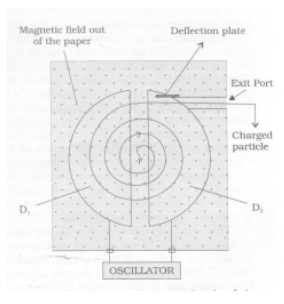
Construction: The cyclotron is made up of two hollow semi-circular disc like metal containers, $D_1$ and $D_2$, called dees. It uses crossed electric and magnetic fields. The electric field is provided by an oscillator of adjustable frequency.

Working: In a cyclotron, the frequency of the applied alternating field is adjusted to be equal to the frequency of revolution of the charged particles in the magnetic field. This ensures that the particles get accelerated every time they cross the space between the two dees. The radius of their path increases with increase in energy and they are finally made to leave the system via an exit slit.
View full question & answer
Question 25 Marks
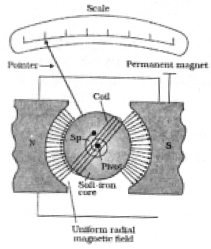
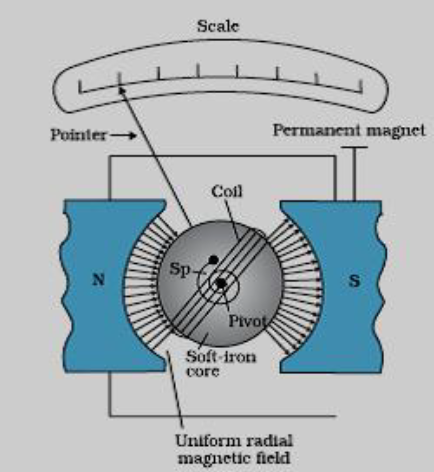
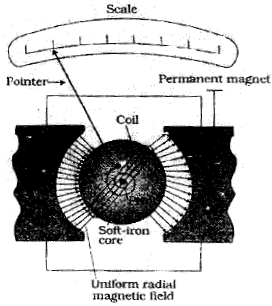
  1. Draw a labelled diagram of a moving coil galvanometer. Describe briefly its principle and working.
  2. Answer the following:
  1. Why is it necessary to introduce a cylindrical soft iron core inside the coil of a galvanometer?
  2. Increasing the current sensitivity of a galvanometer may not necessarily increase its voltage sensitivity. Explain, giving reason.
Answer

Principle and working: A current carrying coil, placed in a uniform magnetic field, (can) experience a torque

Consider a rectangular coil for which no. of turns = N,
Area of cross- section = l × b = A,

Intensity of the uniform magnetic field = B,

Current through the coil = I.

$\therefore$ Deflecting torque $ = \text{BIL}\times\text{b} = \text{BIA}$

$\text{For N turns } \tau = \text{NBIA}$

Restoring torque in the spring = k$\theta$

(k = restoring torque per unit twist)

$\therefore\text{NBIA} = \text{k}\theta$

$\therefore\text{I} = \bigg(\frac{\text{k}}{\text{NBA}}\bigg)\theta$

$\therefore\text{I}\propto \theta$

The deflection of the coil, is, therefore, proportional to the current flowing through it.
  1.  
  1. The soft iron core not only makes the field radial but also increases.the strength of the magnetic field
  2. We have
Current sensitivity $ = \frac{\theta}{\text{I}} = \text{NBA/k}$

Voltage sensitivity $ = \frac{\theta}{\text{V}} = \frac{\theta}{\text{IR}} = \big(\frac{\text{NBA}}{\text{k}}\big).\frac{1}{\text{R}}$

It follows that an increase in current senstivity may not necessarily increase the voltage sensitivity.
View full question & answer
Question 35 Marks
  1. Draw a schematic sketch of a cyclotron. Explain clearly the role of crossed electric and magnetic field in accelerating the charge. Hence derive the expression for the kinetic energy acquired by the particles.
  2. An α–particle and a proton are released from the centre of the cyclotron and made to accelerate.
    1. Can both be accelerated at the same cyclotron frequency? Give reason to justify your answer.
    2. When they are accelerated in turn, which of the two will have higher velocity at the exit slit of the dees?
Answer
Role of electric field:
  1. Electric field accelerates the charge particle passing through the gap with the help of electric oscillator.
  2. Electric oscillator imparts the energy to charged particle till it comes out from the exit slit.
Role of magnetic field
As the accelerated charge particle enters normally to the uniform magnetic field, it exerts a magnetic force in the form of centripetal force and charge particle moves on a semicircular path of increasing radii in each dee $(D_1$ or $D_2).$


So $\text{q}v\text{B} = \frac{\text{m}v^{2}}{\text{r}}$
$\Rightarrow\text{v} = \frac{\text{qBr}}{\text{m}}$ - - - - (1)
Kinetic energy $\text{K} = \frac{1}{2}\text{m}v^{2}$
$ = \frac{\text{q}^{2}\text{B}^{2}\text{r}^{2}}{2\text{m}}$ - - - - (2)
  1. (i) Now, from equation (1) $v = \frac{\text{qBr}}{\text{m}}$
$\Rightarrow\text{v} =\text{r}\omega = \frac{\text{qBr}}{\text{m}}$
$\Rightarrow2\pi\text{v} = \frac{\text{qB}}{\text{m}}$
$\Rightarrow\text{v} = \frac{\text{qB}}{2\pi\text{m}}$
Cyclotron frequency depends on $\bigg(\frac{\text{q}}{\text{m}}\bigg)$ ratio, since
$\bigg(\frac{\text{q}}{\text{m}}\bigg)_{\alpha} < \bigg(\frac{\text{q}}{\text{m}}\bigg)_{P}$
or $\text{v}_{\alpha}<\text{v}_{p}$
(ii) From equation (2), kinetic energy $\text{K} = \frac{\text{q}^{2}\text{B}^{2}\text{r}^{2}}{2\text{m}}$
$\bigg(\frac{\text{q}^{2}}{\text{m}}\bigg)_{proton} > \bigg(\frac{\text{q}^{2}}{\text{m}}\bigg)_{\alpha}$
So, proton acquires higher velocity at the exit slit for fixed radius $\text{r}\leq\text{R},$ where R is the radius of the dee.
View full question & answer
Question 45 Marks
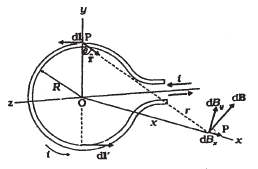
  1. Using Biot-Savart’s law, derive the expression for the magnetic field in the vector form at a point on the axis of a circular current loop.
  2. What does a toroid consist of ? Find out the expression for the magnetic field inside a toroid for N turns of the coil having the average radius r and carrying a current I. Show that the magnetic field in the open space inside and exterior to the toroid is zero.
Answer
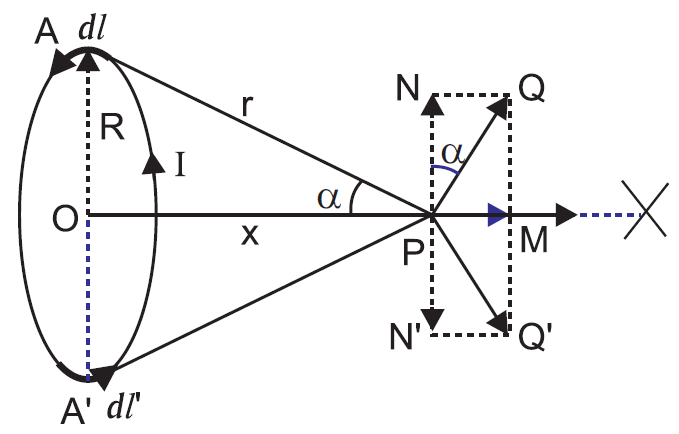
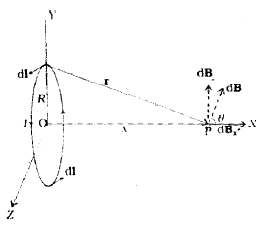
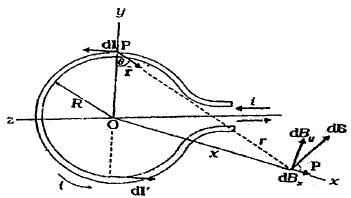
  1. Magnetic field at the axis of a circular loop: Consider a circular loop of radius R carrying current I, with its plane perpendicular to the plane of paper. Let P be a point of observation on the axis of this circular loop at a distance x from its centre O. Consider a small element of length dl of the coil at point A. The magnitude of the magnetic induction $\overrightarrow{\text{dB}}$at point P due to this element is given by


$\overrightarrow{\text{dB}}= \frac{\mu_{0}}{4\pi}\frac{\text{I}\delta\text{l}\sin\alpha}{\text{r}^{2}}$ - - - - - - (1)

The direction of $\overrightarrow{\text{dB}}$ is perpendicular to the plane containing $\overrightarrow{\text{dl}}$ and $\overrightarrow{\text{r}}$ and is given by right hand screw rule. As the angle between I $\overrightarrow{\text{dl}}$ and $\overrightarrow{\text{r}}$ is 90°, the magnitude of the magnetic induction $\overrightarrow{\text{dB}}$ is given by,

$\overrightarrow{\text{dB}} = \frac{\mu_{0}\text{I}}{4\pi} \frac{\text{dl}\sin90^{o}}{\text{r}^{2}} = \frac{\mu_{0}\text{I}\text{dl}}{4\pi\text{r}^{2}}$ - - - - (2)

If we consider the magnetic induction produced by the whole of the circular coil, then by symmetry the components of magnetic induction perpendicular to the axis will be cancelled out, while those parallel to the axis will be added up. Thus the resultant magnetic induction $\overrightarrow{\text{B}}$ at axial point P is along the axis and may be evaluated as follows:

The component of $\overrightarrow{\text{dB}}$ along the axis,

$\overrightarrow{\text{dB}}_{x} = \frac{\mu_{0}\text{I dl}}{4\pi\text{r}^{2}}\sin\alpha$ - - - - - - (3)

But sin $\alpha =\frac{\text{R}}{\text{r}}\text{ and }\text{r} = (\text{R}^{2} + \text{x}^{2})^{1/2}$

$ \therefore\overrightarrow{\text{dB}}_{x} =\frac{\mu_{0}\text{I dl}}{4\pi\text{r}^{2}}. \frac{\text{R}}{\text{r}} =\frac{\mu_{0}\text{IR}}{4\pi\text{r}^{3}}\text{dl} = \frac{\mu_{0}\text{IR}}{4\pi(\text{R}^{2} +\text{x}^{2})^{3/2}}\text{dl}$ - - - - (4)

Therefore the magnitude of resultant magnetic induction at axial point P due to the whole circular coil is given by

$ \overrightarrow{\text{B}} = \oint\frac{\mu_{0}\text{IR}}{4\pi(\text{R}^{2} + \text{x}^{2})^{3/2}}\text{dl} = \frac{\mu_{0}\text{IR}}{4\pi(\text{R}^{2} + \text{x}^{2})^{3/2}}\oint\text{dl}$

But $\oint\text{dl} = \text{ length of the loop } = 2\pi\text{R}$ - - - - - - - (5)

Therefore, $\text{B} =\frac{\mu_{0}\text{IR}}{4\pi(\text{R}^{2} + \text{x}^{2})^{3/2}}(2\pi\text{R})$

$\overrightarrow{\text{B}} = \text{B}_{x}\hat{i} =\frac{\mu_{0}\text{IR}^{2}}{2(\text{R}^{2} + \text{x}^{2})^{3/2}}\hat{\text{i}}.$
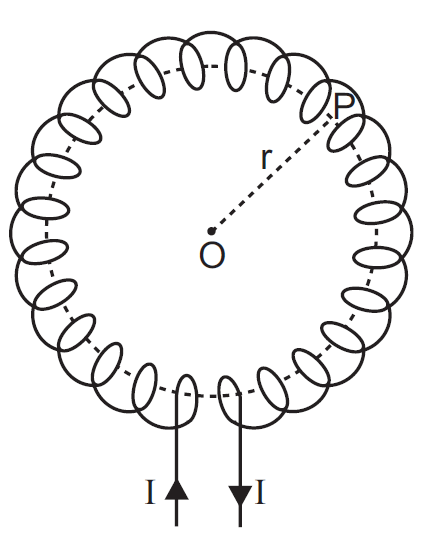
  1. A long solenoid on bending in the form of closed ring is called a toroidal solenoid.
Figure shows a toroidal solenoid of average radius ‘r’ and of N turns.

For points inside the core of toroid Current I, flowing through it, set up a magnetic field within the core.

According to Ampere’s circuital law

$\oint\overrightarrow{\text{B}}.\overrightarrow{\text{d}l} = \mu_{0}\text{I}$


where ‘I’ is the current in the toroid.

Net current =NI

$\therefore\oint\overrightarrow{\text{B}}.\overrightarrow{\text{d}l} = \mu_{0}\text{NI}$

$\Rightarrow|\text{B}|2\pi\text{r} = \mu_{0}\text{NI}$

$\Rightarrow|\text{B}| = \frac{\mu_{0}\text{NI}}{2\pi\text{r}}$

$ = \mu_{0}\text{n} \text{I}$

$\bigg[\because\text{n} = \frac{\text{N}}{2\pi\text{r}}\bigg]$
  1. For points in the open space inside the toroid: No current flows through the Amperian loop, so I =0
$\oint\overrightarrow{\text{B}}. \overrightarrow{\text{d}l} = \mu_{0|}\text{I} = 0 $

$\Rightarrow|\text{B}|_{inside} = 0 $
  1. For points in the open space exterior to the toroid : The net current entering the plane of the toroid is exactly cancelled by the net current leaving the plane of the toroid.
$\oint\overrightarrow{\text{B}}.\overrightarrow{\text{d}l} = 0$

$\Rightarrow|\text{B}|_{exterior}= 0.$
View full question & answer
Question 55 Marks
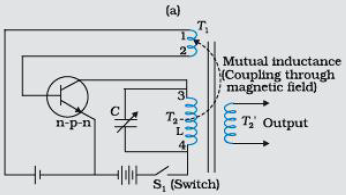
  1. Explain briefly the principle on which a transistor-amplifier works as an oscillator. Draw the necessary circuit diagram and explain its working.
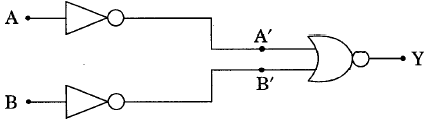
  2. Identify the equivalent gate for the following circuit and write its truth table.
Answer
  1. Principle: A portion of the output power is returned back (feedback) to the input in phase with the starting power. (This process is termed as positive feedback)


Working:

As the switch $S_1$ is put on, a surge of collector current flows in the transistor. This current flows through the coil $T_2$. The inductive coupling between coil $T_2$ and coil $T_1$ now causes a current to flow in theemitter circuit.As a result of thispositive feed back, the emitter current also increases. When the current in $T_2$ becomes saturated, it stops increasing. Now emitter current begins to fall and becomes minimum. The whole process keeps on repeating itself.
  1. AND Gate:
A B Y = A.B
0 0 0
0 1 0
1 0 0
1 1 1
View full question & answer
Question 65 Marks
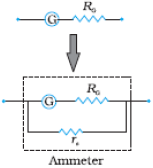
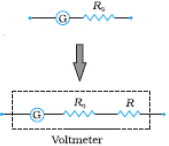
  1. Explain, giving reasons, the basic difference in converting a galvanometer into (i) a voltmeter and (ii) an ammeter.
  2. Two long straight parallel conductors carrying steady currents $I_1$ and $I_2$ are separated by a distance 'd'. Explain briefly, with the help of a suitable diagram, how the magnetic field due to one conductor acts on the other. Hence deduce the expression for the force acting between the two conductors. Mention the nature of this force.
Answer
  1. A galvanometer can be converted into a voltmeter by connecting a high resistance in series with its coil.
  2. A galvanometer can be converted into an ammeter by connecting a low resistance in parallel to its coil.
Alternate Answer


The magnetic field, due to wire – 1, at any point on the wire – 2, is directed normal to the direction of current flowin wire – 2.
Expression for force
$B_{21} =$Magnetic field atwire – 2, due to a current $I_1$ in
wire $ - 1 = \frac{\mu_{o}\text{I}_{1}}{2\pi\text{r}}$
Force upon conductor carrying current due to magnetic field
$\overrightarrow{\text{F}} = \text{I}(\overrightarrow{\ell}\times\overrightarrow{\text{B}})$
$\therefore\text{ Force, F}_{21}\text{ on a length l of wire} – 2 = \text{I}_{2} . l.\frac{\mu_{o}\text{I}_{1}}{2\pi\text{r}}$
$ =\frac{\mu_{o}\text{I}_{1}\text{I}_{2}}{2\pi\text{r}}l$
$\text{Similarly,} = \text{F}_{12} = \frac{\mu_{0}\text{I}_{1}\text{I}_{2}}{2\pi\text{r}}l$
Nature
The force is repulsive for currents in opposite direction and attractive when currents flow in the same direction.
View full question & answer
Question 75 Marks
  1. Write the expression for the force, $\overrightarrow{\text{F}}$, acting on a charged particle of charge 'q', moving with a velocity$\overrightarrow{\text{v}}$ in the presence of both electric field $\overrightarrow{\text{E}}$and magnetic field $\overrightarrow{\text{B}}.$ Obtain the condition under which the particle moves undeflected through the fields.
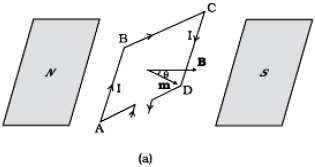
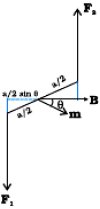
  2. A rectangular loop of size l x b carrying a steady current I is placed in a uniform magnetic field $\overrightarrow{\text{B}}.$ Prove that the torque$\overrightarrow{\tau}$ acting on the loop is given by $\overrightarrow{\tau} =\overrightarrow{\text{m}}\times\overrightarrow{\text{B},}$were $\overrightarrow{\text{m}}$is the magnetic moment of the loop.
Answer
  1. $\overrightarrow{\text{F}} = \text{q}[\overrightarrow{\text{E}} + (\overrightarrow{\nu}\times\overrightarrow{\text{B}})]$
Condition for undeflected motion
$\overrightarrow{\text{F}} - 0 $
$\rightarrow\text{q}[\overrightarrow{\text{E}} + (\overrightarrow{\nu}\times\overrightarrow{\text{B}})] = 0$
$\Rightarrow\overrightarrow{\text{E}} + \overrightarrow{\nu}\times\overrightarrow{\text{B}} = 0$
$\Rightarrow\overrightarrow{\text{E}} = - (\overrightarrow{\nu}\times\overrightarrow{\text{B}})$
or $\overrightarrow{\text{E}} - \overrightarrow{\text{E}}\times\overrightarrow{\nu}\text{ or }\text{ E} = \text{B } v \sin\theta$
$ =\text{B} \text{v}( \text{When }\theta = 90^{o})$
giving v = E/B when E, B and v are mutually perpendicular.
  1.  


$F_1 = F_2 = IbB$
$\overrightarrow{\tau} = \text{F}_{1}\frac{\text{a}}{2}\sin\theta + \text{F}_{2}\frac{\text{a}}{2}\sin\theta$
$ = \text{I abB} \sin \theta$
$ = \text{I AB }\sin\theta$
But $\text{m} = \text{I A }$
$\therefore\tau = \text{mB}\sin\theta$
$\overrightarrow{\tau} = \overrightarrow{\text{m}}\times\overrightarrow{\text{B}}$
Hence, The sense of $\overrightarrow{\tau}$ is in the sense of $\overrightarrow{\text{m}}\times\overrightarrow{\text{B}}.$
View full question & answer
Question 85 Marks
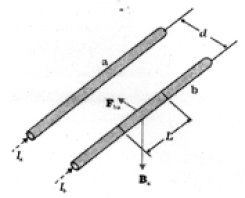
  1. Derive an expression for the force between two long parallel current carrying conductors.
  2. Use this expression to define S.I. unit of current.
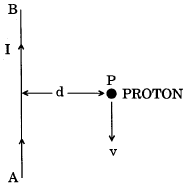
  3. A long straight wire AB carries a current I. A proton P travels with a speed v, parallel to the wire, at a distance d from it in a direction opposite to the current as shown in the figure. What is the force experienced by the proton and what is its direction?
Answer
  1.  


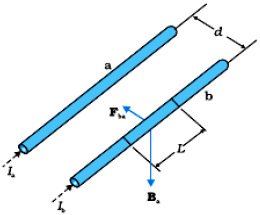
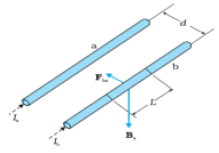
Two long parallel conductors ‘a’ and ‘b’ are separated by a distance d and carry (parallel) currents $I_a$ and $I_b$, respectively. The conductor ‘a’ produces, the same magnetic field $B_a$ at all points along the conductor ‘b’.

$\text{B}_{a} = \frac{\mu_{0}\text{I}_{a}}{2\pi\text{d}}$

$F_{ba},$ is the force on a segment L of ‘b’ due to ‘a’. The magnitude of this force is given by

$F_{ba}= I_b\  LB_a$

$=\frac{\mu_{0}\text{I}_{a}\text{I}_{b}}{2\pi\text{d}}\text{L}$
  1. The ampere is the value of that steady current which, when maintained in each of the two very long, straight, parallel conductors of negligible cross-section, and placed one metre apart in vacuum, would produce on each of these conductors a force equal to $2 \times 10^{–7}$ newton per metre of length.
  2. Magnetic field due to the straight wire AB at a perpendicular distance d from it.
$\text{B} = \frac{\mu_{0}\text{I}}{2\pi\text{d}}$

Therefore, force on proton moving with velocity ‘v’ perpendicular to B, is

$\text{f} = \text{qvB} = \frac{\mu_{0}\text{Iqv}}{2\pi\text{d}}$

Direction: Towards right.
View full question & answer
Question 95 Marks
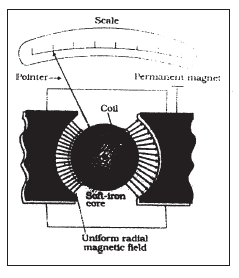
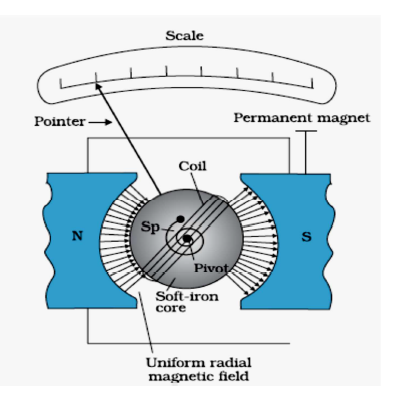
  1. With the help of a diagram, explain the principle and working of a moving coil galvanometer.
  2. What is the importance of a radial magnetic field and how is it produced?
  3. Why is it that while using a moving coil galvanometer as a voltmeter a high resistance in series is required whereas in an ammeter a shunt is used?
Answer

Principle: Torque acts on the current carrying loop when placed in magnetic field.
$(\tau = \text{NIAB}\sin\theta.)$
Working: The magnetic torque tends to rotate the coil. A spring provides a counter torque that balances the magnetic torque; resulting in a steady angular deflection. The deflection is indicated on the scale by a pointer attached to the spring.
Importance and production of radial magnetic field:
In a radial magnetic field magnetic torque remains maximum for all positions of the coils.
It is produced due to cylindrical pole pieces and soft iron core.
Reason:
Voltmeter: This ensures that a very low current passes through the voltmeter and hence does not change (much) the original potential difference to be measured.
Ammeter: This ensures that the total resistance of the circuit does not change much and the current flowing remains (almost) at its original value.
View full question & answer
Question 105 Marks
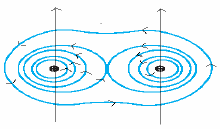
  1. Two straight long parallel conductors carry currents $I_1$ and $I_2$ in the same direction. Deduce the expression for the force per unit length between them.
Depict the pattern of magnetic field lines, around them.
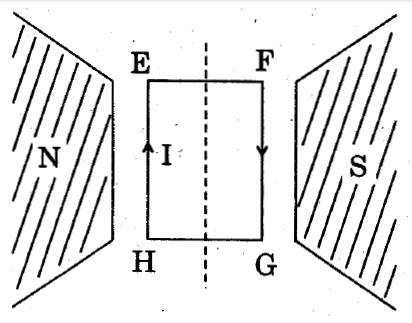
  1. A rectangular current carrying loop EFGH is kept in a uniform magnetic field as shown in the figure.
  1. What is the direction of the magnetic moment of the current loop?
  2. When is the torque acting on the loop (A) maximum, (B) zero?
Answer
Derivation of force per unit length:

Figure shows two long parallel conductors a and b separated by a distance d and carrying (parallel) currents $I_$a and $I_b,$ respectively. The conductor ‘a’ produces, the same magnetic field $B_a$ at all points along the conductor ‘b’. The right-hand rule tells us that the direction of this field is downwards (when the conductors are placed horizontally). From Ampere’s circuital law, its magnitude is given by
$\text{B}_{a} = \frac{\mu_{0}\text{I}_{a}}{2\pi\text{d}}$
The conductor ‘b’ carrying a current $I_b$ will experience a sideways force due to the field $B_a$. The direction of this force is towards the conductor ‘a’. We label this force as $F_{ba}$, the force on a segment L of ‘b’ due to ‘a’. The magnitude of this force is given by.
$\text{F}_{ba} = \text{I}_{b }\text{L B}_{a} = \frac{\mu_{0}\text{I}_{a}\text{I}_{b}}{2\pi\text{d}}\text{L}$
Let $f_{ba}$ represent the magnitude of the force $F_{ba}$ per unit length. Then, from the above equation
$\text{f}_{ba} = \frac{\mu_{0}\text{I}_{a}\text{I}_{b}}{2\pi\text{d}}$
Pattern of Magnetic Field lines:
    1. Direction of magnetic moment $\overrightarrow{\text{M}}$ of the current loop is perpendicular to the plane of the page and directed downwards.
      1. Torque acting on the loop is maximum when $\overrightarrow{\text{M}}$ is perpendicular dicular to $\overrightarrow{\text{B}}.$
      2. It is minimum when $\overrightarrow{\text{M}}$ is parallel to $\overrightarrow{\text{B}}.$
View full question & answer
Question 115 Marks
Draw a schematic sketch of a cyclotron. Explain briefly how it works and how it is used to accelerate the charged particles.
  1. Show that time period of ions in a cyclotron is independent of both the speed and radius of circular path.
  2. What is resonance condition? How is it used to accelerate the charged particles?
Answer
Labelled diagram:

Working: The cyclotron uses crossed electric and magnetic fields in combination to increase the energy of charged particles. Cyclotron uses the fact that the frequency of revolution of the charged particle in a magnetic field is independent of its energy. The particles move most of the time inside two semicircular disc-like metal containers, $D_1$ and $D_2$, called dees. Inside the metal boxes the particle is shielded and is not acted on by the electric field.
The magnetic field, however, acts on the particle and makes it go round in a circular path inside the dee. Every time the particle moves from one dee to another it is acted upon by the electric field. The sign of the electric field is changed alternately in tune with the circular motion of the particle. This ensures that the particle is always accelerated by the electric field. Each time the acceleration increases the energy of the particle.
Expression of time period: The particles move in a semi-circular path in one of the dees and must arrive in the gap between the dees in a time interval T/2; where T, their period of revolution, is given by $\frac{1}{\text{v}_{c}} = \text{T} = \frac{2\pi\text{r}}{\text{r}}$ $\text{ν is given by:} \frac{\text{mv}^{2}}{\text{r}} = \text{qvB},\text{i.e v} = \frac{\text{qBr}}{\text{m}}$ $\therefore\text{T} = \frac{2\pi\text{m}}{\text{qB}}\text{ and }\text{v}_{c} = \frac{\text{qB}}{2\pi\text{m}}$ Resonance condition and its application in acceleration in charged particle: Let $v_a$ be the frequency of the applied alternating voltage source. The requirement $v_a = v_c$ is called the resonance condition.
This ensure that the ions always get accelerated across the gap. Inside the dees the particles travel in a region free of the electric field. The increase in their kinetic energy is qV each time they cross from one dee to another.
View full question & answer
Question 125 Marks
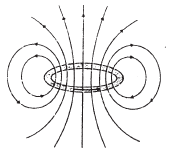
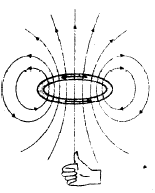
State the Biot-Savart law for the magnetic field due to a current carrying element. Use this law to obtain a formula for magnetic field at the centre of a circular loop of radius R carrying a steady current I. Sketch the magnetic field lines for a current loop clearly indicating the direction of the field.
Answer
Statement:- The magnitude of the magnetic field dB at any point, due to a current carrying conductor, is directly proportional to the current ‘I’ the element length ‘dl’ and inversely proportional to the square of the distance ‘r’. Its direction is perpendicular to the plane containing ‘dl’ and r.
$\overrightarrow{\text{dB}} =\frac{\mu_{\circ}}{4\pi} \frac{\text{I}|\text{f}\overrightarrow{\ell}\times\overrightarrow{\text{r}}|}{\text{r}^{3}}$ $\text{dB} = \frac{\mu_{\circ}}{4\pi} \cdot \frac{\text{Idl}\cos\theta}{\big(\text{X}^{2} + \text{R}^{2}\big)^{3/2}}$ $= \frac{\text{R}}{\big(\text{x}^{2} +\text{R}^{2}\big)^{3/2}}$ $\text{dB}_{x} = \frac{\mu_{\circ}\text{I}}{4\pi} \frac{\text{Rd}\ell}{\big(\text{x}^{2} + \text{R}^{2}\big)^{3/2}}$ $\text{B} = \text{B}_{x}\hat{\text{i}} = \frac{\mu_{\circ}\text{IR}^{2}}{2\big(\text{x}^{2} + \text{R}^{2}\big)^{3/2}}\hat{\text{i}}$ $\therefore \text{B}_{\circ} = \frac{\mu_{\circ}\text{I}}{2\text{R}} \hat{\text{i}}$
View full question & answer
Question 135 Marks
Draw a neat and labelled diagram of a cyclotron. State the underlying principle and explain how a positively charged particle gets accelerated in this machine. Show mathematically that the cyclotron frequency does not depend upon the speed of the particle.
Answer


Principle: A charged particle experiences a force in an electric field and gets accelerated. It then enters the uniform magnetic field acting at right angles to its direction of motion and follows a circular path with constant speed.
Explanation: The positive ions moves towards the dee which is negative at the instant. Because of the transverse magnetic field it moves in a circular path. By the time it comes to the edge of the dees, the polarity gets reversed and the ion is accelerated again towards the other dee. The process is repeated.
$\text{Bqv} = \frac{\text{mv}^{2}}{\text{r}}$
$\therefore \text{r} = \frac{\text{mv}}{\text{Bq}}$
$\text{v} = \text{w}_{c}\text{r} $,
$\therefore \text{r} =\frac{\text{mw}_{c}\text{r}}{\text{qB}}$
$\text{w}_{c} = \frac{\text{qB}}{\text{m}}$
$\text{f}_{c} = \frac{\text{qB}}{2\pi\text{m}}$, Where $f_c$ cyclotron frequency.
View full question & answer
Question 145 Marks
  1. With the help of a neat and labelled diagram, explain the principle and working of a moving coil galvanometer.
  2. What is the function of uniform radial field and how is it produced?
  3. Define current sensitivity of a galvanometer. How is current sensitivity increased?
Answer
  1. A current carrying loop experience a torque in a magnetic field.

Torque on the current coil, $\tau=NIAB\text{ }\sin90^\circ$( in radial field)
Counter torque provided by the spring = $k\phi$ where $\phi$ is the deflection of the coil and k is torsional constant of the spring.
At equilibrium, $k\phi=NIAB$
$\Rightarrow\phi=\big(\frac{NAB}{K}\big)I$
  1. Radial field makes the scale of galvanometer linear or $I\propto\phi$ It is produced by making pole pieces of the magnet cylindrical in shape.
  2. Current sensitivity is defined as current per unit deflection. Current sensitivity is increased by increasing the number of turns N.
View full question & answer
Question 155 Marks
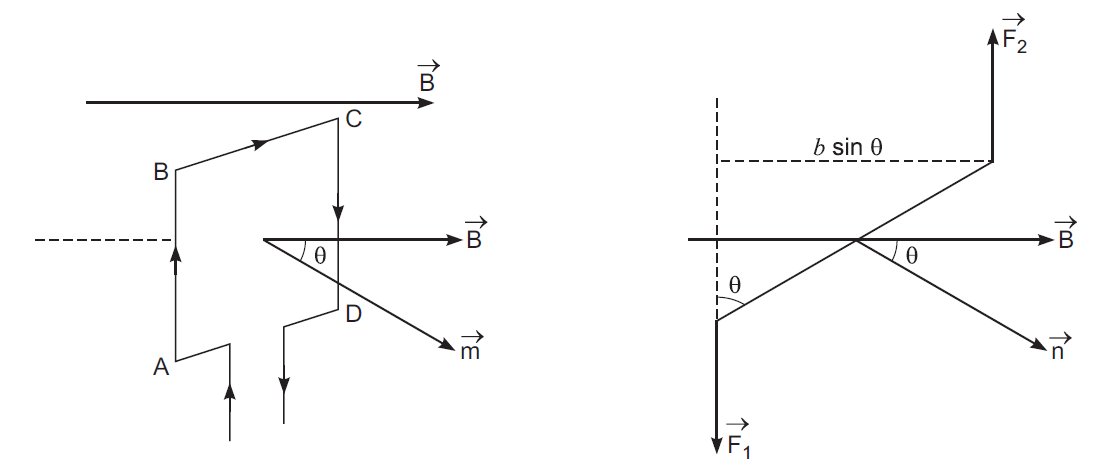
  1. Derive the expression for the torque on a rectangular current carrying loop suspended in a uniform magnetic field.
  2. A proton and a deuteron having equal momenta enter in a region of uniform magnetic field at right angle to the direction of the field. Depict their trajectories in the field.
Answer
  1.  

A rectangular loop ABCD of dimensions l and b, carrying a steady current is placed in uniform magnetic field as shown in fig; such that normal of the plane is at angle q with the magnetic field lines.
The force $F_{BC}$ and $F_{AD} $ on arms BC and AD are equal, opposite and along the axis of the coil, so they cancel each other.
The forces $F_{AB}$ and $F_{CD}$ are also equal and opposite, but are not collinear, so they constitute a couple, and the magnitude of the torque can be given as
$\tau = \text{F}_{AB}.\frac{\text{b}}{2}\sin\theta + \text{F}_{CD}.\frac{\text{b}}{2}\sin\theta$
Since
$|\text{F}_{AB}| = |\text{F}_{CD}| =\text{BI}\ell$
$\tau = \text{BI}\ell\times\text{b}\times\sin\theta$
$ = \text{BI}(\ell\text{b})\sin\theta$
= BI A sin $\theta$
$[\text{A} = \ell \text{b} = \text{ area of the rectangle}]$
Since magnetic moment m = I |A|
$\tau = \text{mB} \sin \theta$
In vector from $\overrightarrow{\tau} = \overrightarrow{\text{m}}\times\overrightarrow{\text{B}}$
  1. If a charge particle enters right angle to the direction of magnetic field, it follows a circular trajectory, and radius can be given as
$\text{q}v\text{B} = \frac{\text{m}v^{2}}{\text{r}}$
$\Rightarrow\text{r} = \frac{\text{m}v}{\text{qB}} = \frac{\text{p}}{\text{qB}}$
Since momentum are equal, and they have equal charges.
So, $r_p : r_d = 1:1.$
View full question & answer
Question 165 Marks
With the help of a labelled diagram, state the underlying principle of a cyclotron.
Explain clearly how it works to accelerate the charged particles. Show that cyclotron frequency is independent of energy of the particle. Is there an upper limit on the energy acquired by the particle? Give reason.
Answer
Principle: Acharged particle can be accelerated to high energy by making it cross the same electric field again and again using a perpendicutarmagnetic field.

Working: High frequency oscillat or maintains modest alternating potential difference between the dees. This potential difference establishes an electric field that reverses its direction periodically. Suppose a positive ion of moderate mass produced at the centre of the dees, finds $D_2$ at negative potential. It gets accelerated towards it. Auniformmagnetic field, normal to the plane of the dces,makes it move in a circular track. Particle traces a semicircular track and returns back to the region between the dees. The moment it arrives in the region. Electric field reverses its direction and accelerates the charge towards $D_1.$ This way charge keeps on getting accelerated until it is removed out of the dees. Centripetal force, needed by the charged particle to move in circular track, is provided by the magnetic field. $\frac{\text{mv}^{2}}{\text{r}} = \text{qvB}$ $\Rightarrow\text{v} = \frac{\text{qBr}}{\text{m}}$ Period of revolution, $\text{T} = \frac{2\pi\text{r}}{\text{r}}$$ = \frac{2\pi\text{rm}}{\text{qBr}}$
$\Rightarrow\text{T} = \frac{2\pi\text{m}}{\text{qB}}\Rightarrow\text{v} = \frac{1}{\text{T}} = \frac{\text{qB}}{2\pi\text{m}}$ Thus frequency of revolution v is independent of the energy of the particle. Yes, there is an upper limit on the energy acquired by the charged particle. The charged particle gains maximum speed when it moves in a path of radius equal to the radius of the dces. i.e. $\text{V}_{max} = \frac{\text{qBR}}{\text{m}}$ where R = radius of the dees. So maximum K.E= $\frac{1}{2}\text{mv}^{2}_{max} = \frac{1}{2}\text{m}\bigg(\frac{\text{qBR}}{\text{m}}\bigg)^{2} = \frac{\text{q}^{2}\text{B}^{2}\text{R}^{2}}{2\text{m}}.$
View full question & answer
Question 175 Marks
State Biot-Savart law, giving the mathematical expression for it.
Use this law to derive the expression for the magnetic field due to a circular coil carrying current at a point along its axis.
How does a circular loop carrying current behave as a magnet?
Answer
Statement of Biot Savart Law: The magnitude of magnetic field d$\overrightarrow{\text{B}}$due to current element is directly proportional to the current I, the element length |dl| and inversely proportional to the square of the distance r of the field point. Its direction is perpendicular to the plane containing d$\overrightarrow{\ell} \text { and } \overrightarrow{\text{r}}.$ $\text{d}\overrightarrow{\text{B}}\alpha\frac{\text{ld}\overrightarrow{\text{l}}\times\overrightarrow{\text{r}}}{\text{r}^{3}}$ Or $\text{d}\overrightarrow{\text{B}} = \frac{\mu_{o}}{4\pi}\frac{\text{Id}\overrightarrow{\text{l}}\times\overrightarrow{\text{r}}}{\text{r}^{3}}$
The magnetic field due to $\text{d}\overrightarrow{\text{l}}$ is given byBiot Savart lawas $\text{dB} = \frac{\mu_{o}}{4\pi} \frac{\text{I}|\overrightarrow{\text{dl}}\times\overrightarrow{\text{r}}}{\text{r}^{3}}$ Now, $\text{dB}_{x} =\text{dB}\cos\theta = \frac{\mu_{o}}{4\pi}\frac{\text{Idl}}{(\text{x}^{2} + \text{R}^{2})}\cos\theta$ $ = \frac{\mu_{o}}{4\pi}\frac{\text{Idl}}{(\text{x}^{2} + \text{R}^{2})}\frac{\text{R}}{(\text{x}^{2} + \text{R}^{2})^{1/2}}$ So $\text{B}_{x} = \text{dB}_{x} = \frac{\mu_{o}}{4\pi}\frac{\text{IR}}{(\text{x}^{2} + \text{R}^{2})^{3/2}} \DeclareMathOperator*{\median}{\int\text{dl}} \median_{entireloop}$ $ = \frac{\mu_{o}}{4\pi}\frac{\text{IR}}{(\text{x}^{2} + \text{R}^{2})^{3/2}}2\pi\text{R}$ $ = \frac{\mu_{o}\text{IR}^{2}}{2(\text{x}^{2} + \text{R}^{2})^{3/2}}$ (The y-components, of the field, add up to zero, due to symmetry) $\therefore$Magnetic field at P due to a circular loop $ = \overrightarrow{\text{B}} = \text{B}_{x}\overrightarrow{\text{i}} = \frac{\mu_{o}\text{IR}^{2}}{2(\text{x}^{2} + \text{R}^{2})^{3/2}}\overrightarrow{\text{i}}$ Explanation: A circular current loop produces magnetic field and its magnetic moment is the product of current and its area $\overrightarrow{\text{M}} = \overrightarrow{\text{IA}}$Alternate Answer

Alternate Answer
One side of the current carrying coil behaves like the N-Pole and the other side as the S-Pole of amagnet.
View full question & answer
Question 185 Marks
Draw a schematic diagram of a cyclotron. Explain its underlying principle and working, stating clearly the function of the electric and magnetic fields applied on a charged particle. Deduce an expression for the period of revolution and show that it does not depend on the speed of the charged particle.
Answer
  1.  
  1. Principle and working.
  2. The magnetic field make the charged particles go round in circular path inside the dees and electric field accelerates them every time the particles move from one dee to other.
$\frac{\text{mv}^{2}}{\text{r}} = \text{qvB}$
$\therefore \text{v} = \frac{\text{qBr}}{\text{m}}$
$\therefore$ Period of revolution, $\text{T} = \frac{2\pi\text{r}}{\text{v}}$
$=\frac{2\pi\text{rm}}{\text{qBr}} = \frac{2\pi\text{m}}{\text{qB}}$
$\therefore$ 'T' is independent of 'v'.
View full question & answer
Question 195 Marks
  1. Using Biot-Savart’s law, derive an expression for the magnetic field at the centre of a circular coil of radius R, number of turns N, carrying current i.
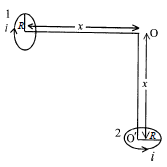
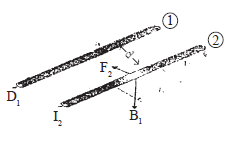
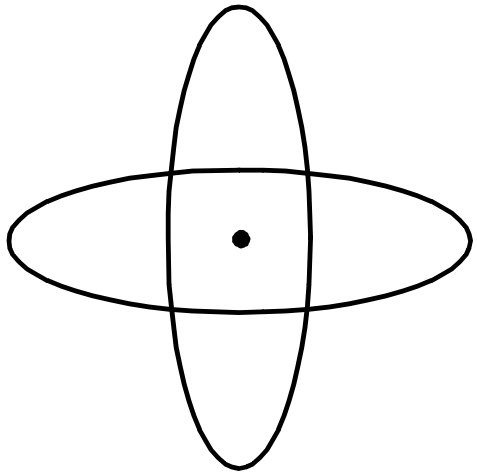
  2. Two small identical circular coils marked 1, 2 carry equal currents and are placed with their geometric axes perpendicular to each other as shown in the figure. Derive an expression for the resultant magnetic field at O.
Answer
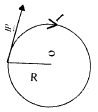
  1. From Biot Savart's law, magnetic field due to current element dl at the centre O.
$\overrightarrow{\text{d}\beta} = \frac{\mu_\circ}{4\pi}\frac{\text{I}\bigg(\overrightarrow{\text{dl}}\times\overrightarrow{\text{R}}\bigg)}{|\overrightarrow{\text{R}}|^{3}}$

$\therefore$$\text{dB} =\frac{\mu_\circ}{4\pi\text{R}^2} \frac{\text{Idl}\sin(90)^{\circ}}{\text{R}^2}$
$\text{B} = \frac{\mu_0\text{I}}{4\pi\text{R}^2} \int\text{dl} = \frac{\mu_0\text{I}}{4\pi\text{R}^{2}}. 2 \pi\text{R}$
$\therefore$ Field due to coil $ = \frac{ \mu_0\text{I}}{2}$
  1. Field due to loop (1)
$\text{B}_{1} = \frac{\mu_\circ\text{IR}^{2}}{2\big(\text{x}^{2} + \text{R}^{2}\big)^{3/2}} \cong \frac{\mu_\circ\text{IR}^{2}}{2\text{X}^{3}}$
$\overrightarrow{B}_{1}$ is directed along geometric axes of loop (1)
Field due to loop (2)
$\text{B}_{2} = \frac{\mu_\circ\text{IR}^{2}}{2\big(\text{x}^{2} + \text{R}^{2}\big)^{3/2}} \cong \frac{\mu_\circ\text{IR}^{2}}{2\text{X}^{3}}$
$\overrightarrow{B}_{2}$ is directed along geometric axes of loop (2)
$\therefore$ Resultant field at $\text{O},\text{B} = \sqrt{\text{B}^{2}_{1} + \text{B}^{2}_{2}}$
$\therefore\text{B} = \frac{\sqrt{2\mu_\circ\text{IR}^2}}{2\text{x}^{3}}$ (Note: Also accept $\text{B} = \frac{\sqrt{2}\mu_0\text{IR}^{2}}{2\big(\text{x}^{2} + \text{R}^{2}\big)^{3/2}}\big).$
View full question & answer
Question 205 Marks
Draw a labelled diagram of a moving coil galvanometer. State the principle on which it works.Deduce an expression for the torque acting on a rectangular current carrying loop kept in a uniform magnetic field. Write two factors on which the current sensitivity of a moving coil galvanometer depend.
Answer

Principle: When a current carrying coil is kept in a uniform magnetic field it experiences a torque.
Derivation:
$\tau = \text{NIBA} \sin\theta$
$= \text{MB} \sin \theta \big(\text{M = NIA)}$
Alternate Answer
$\tau = \text{M}\times\text{B} $
Current sensitivity depends on:
  1. Number of turns.
  2. Strength of the magnetic field.
  3. Torsional constant of the suspension wire.
  4. Area of the coil.
View full question & answer
Question 215 Marks
State Biot-Savart law. Use it to derive an expression for the magnetic field at the centre of a circular loop of radius R carrying a steady current I. Sketch the magnetic field lines for such a current carrying loop.
Answer
Statement: The magnitude of the magnetic field, dB, at any point, due to a current carrying conductor, is directly proportional to the current, I, the element length 'd1' and inversely proportional to the square of the distance 'r'.Its direction is perpendicular to the plane containing 'dl' and r as defined by $\overrightarrow{\text{d}\ell}\times\overrightarrow{\text{r}}$.Alternate Answer
Derivation: $\text{dB} = \frac{\mu_\circ}{4\pi} $ $\frac{\text{I}|d\overrightarrow1\times\overrightarrow{r}|}{\text{r}^{3}}$ $\text{dB} = \frac{\mu_\circ}{4\pi}$ $\frac{\text{Id}\ell}{(\text{X}^2+\text{R}^2)}$ , $\text{cos}\theta = \frac{\text{R}}{(\text{X}^{2} + \text{R}^{2})^{1/2}}$ $\text{dB}_{x} = \frac{\mu_\circ\text{I}}{4\pi} \frac{\text{dIR}}{(\text{X}^{2} + \text{R}^{2})^{3/2}}$ $\text{B} = \text{B}_{x}\overline{\text{i}} = \frac{\mu_\circ\text{IR}^{2}}{2(\text{x}^{2}+\text{R}^{2})^{3/2}}\overline{\text{i}}$ $\therefore \text{B}_{\circ} = \frac{\mu_\circ\text{I}}{2\text{R}} \overline {\text{i}}$ (also accept the direct derivation of the field at the centre of the coil)
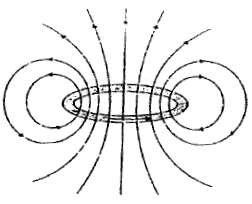
View full question & answer
Question 225 Marks
With the help of a neat and labelled diagram, explain the underlying principle and working of a moving coil galvanometer. What is the function of:
  1. Uniform radial field.
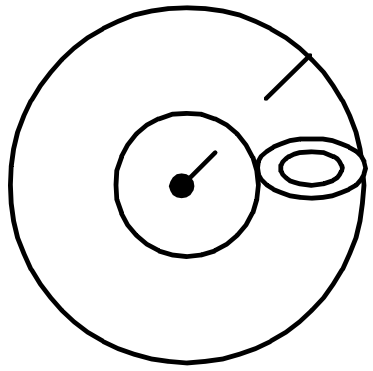
  2. Soft iron core in.
In such a device?
Answer
  1. Labeled diagram:

Principle: When a current carrying coil is placed in a magnetic field it experiences a torque.
Explanation of working:
Function:
  1. In the radial magnetic field, the plane of the coil always remain parallel or along the direction of magnetic field lines.
  2. To concentrate the lines of force of the magnetic field through the coil.
View full question & answer
Question 235 Marks
Derive a mathematical expression for the force per unit length experienced by each of the two long current carrying conductors placed parallel to each other in air. Hence define one ampere of current.Explain why two parallel straight conductors carrying current in the opposite direction kept near each other in air repel?
Answer
  1. Diagram:
  1. Magnetic field due to the current $\text{I}_{1}$ flowing in conductor 1 at a point on conductor 2 $\text{B}_{1} = \frac{\mu_\circ\text{I}_{1}}{2\pi\text{d}}$
$\therefore $ force on conductor 2 due to $\text{B}_{1}$ is
$\text{F}_{2} = \text{I}_{2} \big( \overrightarrow\ell{_2}\times\overrightarrow{\text{B}}_{1}\big)$
$=\text{I}_{2}\ell_{2}\times\text{B}_{1}$
$\therefore \frac{\text{F}_{2}}{\ell_2} = \frac{\mu_\circ\text{I}_{1}\text{I}_2}{2{\pi}\text{d}}$
  1. Ampere: The equal currents, flowing through two thin long straight parallel conductors said to be one ampere each if they interact with each other with a force of $2\times 10^{-7}$ N/m when kept one metre apart in vacuum.
  2. Direction of magnetic field, at the second conductor, due to current in the first conductor.
Direction of force on the second conductor, (carrying a parallel current) due to this magnetic field.
View full question & answer
Question 245 Marks
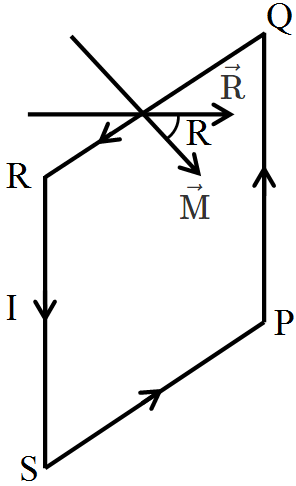
  1. Derive the expression for the torque acting on the rectangular current carrying coil of a galvanometer. Why is the magnetic field made radial?
  2. An $\alpha-$particle is accelerated through a potential difference of 10kV and moves along x-axis. It enters in a region of uniform magnetic field $B = 2 \times 10^{–3}T$ acting along y-axis. Find the radius of its path. (Take mass of $\alpha-$particle $= 6.4 \times 10^{–27}kg$).
Answer
  1.  

$\text{PQ}=\text{RS}=1$
$\text{PS}=\text{QR}=\text{b}$
Area $\text{A}=\text{lb}$
$\vec{\text{M}}\times\vec{\text{IA}}$
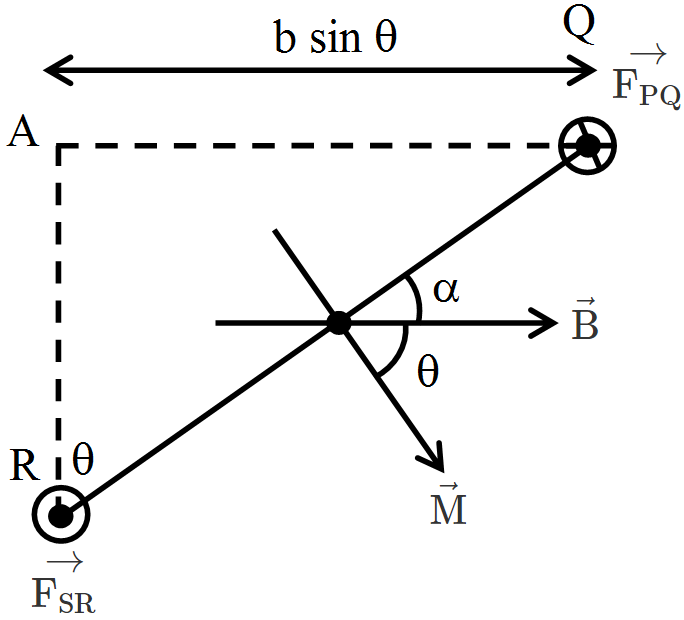
$\overrightarrow{\text{F}_{\text{PQ}}}=\text{IlB}\otimes$
$\overrightarrow{\text{F}_{\text{RS}}}=\text{IlB}\ominus$
$\overrightarrow{\text{F}_{\text{QR}}}=\text{IbB}\sin(90^\circ-\theta)=\text{IbB}\cos\theta\text{ up}$
$\overrightarrow{\text{F}_{\text{SP}}}=\text{IbB}\sin(90^\circ-\theta)=\text{IbB}\cos\theta\text{ down}$
Only $\overrightarrow{\text{F}_{\text{PB}}}\ \& \ \overrightarrow{\text{F}_{\text{RS}}}$ form a couple to apply torque on loop,

$\tau=\text{MB}\sin\theta$
Magnetic field is taken radial in Galvanometer coil in order to create $\theta=90^\circ$ at every orientation of coil in the magnetic field so that current varies linearly with deflection.
  1. $\text{qV}=\frac{1}{2}\text{mv}^2$
$\Rightarrow\text{v}=\sqrt{\frac{2\text{qV}}{\text{m}}}$
$\because\vec{\text{v}}=\text{vi}\perp\vec{\text{B}}(=\text{Bj})$
$\therefore$ Particle deflects along circular path of radius $\text{r}=\frac{\text{mv}}{\text{qB}}=\frac{\text{m}}{\text{qB}}\sqrt{\frac{2\text{qv}}{\text{m}}}=\frac{1}{\text{B}}\sqrt{\frac{2\text{mv}}{\text{q}}}$
$\text{r}=\frac{1}{2\times10^{-3}}\sqrt{\frac{2\times6.4\times10^{-27}\times10^4}{2\times1.6\times10^{-19}}}$
$=\frac{1}{2\times10^{-3}}\times2\times10^{-2}$
$=10^1\text{m}=10\text{m}.$
View full question & answer
Question 255 Marks
Doubly-ionised helium ions are projected with a speed of $10km/s^{-1}$ in a direction perpendicular to a uniform magnetic field of magnitude 1.0T. Find
  1. The force acting on an ion.
  2. The radius of the circle in which it circulates.
  3. The time taken by an ion to complete the circle.
Answer
$\text{V}=10\text{Km}=10^4\text{m/s}$
$\text{B}=1\text{T},\text{q}=2\text{e}.$
  1. $\text{F}=\text{qVB}=2\times1.6\times10^{-19}\times10^4\times1$
$=3.2\times10^{-15}\text{N}$
  1. $\text{r}=\frac{\text{mV}}{\text{qB}}=\frac{4\times1.6\times10^{-27}\times10^4}{2\times1.6\times10^{-19}\times1}$
$=2\times\frac{10^{-23}}{10^{-19}}=2\times10^{-4}\text{m}$
  1. Time taken $\frac{2\pi\text{r}}{\text{V}}=\frac{2\pi\text{mv}}{\text{qB}\times\text{v}}=\frac{2\pi\times4\times1.6\times10^{-27}}{2\times1.6\times10^{-19}\times1}$
$=4\pi\times10^{-8}=4\times3.14\times10^{-8}$

$=12.56\times10^{-8}=1.256\times10^{-7}\text{}.$
View full question & answer
Question 265 Marks
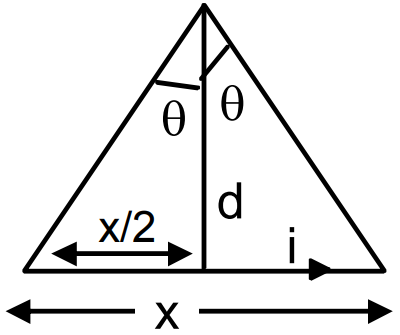
Consider a straight piece of length x of a wire carrying a current i. Let P be a point on the perpendicular bisector of the piece, situated at a distance d from its middle point. Show that for d >> x, the magnetic field at P varies as $\frac{1}{\text{d}^2}$ whereas ford d << x, it varies as $\frac{1}{\text{d}}.$
Answer
$\text{B}=\frac{\pi_0\text{i}}{4\pi\text{d}}2\sin\theta$
$=\frac{\pi_0\text{i}}{4\pi\text{d}}\frac{2\times\text{x}}{2\times\sqrt{\text{d}^2+\frac{\text{x}^2}{4}}}=\frac{\mu_0\text{ix}}{4\pi\text{d}+\sqrt{\text{d}^2+\frac{\text{x}^2}{4}}}$
  1. When d >> x
Neglecting x w.r.t.d

$\text{B}=\frac{\pi_0\text{ix}}{\mu\pi\sqrt{\text{d}^2}}=\frac{\mu_0\text{ix}}{\mu\pi\text{d}^2}$

$\therefore\text{B}\propto\frac{1}{\text{d}^2}$
  1. When x >> d, neglecting d w.r.t x
$\text{B}=\frac{\mu_0\text{ix}}{\frac{4\pi\text{dx}}{2}}=\frac{2\mu_0\text{i}}{4\pi\text{d}}$

$\therefore\text{B}\propto\frac{1}{\text{d}}$
View full question & answer
Question 275 Marks
If the outer coil of the previous problem is rotated through 90° about a diameter, what would be the magnitude of the magnetic field B at the centre?
Answer

Outer Circle
$\text{n}=100,\ \text{r}=100\text{m}=0.1\text{m}$
$\text{i}=2\text{A}$
$\overrightarrow{\text{B}}=\frac{\text{n}\mu_0\text{i}}{2\text{a}}=\frac{100\times4\pi\times10^{-7}\times2}{2\times0.1}=4\pi\times10^{-4}$ horizontally towards West.
Inner Circle
$\text{r}=5\text{cm}=0.05\text{m},\ \text{n}=50\text{m},\ \text{i}=2\text{A}$
$\overrightarrow{\text{B}}=\frac{\text{n}\mu_0\text{i}}{2\text{r}}=\frac{4\pi\times10^{-7}\times2\times50}{2\times0.05}=4\pi\times10^{-4}$ downwards
Net $\text{B}=\sqrt{(4\pi\times10^{-4})^2+(4\pi\times10^{-4})^2}$
$=\sqrt{32\pi^2\times10^{-8}}$
$=17.7\times10^{-4}\approx18\times10^{-4}$
$=1.8\times10^{-3}=1.8\text{mT}$
View full question & answer
Question 285 Marks
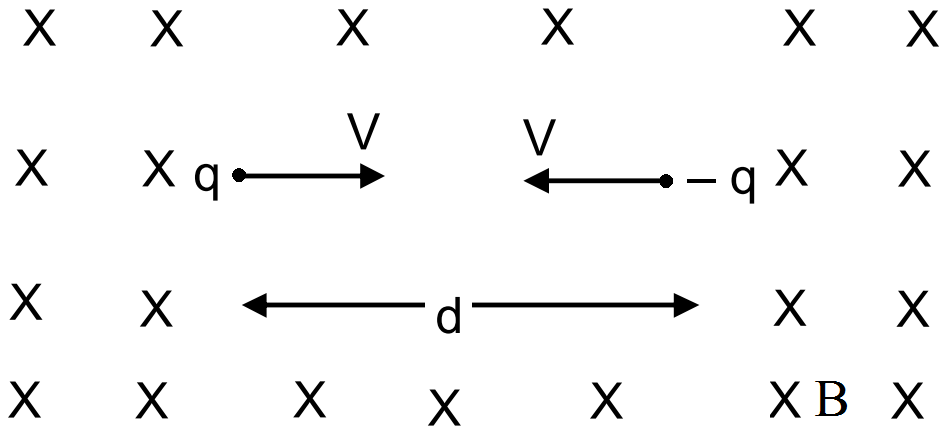
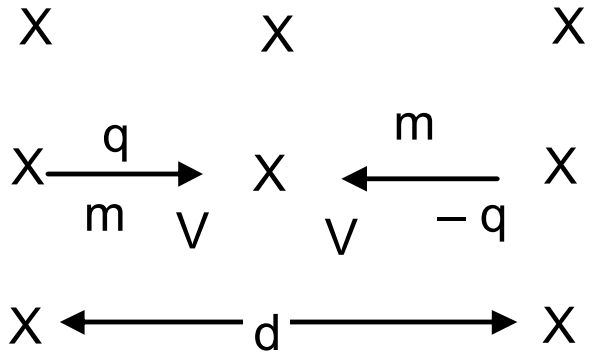
Two particles, each with mass m are placed at a separation d in a uniform magnetic field B, as shown in the figure. They have opposite charges of equal magnitude q. At time t = 0, the particles are projected towards each other, each with a speed v. Suppose the Coulomb force between the charges is switched off.
  1. Find the maximum value $v_m$ of the projection speed, so that the two particles do not collide.
  2. What would be the minimum and maximum separation between the particles if $\text{v}=\text{v}_{\text{m}}\sqrt{2}?$
  3. At what instant will a collision occur between the particles if $v = 2v_m?$
  4. Suppose $v = 2v_m$ and the collision between the particles is completely inelastic. Describe the motion after the collision.
Answer
  1. The particulars will not collide if,
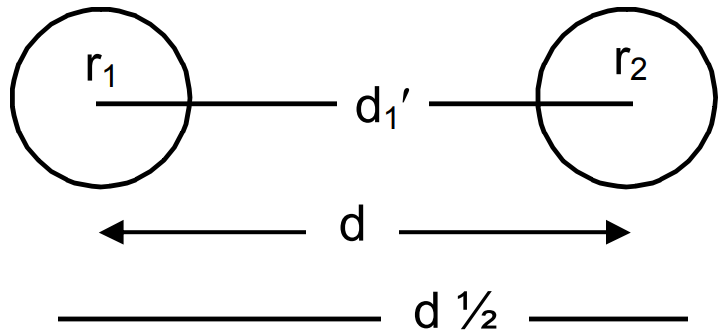
$\text{d}=\text{r}_1+\text{r}_2$


$\Rightarrow\text{d}=\frac{\text{mV}_\text{m}}{\text{qB}}+\frac{\text{mV}_\text{m}}{\text{qB}}$

$\Rightarrow\text{d}=\frac{2\text{mV}_\text{m}}{\text{qB}}$

$\text{V}_\text{m}=\frac{\text{qBd}}{2\text{m}}$
  1. $\text{V}=\frac{\text{V}_\text{m}}{2}$


$\text{d}_1'=\text{r}_1+\text{r}_2=\Big(\frac{\text{m}\times\text{qBd}}{2\times2\text{m}\times\text{qB}}\Big)=\frac{\text{d}}{2}$ (min. dist.)

Max. distance $\text{d}_2'=\text{d}+2\text{r}=\text{d}+\frac{\text{d}}{2}=\frac{3\text{d}}{2}$
  1. $\text{V}=2\text{V}_\text{m}$
$\text{r}_1'=\frac{\text{m}_2\text{V} _\text{m}}{\text{qB}}=\frac{\text{m}\times2\times\text{qBd}}{2\text{n}\times\text{qB}}$

$\text{r}_2=\text{d}$

$\therefore$ The arc is $\frac{1}{6}$
  1. $\text{V}_\text{m}=\frac{\text{qBd}}{2\text{m}}$


The particles will collide at point P. At point p, both the particles will have motion m in upward direction. Since the particles collide inelastically the stick together.

Distance l between centres $=\text{d},\sin\theta=\frac{1}{2\text{r}}$

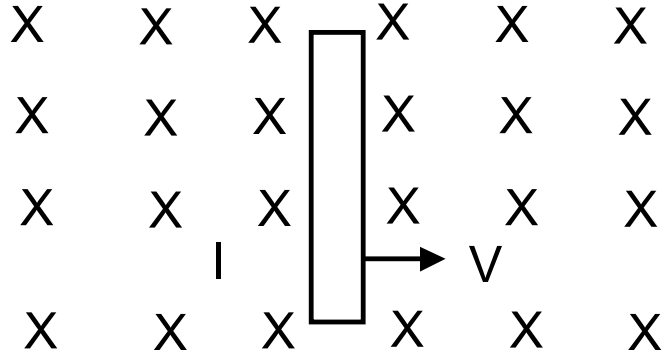
Velocity upward $=\text{v}\cos90-\theta=\text{V}\sin\theta=\frac{\text{Vl}}{2\text{r}}$

$\frac{\text{mv}^2}{\text{r}}=\text{qvB}$

$\Rightarrow\text{r}=\frac{\text{mv}}{\text{qB}}$

$\text{V}\sin\theta=\frac{\text{vl}}{2\text{r}}=\frac{\text{vl}}{2\frac{\text{mv}}{\text{qb}}}=\frac{\text{qBd}}{2\text{m}}=\text{V}_\text{m}$

Hence the combined mass will move with velocity $V_m.$
View full question & answer
Question 295 Marks
An electron is projected horizontally with a kinetic energy of 10keV. A magnetic field of strength $1.0 \times 10^{-7}T$ exists in the vertically upward direction.
  1. Will the electron deflect towards the right or left of its motion?
  2. Calculate the sideways deflection of the electron while travelling through 1m. Make appropriate approximations.
Answer


$\text{KE}=10\text{Kev}=1.6\times10^{-15}\text{J}$
$\overrightarrow{\text{B}}=1\times10^{-7}\text{T}$
  1. The electron will be deflected towards left
  2. $\Big(\frac{1}{2}\Big)\text{mv}^2=\text{KE}$
$\Rightarrow\text{V}=\sqrt{\frac{\text{KE}\times2}{\text{m}}}$
$\text{F}=\text{qVB}\ \&\text{ accin}=\frac{\text{qVB}}{\text{m}_\text{e}}$
Applying $\text{s}=\text{ut}+\Big(\frac{1}{2}\Big)\text{at}^2=\frac{1}{2}\times\frac{\text{qVB}}{\text{m}_\text{e}}\times\frac{\text{x}^2}{\text{v}^2}$
$=\frac{\text{qBx}^2}{2\text{m}_\text{e}\text{V}}$
$=\frac{\text{qBx}^2}{2\text{m}_\text{e}\sqrt{\frac{\text{KE}\times2}{\text{m}}}}$
$=\frac{1}{2}\times\frac{1.6\times10^{-19}\times1\times10^{-7}\times1^2}{9.1\times10^{-31}\times\sqrt{\frac{1.6\times10^{-15}\times2}{9.1\times10^{-31}}}}$
By solving we get, $\text{s}=0.0148\approx1.5\times10^{-2}\text{cm}$
View full question & answer
Question 305 Marks
A magnetic field of $(4.0\times10^{-3}\vec{\text{k}})$ T exerts a force of $(4.0\vec{\text{i}}+3.0\vec{\text{j}})\times10^{-10}$ N on a particle with a charge of $1.0\times10^{-9}\text{C}$ and going in the x−y plane. Find the velocity of the particle.
Answer
$\text{B}=4\times10^{-3}\text{T}(\hat{\text{k}})$
$\text{F}=[4\hat{\text{i}}+3\hat{\text{j}}\times10^{-10}]\text{N}.$
$\text{F}_\text{x}=4\times10^{-10}\text{N}$
$\text{F}_\text{y}=3\times10^{-10}\text{N}$
$\text{Q}=1\times10^{-9}\text{C}.$
Considering the motion along x-axis:
$\text{F}_\text{x}=\text{quV}_\text{y}\text{B}$
$\Rightarrow\text{V}_\text{x}=\frac{\text{F}}{\text{qB}}$
$=\frac{3\times10^{-10}}{1\times10^{-9}\times4\times10^{-3}}$
$=75\text{m/s}$
Velocity $=(-75\hat{\text{i}}+100\hat{\text{j}})\text{m/s}$
View full question & answer
Question 315 Marks
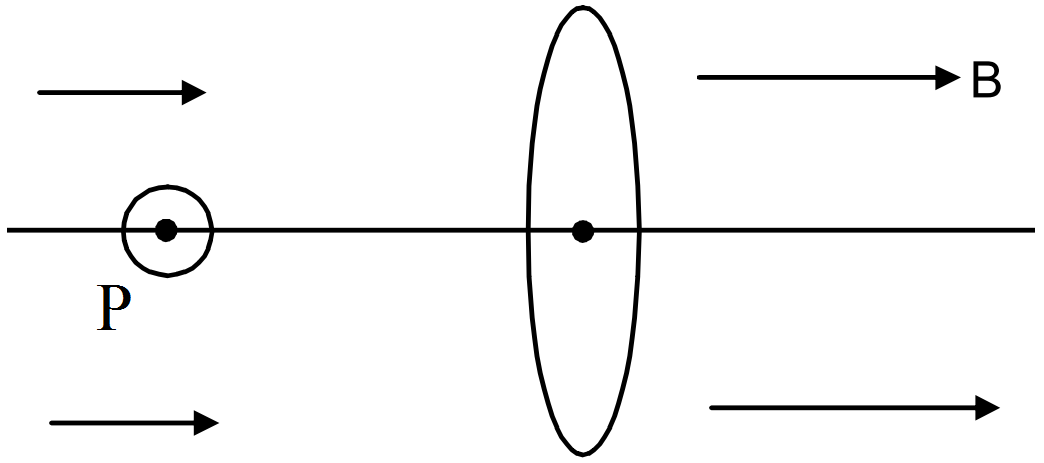
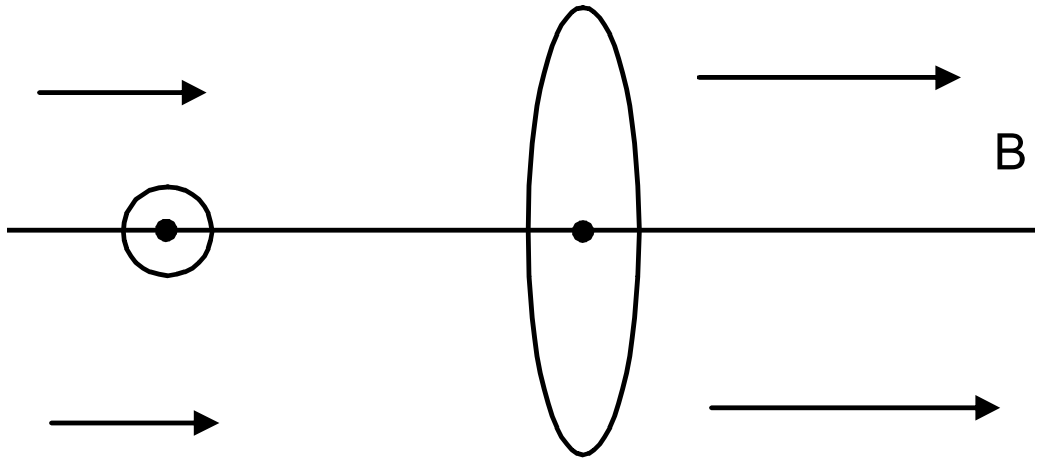
Shows a convex lens of focal length 12cm lying in a uniform magnetic field B of magnitude 1.2T parallel to its principal axis. A particle with charge $2.0 \times 10^{-3}C$ and mass $2.0 \times 10^{-5}$ kg is projected perpendicular to the plane of the diagram with a speed of $4.8 ms^{-1}$. The particle moves along a circle with its centre on the principal axis at a distance of 18cm from the lens. Show that the image of the particle moves along a circle and find the radius of that circle.
Answer


The object will make a circular path, perpendicular to the plance of paper Let the radius of the object be r.
$\frac{\text{mv}^2}{\text{r}}=\text{qvB}\Rightarrow\text{r}=\frac{\text{mV}}{\text{qB}}$
Here object distance K = 18cm.
$\frac{1}{\text{v}}-\frac{1}{\text{u}}=\frac{1}{\text{f}}$ (lens eqn.) $\Rightarrow\frac{1}{\text{v}}-\Big(\frac{1}{-18}\Big)=\frac{1}{12}\Rightarrow\text{v}=36\text{cm}.$
Let the radius of the circular path of image = r'
So magnification $=\frac{\text{v}}{\text{u}}=\frac{\text{r}'}{\text{r}}\Big(\text{magnetic path}=\frac{\text{image height}}{\text{object height}}\Big)$
$\Rightarrow\text{r}'=\frac{\text{v}}{\text{u}}\text{r}$
$\Rightarrow\text{r}'=\frac{36}{18}\times4=8\text{cm}$
Hence radius of the circular path in which the image moves is 8cm
View full question & answer
Question 325 Marks
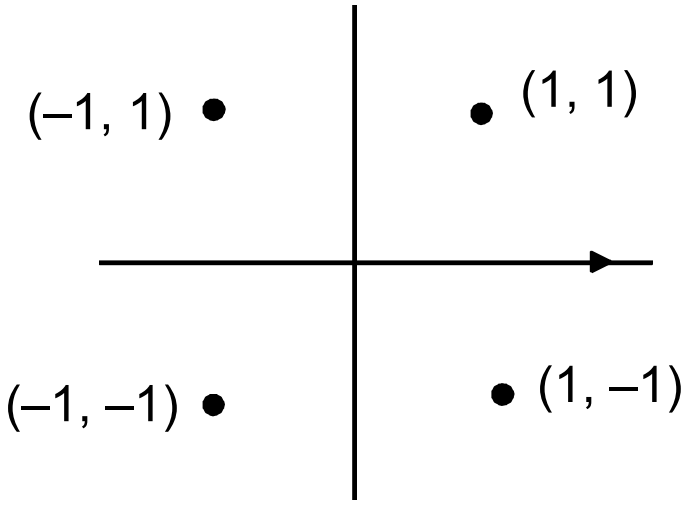
Two long, straight wires, each carrying a current of 5A, are placed along the X and Y-axes respectively. The currents point along the positive directions of the axes. Find the magnetic fields at the points $(a) (1m, 1m), (b) (-1m, 1m), (c) (-1m,-1m)$ and $(d) (1m, -1m),$
Answer
  1. $\overrightarrow{\text{B}}\ \text{for}\ \text{X}=\overrightarrow{\text{B}}\ \text{for}\ \text{Y}$
Both are oppositely directed hence net $\overrightarrow{\text{B}}=0$
  1. $\overrightarrow{\text{B}}$ due to $\text{X}=\overrightarrow{\text{B}}$ due to X both directed along Z-axis
Net $\overrightarrow{\text{B}}=\frac{2\times10^{-7}\times2\times5}{1}=2\times10^{-6}\text{T}=2\mu\text{T}$
  1. $\overrightarrow{\text{B}}$ due to $\text{X}=\overrightarrow{\text{B}}$ due to Y both directed opposite to each other.
Hence Net $\overrightarrow{\text{B}}=0$
  1. $\overrightarrow{\text{B}}$ due to $\text{X}=\overrightarrow{\text{B}}$ due to $Y = 1 \times 10^{-6}T$ both directed along (-)ve Z-axis
Hence Net $\overrightarrow{\text{B}}=2\times1.0\times10^{-6}=2\mu\text{T}$
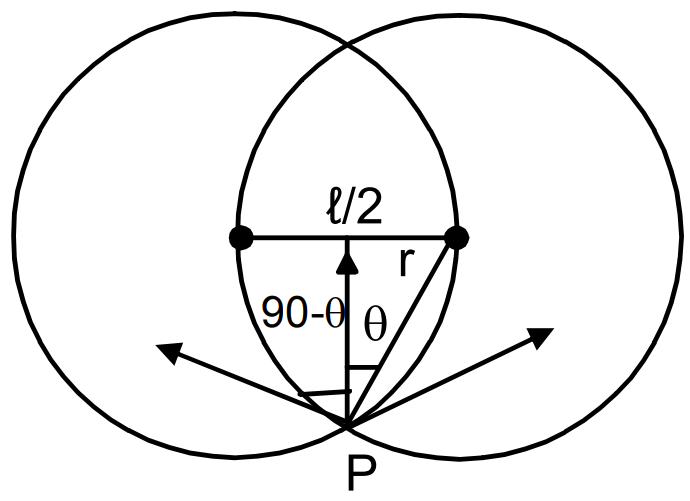
View full question & answer
Question 335 Marks
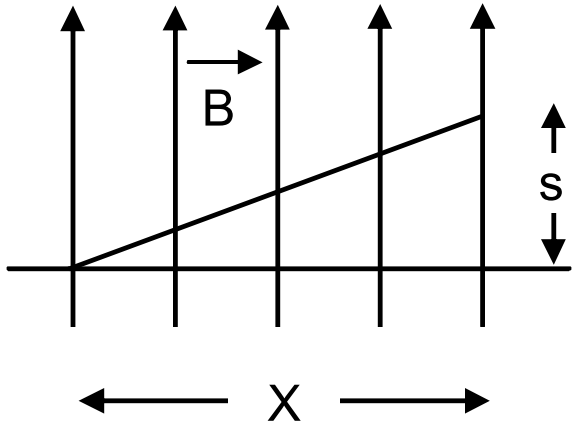
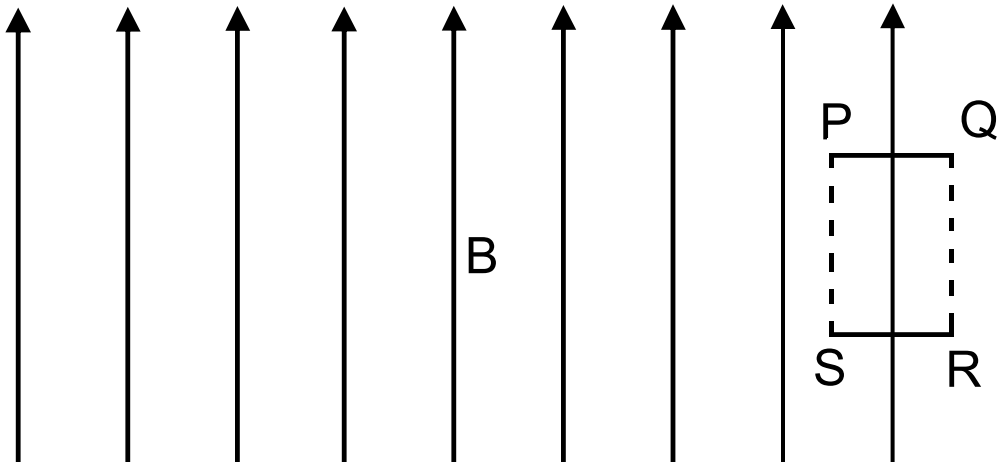
Sometimes we show an idealised magnetic field which is uniform in a given region and falls to zero abruptly. One such field is represented in figure. Using Ampere's law over the path PQRS, show that such a field is not possible.
Answer
We know, $\int\text{B}\times\text{dl}=\mu_0\text{i}.$ Theoritically B = 0 a t A.

If, a current is passed through the loop PQRS, then
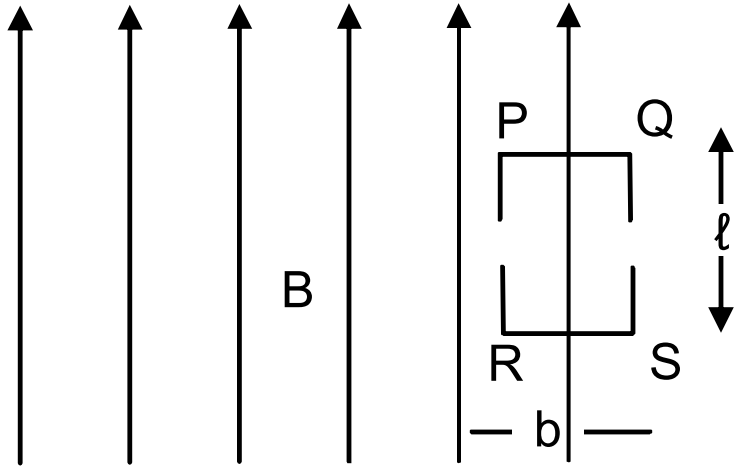
$\text{B}=\frac{\mu_0\text{i}}{2(\ell+\text{b})}$will exist in its vicinity
Now, As the $\overrightarrow{\text{B}}$ at A is zero. So there’ll be no interaction.
However practically this is not true. As a current carrying loop, irrespective of its near about position is always affected by an existing magnetic field.
View full question & answer
Question 345 Marks
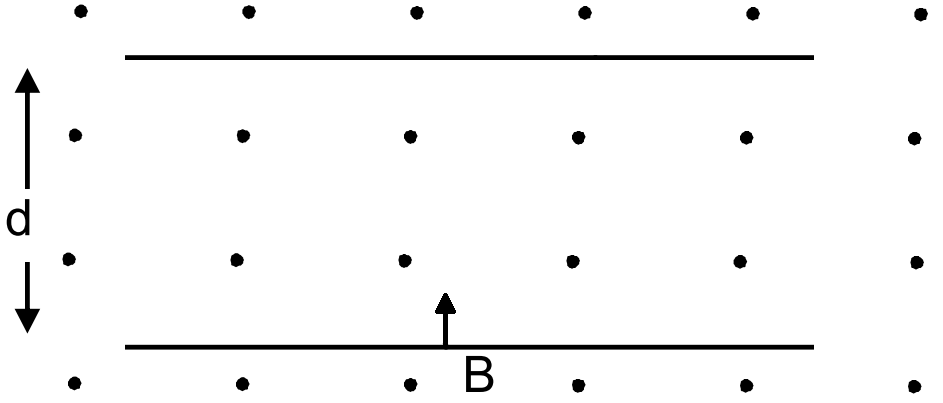
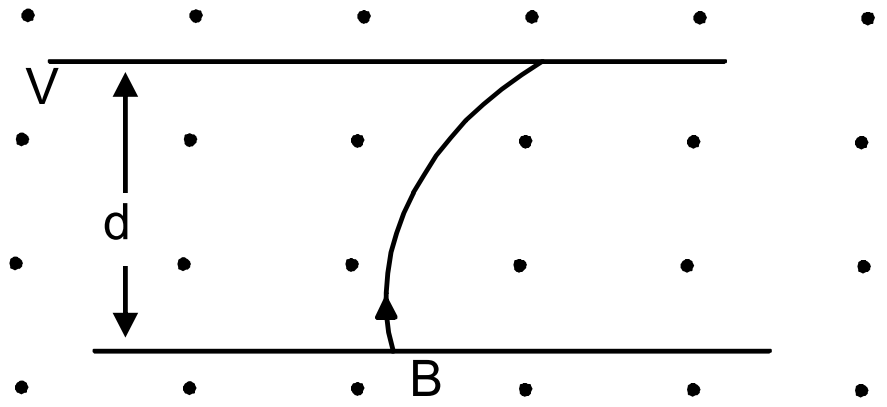
An electron is emitted with negligible speed from the negative plate of a parallel-plate capacitor charged to a potential difference V. The separation between the plates is d and a magnetic field Bexists in the space, as shown in the figure. Show that the electron will fail to strike the upper plates if $\text{d}>\Big(\frac{2\text{m}_\text{e}\text{v}}{\text{eB}^2}\Big)^{\frac{1}{2}}.$
Answer


The force experienced first is due to the electric field due to the capacitor
$\text{E}=\frac{\text{V}}{\text{d}}$
$\text{F}=\text{eE}$
$\text{a}=\frac{\text{eE}}{\text{m}_\text{e}}$ [Where $e →$ charge of electron $m_e →$ mass of electron]
$\text{v}^2=\text{u}^2+2\text{ as}$
$\Rightarrow\text{v}^2=2\times\frac{\text{eE}}{\text{m}_\text{e}}\times\frac{2\times\text{e}\times\text{V}\times\text{d}}{\text{dm}_\text{e}}$
$\text{v}=\sqrt{\frac{2\text{eV}}{\text{m}_\text{e}}}$
Now, The electron will fail to strike the upper plate only when d is greater than radius of the are thus formed.
$\text{d}>\frac{\text{m}_\text{e}\times\sqrt{\frac{2\text{eV}}{\text{m}_\text{e}}}}{\text{eB}}$
$\Rightarrow\text{d}>\frac{\sqrt{2\text{m}_\text{e}\text{V}}}{\text{eB}^2}$
View full question & answer
Question 355 Marks
Suppose that the radius of cross-section of the wire used in the previous problem is r. Find the increase in the radius of the loop if the magnetic field is switched off. Young's modulus of the material of the wire is Y.
Answer

$\text{Y}=\frac{\text{Stress}}{\text{Strain}}=\frac{\Big(\frac{\text{F}}{\pi\text{r}^2}\Big)}{\Big(\frac{\text{dl}}{\text{L}}\Big)}$
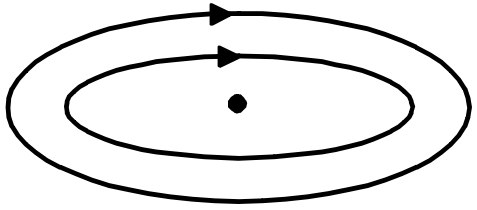
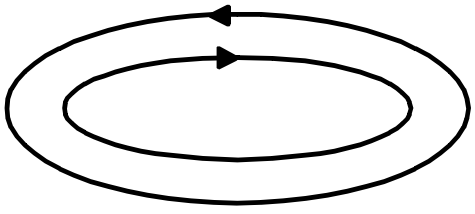
$\Rightarrow\frac{\text{dl}}{\text{L}}\text{Y}=\frac{\text{F}}{\pi\text{r}^2}$
$\Rightarrow\text{dl}=\frac{\text{F}}{\pi\text{r}^2}\times\frac{\text{L}}{\text{Y}}$
$=\frac{\text{iaB}}{\pi\text{r}^2}\times\frac{2\pi\text{a}}{\text{Y}}=\frac{2\pi\text{a}^2\text{iB}}{\pi\text{r}^2\text{Y}}$
So, $\text{dp}=\frac{2\pi\text{a}^2\text{iB}}{\pi\text{r}^2\text{Y}}$ (for small cross sectional circle)
$\text{dr}=\frac{2\pi\text{a}^2\text{iB}}{\pi\text{r}^2\text{Y}}\times\frac{1}{2\pi}=\frac{\text{a}^2\text{iB}}{\pi\text{r}^2\text{Y}}$
View full question & answer
Question 365 Marks
A particle with a charge of 5.0 µC and a mass of $5.0 \times 10^{-12}kg$ is projected with a speed of $1.0km s^{-1}$ in a magnetic field of magnitude 5.0mT. The angle between the magnetic field and the velocity is $\sin^{-1} (0.90)$. Show that the path of the particle will be a helix. Find the diameter of the helix and its pitch.
Answer
$q = 5 uF = 5 \times 10^{-6} C$
$m = 5 \times 10^{-12}kg,$
$V = 1km/s = 103 m/s$
$\theta = \sin^{-1} (0.9),$
$B = 5 \times 10^{-3}T$
We have $mv'^2 = qv'B$
$\text{r}=\frac{\text{mv}'}{\text{qB}}=\frac{\text{mv}\sin\theta}{\text{qB}}$
$=\frac{5\times10^{-12}\times10^3\times9}{5\times10^{-6}+5\times10^3+10}$
$=0.18\text{ metre}$
Hence dimeter = 36cm.
pitch $=\frac{2\pi\text{r}}{\text{v}\sin\theta}\text{v}\cos\theta$
$=\frac{2\times3.1416\times0.1\times\sqrt{1-0.51}}{0.9}$
$=0.54\text{ meter}=54\text{mc.}$
The velocity has a x-component along with which no force acts so that the particle, moves with uniform velocity. The velocity has a y-component with which is accelerates with acceleration a. with the Vertical component it moves in a circular crosssection. Thus it moves in a helix.
View full question & answer
Question 375 Marks
A charged particle is accelerated through a potential difference of 12kV and acquires a speed of $1.0 \times 10^6m s^{−1}.$ It is then injected perpendicularly into a magnetic field of strength 0.2T. Find the radius of the circle described by it.
Answer
$\text{V}=12\text{KV}$
$\text{E}=\frac{\text{qV}}{\text{ml}}$
Now, $\text{F}=\text{qE}=\frac{\text{qV}}{\text{l}}$
$\text{a}=\frac{\text{F}}{\text{m}}=\frac{\text{qv}}{\text{ml}}$
$\text{v}=1\times10^6\text{m/s}$
$\text{v}=\sqrt{2\times\frac{\text{qV}}{\text{ml}}\times\text{l}}=\sqrt{2\times\frac{\text{q}}{\text{m}}\times12\times10^3}$
$1\times10^6=\sqrt{2\times\frac{\text{q}}{\text{m}}\times12\times10^3}$
$\Rightarrow10^{12}=24\times10^3\times\frac{\text{q}}{\text{m}}$
$\Rightarrow\frac{\text{m}}{\text{q}}=\frac{24\times10^3}{10^{12}}=24\times10^{-9}$
$\Rightarrow\frac{\text{mV}}{\text{qB}}=\frac{24\times10^{-9}\times1\times10^6}{2\times10^{-1}}=12\times10^{-2}\text{m}=12\text{cm}$
View full question & answer
Question 385 Marks
Two circular coils of radii 5.0cm and 10cm carry equal currents of 21 A. The coils have 50 and 100 turns reepectively and are placed in such a way that their planes as well as the centres coincide. Find the magnitude of the magnetic field B at the common centre of the coils if the currents in the coils are (a) in the same sense (b) in the opposite sense.
Answer
$\text{r}_1 = 5\text{cm},\ \text{r}_2=10\text{cm}$
$\text{n}_1=50,\ \text{n}_2=100$
$\text{i}=2\text{A}$
  1. $\text{B}=\frac{\text{n}_1\mu_0\text{i}}{2\text{r}_1}+\frac{\text{n}_2\mu_0\text{i}}{2\text{r}_2}$
$=\frac{50\times4\pi\times10^{-7}\times2}{2\times5\times10^{-2}}+\frac{100\times4\pi\times10^{-7}\times2}{2\times10\times10^{-2}}$

$=4\pi\times10^{-4}+4\pi\times10^{-4}=8\pi\times10^{-4}$
  1. $\text{B}=\frac{\text{n}_1\mu_0\text{i}}{2\text{r}_1}-\frac{\text{n}_2\mu_0\text{i}}{2\text{r}_2}=0$
View full question & answer
Question 395 Marks
Two current-carrying wires may attract each other. In absence of other forces, the wires will move towards each other increasing the kinetic energy. Does it contradict the fact that the magnetic force cannot do any work and hence cannot increase the kinetic energy?
Answer
Magnetic field can not do any work and hence can never speed up or down a particle. Consider 2 wires carrying current in upward direction.
Magnetic field due to current in wire 1 produces a magnetic field out of the plane of paper at the position of wire 2. Due to this magnetic field, a force is exerted on wire 2. Wire 2 electron, moving in downward direction, move in circular paths due to this magnetic force. As these electrons can not come out of the wire so while describing circular path,they hit the edges of the wire and tranfer a momentum to the wire. Due to this change in momentum, wire starts moving and gains kinetic energy.
View full question & answer
Question 405 Marks
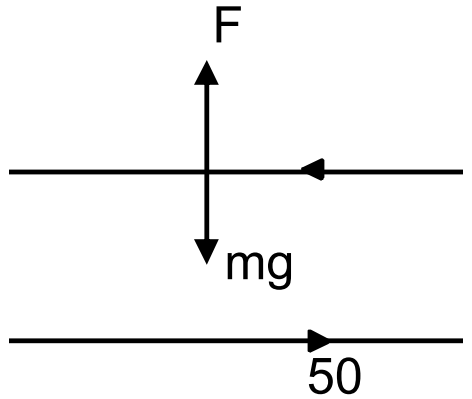
A long, straight wire is fixed horizontally and carries a current of 50.0A. A second wire having linear mass density $1.0 \times 10^{-4}kg/m$ is placed parallel to and directly above this wire at a separation of 5.0mm. What current should this second wire carry such that the magnetic repulsion can balance its weight?
Answer
$\frac{\mu_0\text{i}_1\text{i}_2}{2\pi\text{d}}=\text{mg}$ (For a portion of wire of length 1m)

$\Rightarrow\frac{\mu_0\times50\times\text{i}_2}{2\pi\times5\times10^{-3}}=1\times10^{-4}\times9.8$
$\Rightarrow\frac{4\pi\times10^{-7}\times5\times\text{i}_2}{2\pi\times5\times10^{-3}}=9.8\times10^{-4}$
$\Rightarrow3\times\text{i}_2\times10^{-3}=9.3\times10^{-3}\times10^{-1}$
$\Rightarrow\text{i}_2=\frac{9.8}{2}\times10^{-1}=0.49\text{A}$
View full question & answer
Question 415 Marks
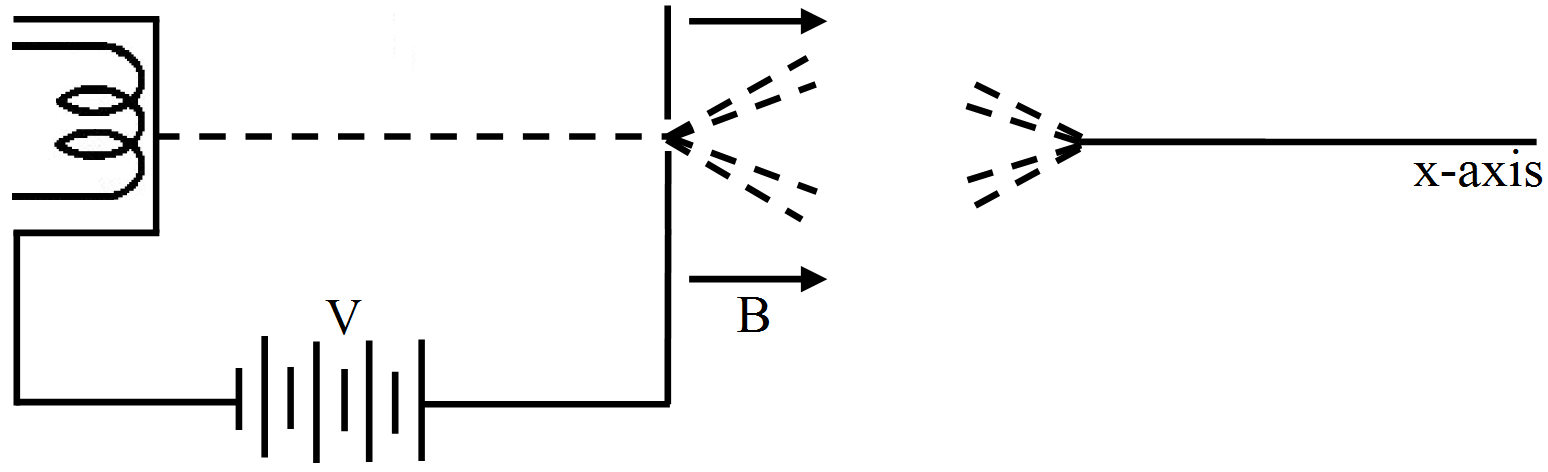
Electrons emitted with negligible speed from an electron gun are accelerated through a potential difference V along the x-axis. These electrons emerge from a narrow hole into a uniform magnetic field B directed along this axis. However, some of the electrons emerging from the hole make slightly divergent angles, as shown in the figure. Show that these paraxial electrons are refocussed on the x-axis at a distance $\sqrt{\frac{8\pi^2\text{mV}}{\text{eB}^2}}.$
Answer
Given magnetic field = B, Pd = V, mass of electron = m, Charge = q,
Let electric field be ‘E’
$\therefore\text{E}=\frac{\text{V}}{\text{R}'}$
Force Experienced = eE
Acceleration $=\frac{\text{eE}}{\text{m}}=\frac{\text{eE}}{\text{Rm}}$
Now, $V^2 = 2 \times a × s [\because\text{x}=0]$
$\text{V}=\sqrt{\frac{2\text{e}\times\text{V}\times\text{R}}{\text{Rm}}}=\sqrt{\frac{\text{2eV}}{\text{m}}}$
Time taken by particle to cover the arc $=\frac{2\pi\text{m}}{\text{qB}}=\frac{2\pi\text{m}}{\text{eB}}$
Since the acceleration is along ‘Y’ axis.
Hence it travels along x axis in uniform velocity,
Therefore, $\text{v}\times\text{t}=\sqrt{\frac{2\text{em}}{\text{m}}}\times\frac{2\pi\text{m}}{\text{eB}}\sqrt{\frac{8\pi^2\text{mV}}{\text{eB}^2}}$
View full question & answer
Question 425 Marks
A 50-turn circular coil of radius 2.0cm carrying a current of 5.0A is rotated in a magnetic field of strength 0.20T.
  1. What is the maximum torque that acts on the coil?
  2. In a particular position of the coil, the torque acting on it is half of this maximum. What is the angle between the magnetic field and the plane of the coil?
Answer
$\text{n}=50,\ \text{r}=0.02\text{m}$
$\text{A}=\pi\times(0.02)^2,\ \text{B}=0.02\text{T}$
$\text{i}=5\text{A},\ \mu=\text{niA}=50\times5\times\pi\times\text{4}\times10^{-4}$
$\tau$ is max. when $\theta=90^\circ$
$\tau=\mu\times\text{B}=\mu\text{B}\sin90^\circ$
$=\mu\text{B}=50\times3.14\times4\times10^{-4}\times2\times10^{-1}$
$=6.28\times10^{-2}\text{N-M}$
Given $\tau=\Big(\frac{1}{2}\Big)\tau_\text{max}$
$\Rightarrow\sin\theta=\Big(\frac{1}{2}\Big)$
or, $\theta=30^\circ=$ Angle between area vector & magnetic field.
⇒ Angle between magnetic field and the plane of the coil $=90^\circ-30^\circ=60^\circ$
View full question & answer
Question 435 Marks
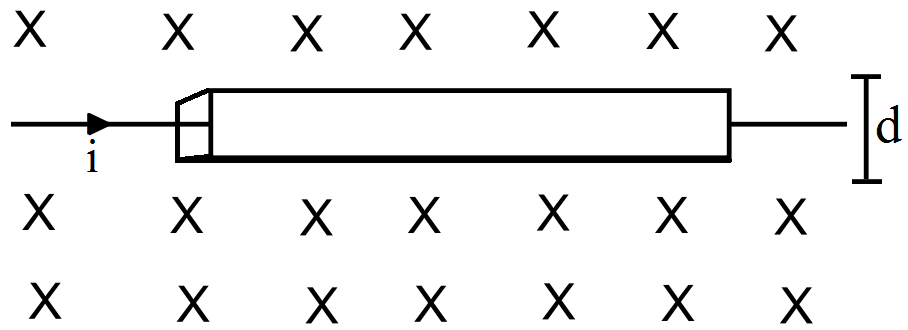
A current i is passed through a silver strip of width d and area of cross-section A. The number of free electrons per unit volume is n.
  1. Find the drift velocity v of the electrons.
  2. If a magnetic field B exists in the region, as shown in the figure, what is the average magnetic force on the free electrons?
  3. Due to the magnetic force, the free electrons get accumulated on one side of the conductor along its length. This produces a transverse electric field in the conductor, which opposes the magnetic force on the electrons. Find the magnitude of the electric field which will stop further accumulation of electrons.
  4. What will be the potential difference developed across the width of the conductor due to the electron-accumulation? The appearance of a transverse emf, when a current-carrying wire is placed in a magnetic field, is called Hall effect.
Answer

  1. $\text{i}=\text{V}_0\text{n}\text{Ae}$
$\Rightarrow\text{V}_0=\frac{\text{i}}{\text{nae}}$
  1. $\text{F}=\text{ilB}=\frac{\text{iB}}{\text{nA}}$ (upwards)
  2. Let the electric field be E
$\text{Ee}=\frac{\text{iB}}{\text{An}}\Rightarrow\text{E}=\frac{\text{iB}}{\text{Aen}}$
  1. $\frac{\text{dv}}{\text{dr}}=\text{E}\Rightarrow\text{dV}=\text{Edr}$
$=\text{E}\times\text{d}=\frac{\text{ib}}{\text{Aen}}\text{d}$
View full question & answer
Question 445 Marks
A circular loop carrying a current i is made of a wire of length L. A uniform magnetic field B exists parallel to the plane of the loop.
  1. Find the torque on the loop.
  2. If the same length of the wire is used to form a square loop, what would be the torque? Which is larger?
Answer
radius = r
Circumference $=\text{L}=2\pi\text{r}$
$\Rightarrow\text{r}=\frac{\text{L}}{2\pi}$
$\Rightarrow\pi\text{r}^2=\frac{\pi\text{L}^2}{4\pi^2}=\frac{\text{L}^2}{4\pi}$
Circumfernce = L
$4\text{S}=\text{L}$
$\Rightarrow\text{S}=\frac{\text{L}}{4}$
Area $=\text{S}^2=\Big(\frac{\text{L}}{4}\Big)^2=\frac{\text{L}^2}{16}$
$\tau=\text{i}\overrightarrow{\text{A}}\times\overrightarrow{\text{B}}=\frac{\text{iL}^2\text{B}}{16}$
View full question & answer
Question 455 Marks
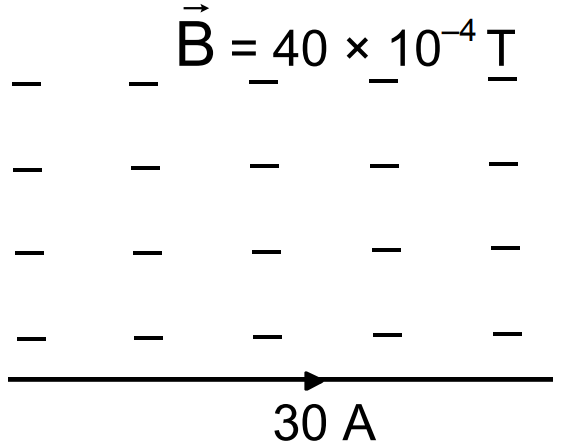
A long, straight wire carrying a current of 30A is placed in an external, uniform magnetic field of $4.0 \times 10^{-4}T$ parallel to the current. Find the magnitude of the resultant magnetic field at a point 2.0cm away from the wire.
Answer


$\mu_0=4\pi\times10^{-7}\text{T-m/A},$
$\text{I}=30\text{A},$
$\text{B}=4.0\times10^{-4}$ Parallel to current.
$\overrightarrow{\text{B}}$ due to wore at pt. 2cm.
$=\frac{\mu_0\text{I}}{2\pi\text{r}}=\frac{4\pi\times10^{-7}\times30}{2\pi\times0.02}=3\times10^{-4}\text{T}$
net field $\sqrt{(3\times10^{-4})^2+(4\times10^{-4})^2}=5\times10^{-4}\text{T}$
View full question & answer
Question 465 Marks
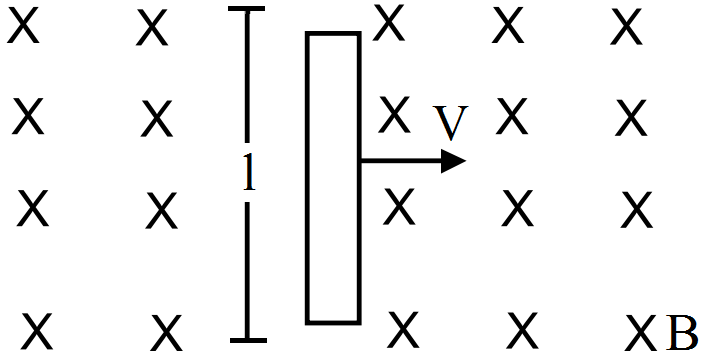
A conducting wire of length l, lying normal to a magnetic field B, moves with a velocity v, as shown in the figure.
  1. Find the average magnetic force on a free electron of the wire.
  2. Due to this magnetic force, electrons concentrate at one end, resulting in an electric field inside the wire. The redistribution stops when the electric force on the free electrons balances the magnetic force. Find the electric field developed inside the wire when the redistribution stops.
  3. What potential difference is developed between the ends of the wire?
Answer

Velocity of electron = v
Magnetic force on electron
F = evB
  1. F = qE ; F = evB
$\Rightarrow\text{qE}=\text{evB}$
$\Rightarrow\text{eE}=\text{evB}$
$\Rightarrow\overrightarrow{\text{E}}=\text{vB}$
  1. $\text{E}=\frac{\text{dV}}{\text{dr}}=\frac{\text{V}}{\text{l}}$
$\Rightarrow\text{V}=\text{lE}=\text{lvB}$
View full question & answer
Question 475 Marks
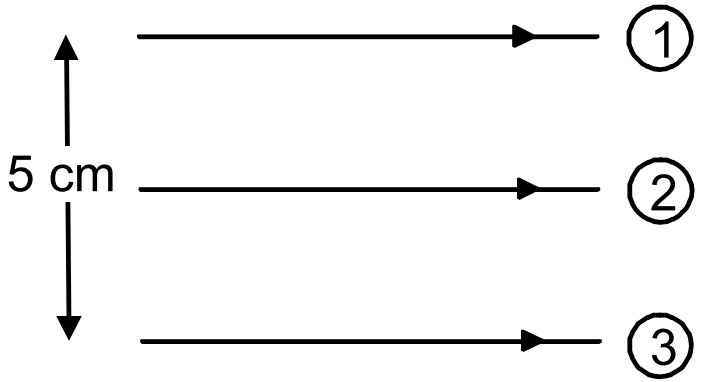
Three coplanar parallel wires, each carrying a current of 10A along the same direction, are placed with a separation 5.0cm between the consecutive ones. Find the matnitude ol the magnetic force per unit lenght acting on the wires.
Answer
i = 10A

Magnetic force due to two parallel Current Carrying wires.
$\text{F}=\frac{\mu_0\text{I}_1\text{I}_2}{2\pi\text{r}}$
So, $\overrightarrow{\text{F}}\ \text{or}\ 1=\overrightarrow{\text{F}}\ \text{or}\ 2+\overrightarrow{\text{F}}\ \text{by}\ 3$
$=\frac{\mu_0\times10\times10}{2\pi\times5\times10^{-2}}+\frac{\mu_0\times10\times10}{2\pi\times10\times10^{-2}}$
$=\frac{4\pi\times10^{-7}\times10\times10}{2\pi\times5\times10^{-2}}+=\frac{4\pi\times10^{-7}\times10\times10}{2\pi\times10\times10^{-2}}$
$=\frac{2\times10^{-3}}{5}+\frac{10^{-3}}{5}=\frac{3\times10^{-3}}{5}=6\times10^{-4}\text{N}$ towards middle wire
View full question & answer
Question 485 Marks
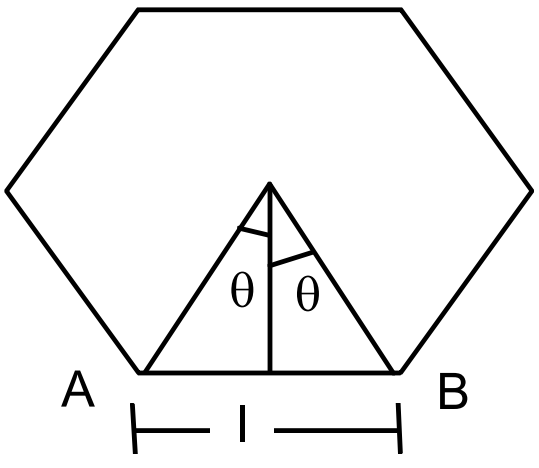
A regular polygon of n sides is formed by bending a wire of total length $27\pi\text{r}$ which carries a current i.
  1. Find the magnetic field B at the centre of the polygon.
  2. By letting $\text{n}\rightarrow\infty,$ deduce the expression for the magnetic field at the centre of a circular current.
Answer

$2\theta=\frac{2\pi}{\text{n}}\Rightarrow\theta=\frac{\pi}{\text{n}},$ $\ell=\frac{2\pi\text{r}}{\text{n}}$

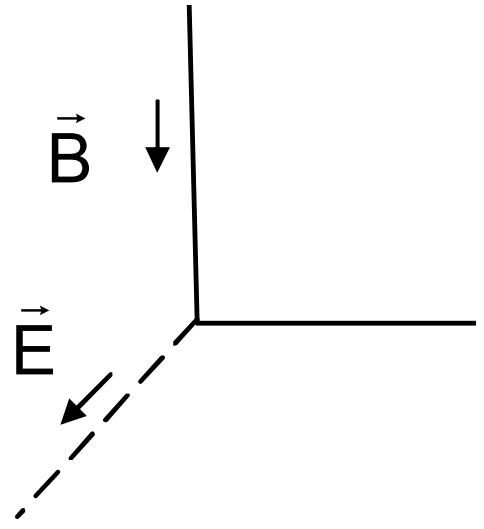
$\tan\theta=\frac{\ell}{2\text{x}}\Rightarrow\text{x}=\frac{\ell}{2\tan\theta}$
$\frac{\ell}{2}=\frac{\pi\text{r}}{\text{n}}$
$\text{B}_\text{AB}=\frac{\mu_0\text{i}}{4\pi(\text{X})}(\sin\theta+\sin\theta)=\frac{\mu_0\text{i}2\tan\theta\times2\sin\theta}{4\pi\ell}$
$=\frac{\mu_0\text{i}2\tan\Big(\frac{\pi}{\text{n}}\Big)2\sin\Big(\frac{\pi}{\text{n}}\Big)\text{n}}{4\pi2\pi\text{r}}=\frac{\mu_0\text{in}\tan\Big(\frac{\pi}{\text{n}}\Big)\sin\Big(\frac{\pi}{\text{n}}\Big)}{2\pi^\text{r}}$
For n sides, $\text{B}_\text{net}=\frac{\mu_0\text{i}2\tan\Big(\frac{\pi}{\text{n}}\Big)\sin\Big(\frac{\pi}{\text{n}}\Big)}{2\pi^2\text{r}}$
View full question & answer
Question 495 Marks
When a proton is released from rest in a room, it starts with an initial acceleration $a_0$​​​​​​​ towards west. When it is projected towards north with a speed $v_0$, it moves with an initial acceleration $3a_0$ towards west. Find the electric field and the maximum possible magnetic field in the room.
Answer
$\text{q}_\text{p}=\text{e},\ \text{mp}=\text{m},\ \text{F}=\text{q}_\text{p}\times\text{E}$
$\text{ma}_0=\text{eE}$
$\text{E}=\frac{\text{ma}_0}{\text{e}}$ towards west

The acceleration changes from $a_0$ to $3a_0$
Hence net acceleration produced by magnetic field $\overrightarrow{\text{B}}$ is $2a_0.$
Force due to magnetic field
$\overrightarrow{\text{F}}_\text{B}=\text{m}\times2\text{a}_0=\text{e}\times\text{V}_0\times\text{B}$
$\Rightarrow\text{B}=\frac{2\text{ma}_0}{\text{eV}_0}$ downwards
View full question & answer
Question 505 Marks
A particle of mass m and charge q is released from the origin in a region in which the electric field and magnetic field are given by
$\overrightarrow{\text{B}}=-\text{B}_0\overrightarrow{\text{j}}$ and $\overrightarrow{\text{E}}=\text{E}_0\overrightarrow{\text{k}}.$ Find the speed of the particle as a function of its z-coordinate.
Answer

Velocity will be along x - z plane
$\overrightarrow{\text{B}}-\text{B}_0\overrightarrow{\text{j}}$
$\overrightarrow{\text{E}}=\text{E}_0\hat{\text{k}}$
$\text{F}=\text{q}\big(\overrightarrow{\text{E}}+\overrightarrow{\text{V}}\times\overrightarrow{\text{B}}\big)$
$=\text{q}\Big[\text{E}_0\hat{\text{k}}+(\text{u}_\text{x}\hat{\text{i}}+\text{u}_\text{x}\hat{\text{k}})(-\text{B}_0\hat{\text{j}})\Big]$
$=(\text{qE}_0)\hat{\text{k}}-(\text{u}_\text{x}\text{B}_0)\hat{\text{k}}+(\text{u}_\text{z}\text{B}_0)\hat{\text{i}}$
$\text{F}_\text{z}=(\text{qE}_0-\text{u}_\text{x}\text{B}_0)$
since $\text{u}_\text{x}=0,\ \text{F}_\text{z}=\text{qE}_0$
$\Rightarrow\text{a}+\text{z}=\frac{\text{qE}_0}{\text{m}}$
So, $\text{v}^2=\text{u}^2+2$
as, $\Rightarrow\text{v}^2=2\frac{\text{qE}}{\text{m}}\text{Z}$ [distance along Z direction be z]
$\Rightarrow\text{V}\sqrt{\frac{2\text{qE}_0\text{Z}}{\text{m}}}$
View full question & answer
5 Marks Questions - Physics STD 12 Science Questions - Vidyadip