Question
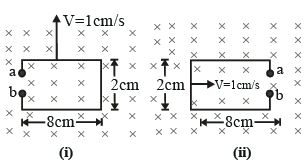
A rectangular conducting loop of sides $8\, cm$ and $2\, cm$ with a small cut is moving out a region of uniform magnetic field of magnitude $0.3\, T$ directed normal to the loop as shown in fig $(i)$ and $(ii)$. If the velocity of loop is $1\,cm\, s^{-1}$, then the ratio of voltage developed across ab in case $(i)$ to case $(ii)$ is......$V$
Answer

In case $(i)$ $V_{1}=B \ell v \quad(\ell=8 \mathrm{\,cm})$

In case $(iii)$ $\mathrm{V}_{2}=\mathrm{B}$ $. bv$ $\quad(\mathrm{b}=2 \mathrm{\,cm})$

$\therefore \frac{\mathrm{V}_{1}}{\mathrm{V}_{2}}=\frac{\mathrm{B} \ell \mathrm{v}}{\mathrm{Bbv}}=\frac{\ell}{\mathrm{b}}=\frac{8}{2}=4$

Need a full question paper?

Generate a complete, print-ready paper with questions like this in minutes — across 16+ boards, with answer keys.

Start Generating Free

Similar questions

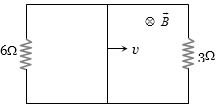
A rectangular loop with a sliding connector of length $l = 1.0 \,m$ is situated in a uniform magnetic field $B = 2\,T$ perpendicular to the plane of loop. Resistance of connector is $r = 2$ $\Omega$ Two resistance of $6$ $\Omega$ and $3$ $\Omega$ are connected as shown in figure. The external force required to keep the connector moving with a constant velocity $v = 2\,m/s$ is........$N$
Benzaldehyde reacts with ammonia to form
A current of $1\,A$ is flowing on the sides of an equilateral triangle of side $4.5\times10^{-2}\,m$ . The magnetic field at the centre of the triangle will be
Let $F_1$ be the frequency of second line of Lyman series and $F_2$ be the frequency of first line of Balmer series then frequency of first line of Lyman series is given by
The kinetic energy of an electron, $\alpha$-particle and a proton are given as $4K,2K$ and $K$ respectively. The de-Broglie wavelength associated with electron ( $\lambda e), \alpha$-particle $(\lambda \alpha)$ and the proton $(\lambda p)$ are as follows:
Two charges each of magnitude $0.01\,C$ and separated by a distance of $0.4\,mm$ constitute an electric dipole. If the dipole is placed in an uniform electric field ' $\vec{E}$ ' of $10\,dyne/C$ making $30^{\circ}$ angle with $\overrightarrow{ E }$, the magnitude of torque acting on dipole is :
Wave has simple harmonic motion whose period is $4\; sec$ while another wave which also possesses simple harmonic motion has its period $3\; sec$. If both are combined, then the resultant wave will have the period equal to ....... $sec$
Electromagnetic wave consists of periodically oscillating electric and magnetic vectors
The electric intensity $E$, current density $j$ and specific resistance $k$ are related to each other by the relation
A man walks on a straight road from his home to a market $2.5 \,km$ away with a speed of $5\, \,km/h$. Finding the market closed, he instantly turns and walks back home with a speed of $7.5 \,km/h$. The average speed of the man over the interval of time $0$ to $40 \,min$. is equal to