Question
A rectangular current carrying loop is placed $1\ cm$ away from a long straight current$-$carrying conductor as shown.
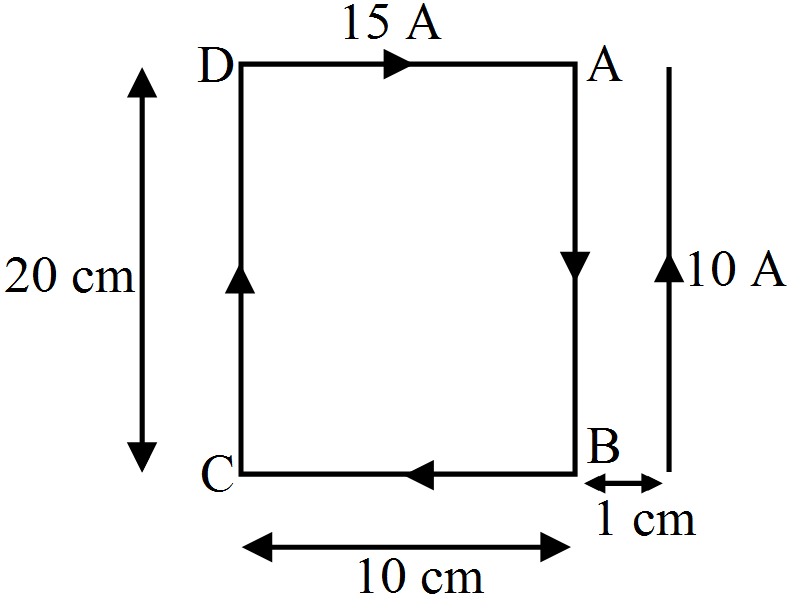
  1. Will the net force acting on the loop due to straight conductor be attractive or repulsive in nature? Justify your answer. Calculate the magnitude of this force.
Answer

The net force acting on the loop will be repulsive in nature.Justification:
Part $AB$ of the loop will experience a force of repulsion whereas part $CD$ will experience attraction. Parts $BC$ and $AD$ will not experience any force. Thus, the overall force will be a force of repulsion because $AB$ is closer to the straight conductor than $CD$ and the force between two current carrying conductors is inversely proportional to the distance between them.
$\text{F}=\frac{\mu_0}{2\pi}\frac{\text{I}_1\text{I}_2}{\text{r}}\text{l}$
Net Force
Force $F_1$ on $AB$ due to current in the straight conductor.
$\text{F}_1=\frac{\mu_0}{2\pi}\times\frac{2\times10\times15}{1\times10^{-2}}\times20\times10^{-2}$
$= 3 \times 10^{-4}N $towards left $\Big(\frac{\mu_0}{2\pi}=10^{-7}\Big)$
Force $F_2$ on $CD$ due to current in thw straight conductor.
$\text{F}_2=\frac{\mu_0}{2\pi}\times\frac{2\times10\times15}{11\times10^{-2}}\times20\times10^{-2}$
$= 0.2725 \times 10^{-4}N$ towards right.
Hence, net force on the loop $= 2.72N$ towards left.

Need a full question paper?

Generate a complete, print-ready paper with questions like this in minutes — across 16+ boards, with answer keys.

Start Generating Free

Similar questions

(i) Which mode of propagation is used by short wave broadcast services having frequency range from a few MHz to 30 MHz? Explain diagrammatically how long distance communication can be achieved by this mode.
(ii) Why is there an upper limit to frequency of waves used in this mode ?
The uniform surface charge density of a thin spherical shell of radius $R$ is $\sigma$. Calculate the intensity of the electric field due it, in the following circumstances : $\square$(i) Elecric field outside the shell(ii) Electric field inside the shell.
Figure shows two identical parallel plate capacitors connected to a battery through a switch S. Initially, the switch is closed so that the capacitors are completely charged. The switch is now opened and the free space between the plates of the capacitors is filled with a dielectric of dielectric constant 3. Find the ratio of the initial total energy stored in the capacitors to the final total energy stored.
An aluminium vessel of mass $0.5\ kg$ contains $0.2\ kg$ of water at $20^\circ C$. A block of iron of mass $0.2\ kg$ at $100^\circ C$ is gently put into the water. Find the equilibrium temperature of the mixture. Specific heat capacities of aluminium, iron and water are $910\ J\ kg^{-1}-K^{-1}, 470\ J\ kg^{-1}-K^{-1}$ and $4200\ J\ kg^{-1}-K^{-1}$ respectively.
A $6$ volt battery of negligible internal resistance is connected across a uniform wire $AB$ of length $100\ cm.$ The positive terminal of another battery of emf $4V$ and internal resistance $1\Omega$ is joined to the point $A,$ as shown in the figure. Take the potential at $B$ to be zero.$ (a)$ What are the potentials at the points $A$ and $C$ ? $(b) $ At which point $D$ of the wire $AB,$ the potential is equal to the potential at $C$ ? $ (c)$ If the points $C$ and $D$ are connected by a wire, what will be the current through it? $(d)$ If the $4V$ battery is replaced by a $7.5V $ battery, what would be the answers of parts $(a)$ and $(b)$?
The radius of a gold nucleus $(Z = 79)$  is about $7.0 \times 10^{-15}m$. Assume that the positive charge is distributed uniformly throughout the nuclear volume. Find the strength of the electric field at:
  1. The surface of the nucleus.
  2. At the middle point of a radius. Remembering that gold is a conductor, is it justified to assume that the positive charge is uniformly distributed over the entire volume of the nucleus and does not come to the outer surface
Obtain the relation for equivalence in series combination of capacitors. Make a circuit diagram.
The figure shows an adiabatic cylindrical tube of volume $V_0$ divided in two parts by a frictionless adiabatic separator. Initially, the separator is kept in the middle, an ideal gas at pressure $p_1$ and temperature $T_1$ is injected into the left part and another ideal gas at pressure $p_2$ and temperature $T_2$ is injected into the right part. $\frac{\text{C}_\text{P}}{\text{C}_\text{V}}=\gamma$ is the same for both the gases. The separator is slid slowly and is released at a position where it can stay in equilibrium. Find,
  1. The volumes of the two parts.
  2. The heat given to the gas in the left part.
  3. The final common pressure of the gases.
A long, straight wire carries a current i. Let $B_1,$ be the magnetic field at a point Pat a distance d from the wire. Consider a section of length l of this wire such that the point $P$ lies on a perpendicular bisector of the section. Let $B_2$ be the magnetic field at this point due to this section only. Find the value of $\frac{\text{d}}{\text{l}}$ so that $B_2$ differs from $B_1,$ by $1\%.$
With the help of circuit diagram, explain the working of junction diode as a full wave rectifier. Draw its input and output waveforms. Which characteristic property of junction diode makes it suitable for rectification?