Question
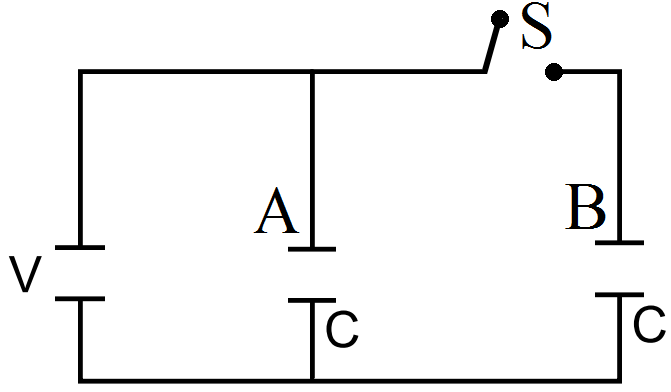
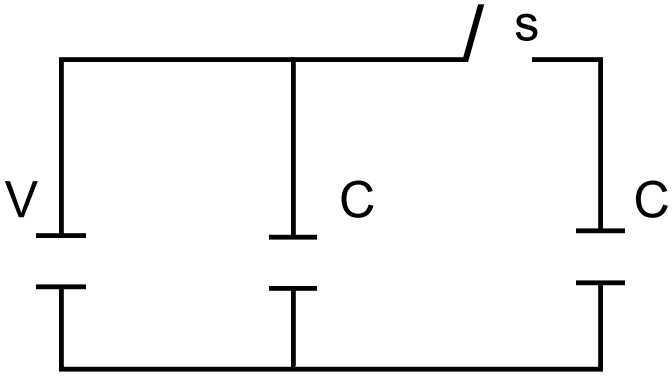
Figure shows two identical parallel plate capacitors connected to a battery through a switch S. Initially, the switch is closed so that the capacitors are completely charged. The switch is now opened and the free space between the plates of the capacitors is filled with a dielectric of dielectric constant 3. Find the ratio of the initial total energy stored in the capacitors to the final total energy stored.
Answer


Initially when switch ‘s’ is closed
Total Initial Energy $=\Big(\frac{1}{2}\Big)\text{CV}^2+\Big(\frac{1}{2}\Big)\text{CV}^2=\text{CV}^2\ \dots(1)$
When switch is open the capacitance in each of capacitors varies, hence the energy also varies.
i.e. in case of ‘B’, the charge remains.
Same i.e. cv
$\text{C}_{\text{eff}}=3\text{C}$
$\text{E}=\frac{1}{2}\times\frac{\text{q}^2}{\text{c}}$
$=\frac{1}{2}\times\frac{\text{c}^2\text{v}^2}{3\text{c}}=\frac{\text{cv}^2}{6}$
In case of 'A'
$\text{C}_{\text{eff}}=3\text{c}$
$\text{E}=\frac{1}{2}\times\text{C}_{\text{eff}}\text{v}^2$
$=\frac{1}{2}\times\text{3c}\times\text{v}^2=\frac{3}{2}\text{cv}^2$
Total final energy $=\frac{\text{cv}^2}{6}+\frac{3\text{cv}^2}{2}=\frac{10\text{cv}^2}{6}$
Now, $\frac{\text{Initial Energy}}{\text{Final Energy}}=\frac{\text{cv}^2}{\frac{10\text{cv}^2}{6}}=3$

Need a full question paper?

Generate a complete, print-ready paper with questions like this in minutes — across 16+ boards, with answer keys.

Start Generating Free

Similar questions

Two particles A and B, each carrying a charge Q, are held fixed with a separation d between them. A particle C having mass m and charge q is kept at the middle point of the line AB.
  1. If it is displaced through a distance x perpendicular to AB, what would be the electric force experienced by it.
  2. Assuming x << d, show that this force is proportional to x.
  3. Under what conditions will the particle C execute simple harmonic motion if it is released after such a small displacement?
Find the time period of the oscillations if these conditions are satisfied.
An eye can distinguish between two points of an object if they are separated by more than $0.22\ mm$ when the object is placed at $25\ cm$ from the eye. The object is now seen by a compound microscope having a $20D$ objective and $10D$ eyepiece separated by a distance of $20\ cm$. The final image is formed at $25\ cm$ from the eye. What is the minimum separation between two points of the object which can now be distinguished?
Shows a convex lens of focal length $12\ cm$ lying in a uniform magnetic field $B$ of magnitude $1.2T$ parallel to its principal axis. A particle with charge $2.0 \times 10^{-3}C$ and mass $2.0 \times 10^{-5} kg$ is projected perpendicular to the plane of the diagram with a speed of $4.8\ ms^{-1}.$ The particle moves along a circle with its centre on the principal axis at a distance of $18\ cm$ from the lens. Show that the image of the particle moves along a circle and find the radius of that circle.
Explain the vector form of Coulomb's law and write its important facts.
In a Young's double slit interference experiment the fringe pattern is observed on a screen placed at a distance D from the slits. The slits are separated by a distance d and are illuminated by monochromatic light of wavelength $\lambda$. Find the distance from the central point where the intensity falls to,
  1. Half the maximum.
  2. One fourth of the maximum.
A wire of resistance $15.0\Omega$ is bent to form a regular hexagon ABCDEFA. Find the equivalent resistance of the loop between the points (a) A and B (b) A and C and (c) A and D.
What is interference of light? Find an expression for fringe width in 'Young's double slit experiment.
$a.$ Use Huygen's geometrical construction to show how a plane wavefront at $t = 0$ propagates and produces a wavefront at a later time.
$b.$ Verify, using Huygen's principle, Snell's law of refraction of a plane wave propagating from a denser to a rarer medium.
$c.$ Illustrate with the help of diagrams the action of
$i.$ convex lens and
$ii.$ concave mirror, on a plane wavefront incident on it.
A professor reads a greeting card received on his 50th birthday with +2.5D glasses keeping the card 25cm away. Ten years later, he reads his farewell letter with the same glasses but he has to keep the letter 50cm away. What power of lens should he now use?
Consider a metal exposed to light of wavelength $600\ nm.$ The maximum energy of the electron doubles when light of wavelength $400\ nm$ is used. Find the work function in $eV.$