Question
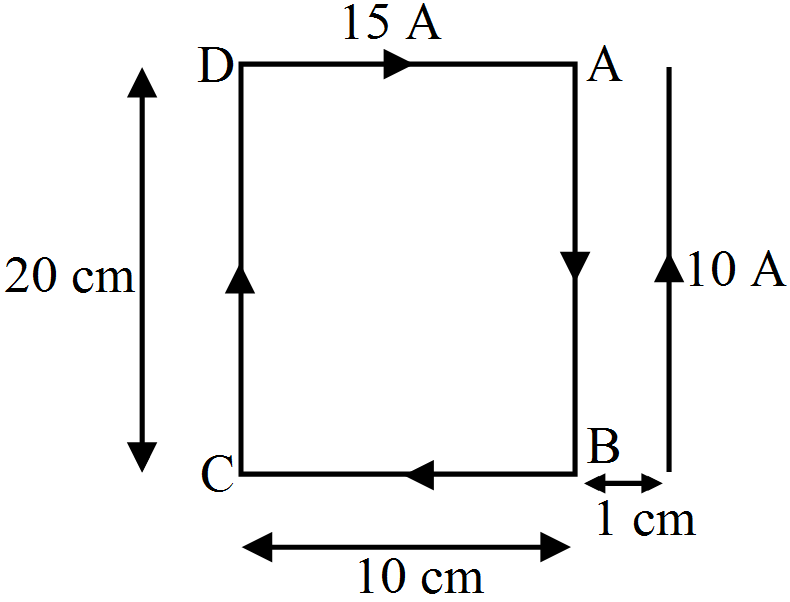
A rectangular current carrying loop is placed 1cm away from a long straight current-carrying conductor as shown.

  1. Will the net force acting on the loop due to straight conductor be attractive or repulsive in nature? Justify your answer. Calculate the magnitude of this force.

Answer

The net force acting on the loop will be repulsive in nature.

Justification:

Part AB of the loop will experience a force of repulsion whereas part CD will experience attraction. Parts BC and AD will not experience any force. Thus, the overall force will be a force of repulsion because AB is closer to the straight conductor than CD and the force between two current carrying conductors is inversely proportional to the distance between them.

$\text{F}=\frac{\mu_0}{2\pi}\frac{\text{I}_1\text{I}_2}{\text{r}}\text{l}$

Net Force

Force F1 on AB due to current in the straight conductor.

$\text{F}_1=\frac{\mu_0}{2\pi}\times\frac{2\times10\times15}{1\times10^{-2}}\times20\times10^{-2}$

= 3 × 10-4N towards left $\Big(\frac{\mu_0}{2\pi}=10^{-7}\Big)$

Force F2 on CD due to current in thw straight conductor.

$\text{F}_2=\frac{\mu_0}{2\pi}\times\frac{2\times10\times15}{11\times10^{-2}}\times20\times10^{-2}$

= 0.2725 ×10-4N towards right.

Hence, net force on the loop = 2.72N towards left.
Need a full question paper?

Generate a complete, print-ready paper with questions like this in minutes — across 16+ boards, with answer keys.

Start Generating Free

Similar questions

Establish an expression for induced electromotive force due to rotational motion of a conducting rod in a uniform magnetic field.
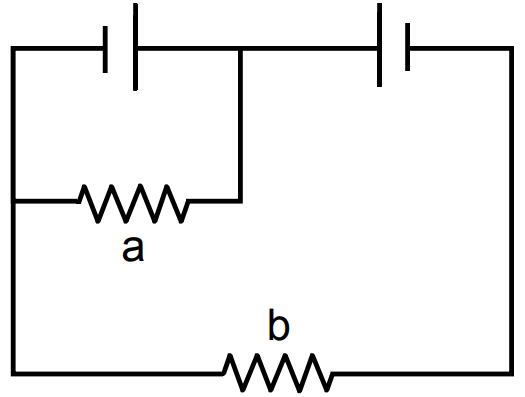
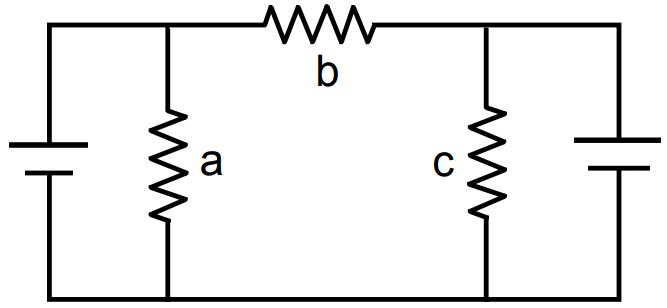
Each of the resistors shown in figure. has a resistance of $10\Omega$ and each of the batteries has an emf of 10V. Find the currents through the resistors a and b in the two circuits.


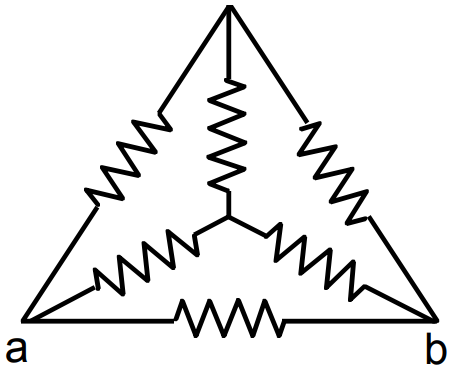
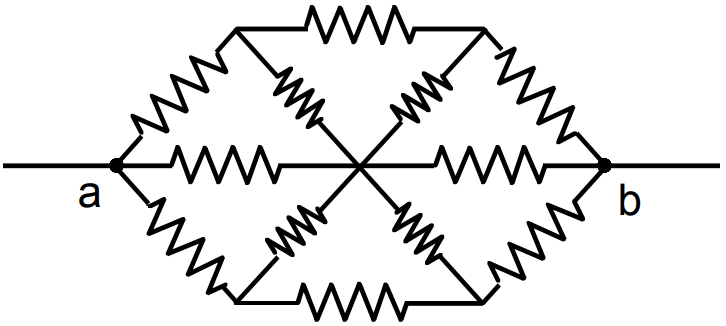
Find the equivalent resistance of the circuits shown in the figure. between the points a and b. Each resistor has resistance r.


Find the change in the internal energy of 2kg of water as it is heated from 0°C to 4°C. The specific heat capacity of water is 4200Jkg-1 K-1 and its densities at 0°C and 4°C are 999.9kgm-3 and 1000kgm-3 respectively. Atmospheric pressure = 10-6Pa.
Consider a straight piece of length x of a wire carrying a current i. Let P be a point on the perpendicular bisector of the piece, situated at a distance d from its middle point. Show that for d >> x, the magnetic field at P varies as $\frac{1}{\text{d}^2}$ whereas ford d << x, it varies as $\frac{1}{\text{d}}.$
Do permeability and relative permeability have the same dimensions?
i. A Why does the electric field inside a dielectric slab decrease when kept in an external electric field?
B. Derive an expression for the capacitance of a parallel plate capacitor filled with a medium of dielectric constant K.
ii. A charge $q =2 \mu C$ is placed at the centre of a sphere of radius 20 cm . What is the amount of work done in moving $4 \mu C$ from one point to another point on its surface?
iii. Write a relation for polarisation $\overrightarrow{ P }$ of a dielectric material in the presence of an external electric field.
The conductivity of an intrinsic samiconductor depends on temperature as $\sigma=\sigma_0\text{ e}^{\frac{-\Delta\text{E}}{2\text{kT}}}$ where $\sigma_0$ is a constant. Find the temperature at which the conductivity pf an intrinsic germanium semiconductor will be double of its value at T = 300K. Assume that the gap for germanium is 0.650eV and remains constant as the temperature is increased.
If neutrons exert only attractive force, why don't we have a nucleus containing neutrons alone?
A paperweight in the form of a hemisphere of radius 3.0cm is used to hold down a printed page. An observer looks at the page vertically through the paperweight. At what height above the page will the printed letters near the centre appear to the observer?