Question
A rectangular field is $50m$ by $40m$. It has two roads through its centre, running parallel to its sides. The widths of the longer and shorter roads are $1.8m$ and $2.5m$ respectively. Find the area of the roads and the area of the remaining portion of the field.
Answer


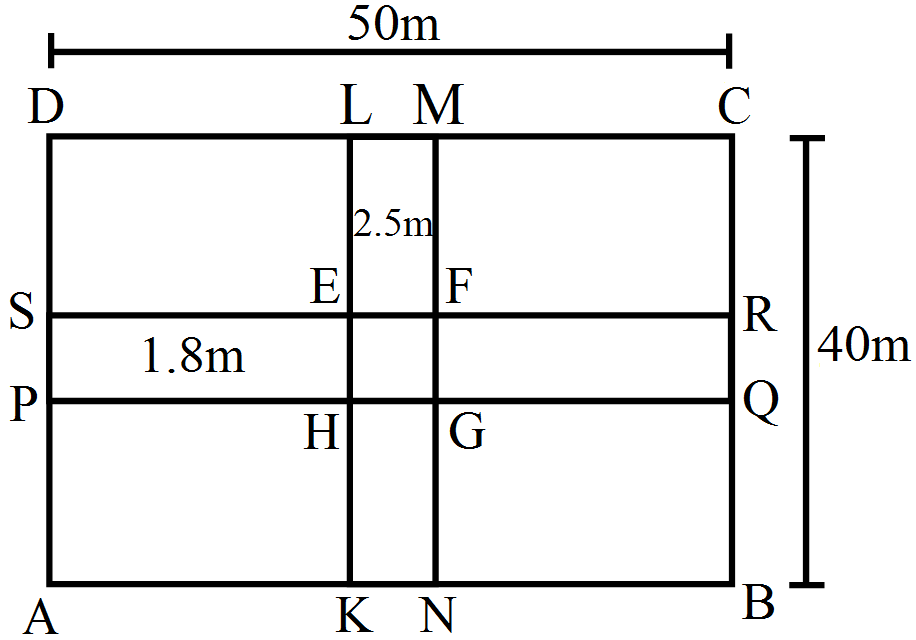
Let $A B C D$ be the rectangular field and $KLMN$ and $PQRS$ the two rectangular roads with width $1.8 m$ and $2.5 m$ , respectively.
Length of the rectangular field $C D=50 cm$ and breadth of the rectangular field $B C=40 m$
Area of the rectangular field $A B C D=50 m \times 40 m=2000 m^2$
Area of the road $KLMN =40 m \times 2.5 m=100 m^2$
Area of the road $P Q R S=50 m \times 1.8 m=90 m^2$
Clearly area of EFGH is common to the two roads.
Thus, Area of $EFGH =2.5 m \times 1.8 m=4.5 m^2$
Hence, Area of the roads $=$ Area $($ KLMN $)+$ Area(PQRS) - Area(EFGH)
$=\left(100 m^2+90 m^2\right)-4.5 m^2$
$=185.5 m^2$
Area of the remaining portion of the field $=$ Area of the rectangular field $A B C D-$ Area of the roads
$=(2000-185.5) m^2$
$=1814.5 m^2$
 

Need a full question paper?

Generate a complete, print-ready paper with questions like this in minutes — across 16+ boards, with answer keys.

Start Generating Free

Similar questions

$AC, AD$ and $AE$ are joined. Find. $\angle \text{FAB}+\angle \text{ABC}+\angle \text{BCD}+\angle \text{CDE} +\angle \text{DEF}+\angle \text{EFA}$
Divide the sum of $\frac{65}{12}$ and $\frac{8}{3}$ by their difference.
The following table shows the weights of 12 persons.
Weight (in kg):4850525458
Number of persons:43221
Find the median and mean weights. Using empirical relation, calculate its mode.
Earth Science: The table lists the world’s $10$ largest deserts.
Largest Deserts in the World  
Desert Area $(km^2)$
Sahara $($Africa$)$ $8,800,000$
Gobi $($Asia$)$ $1,300,000$
Australian Desert $($Australia$)$ $1,250,000$
Arabian Desert $($Asia$)$ $850,000$
Kalahari Desert $($Africa$)$ $580,000$
Chihuahuan Desert $($North America$)$ $370,000$
Takla Makan Desert $($Asia$)$ $320,000$
Kara Kum $($Asia$)$ $310,000$
Namib Desert $($Africa$)$ $310,000$
Thar Desert $($Asia$)$ $260,000$
$a.$ What are the mean, median and mode of the areas listed?
$b.$ How many times the size of the Gobi Desert is the Namib Desert?
$c.$ What percentage of the deserts listed are in Asia?
$d.$ What percentage of the total area of the deserts listed is in Asia?
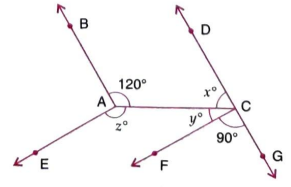
In Fig.$A B \| C D$ and $A E \| C F ; \angle F C G=90^{\circ}$ and $\angle B A C=120^{\circ}$. Find the values of $x, y$ and $z$.
Image
Find the missing value of p for the following distribution whose mean is $12.58$
x:
$5$ $8$
$10$
$12$
$p$ $20$ $25$
f:
$2$
$5$
$8$
$22$ $7$ $4$ $2$
A wire is (7x - 3) m long. A length of (3x - 4) m is cut for use. Now, answer the following questions.
(i) How much wire is left?
(ii) If this left out wire is used for making an equilateral triangle, then what is the length of each side of the triangle so formed?
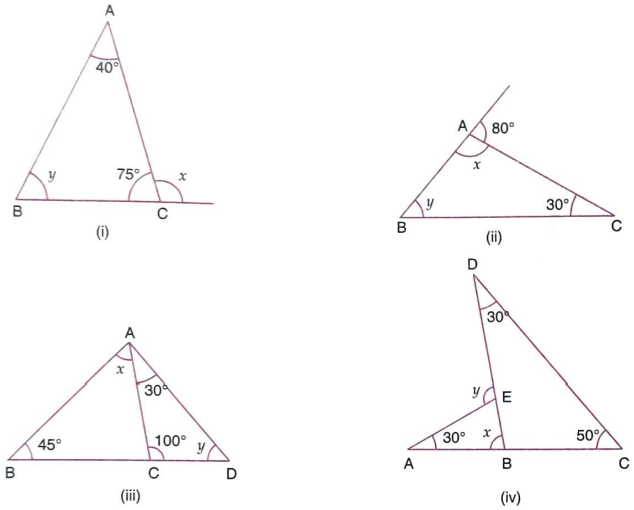
Explain the concept of interior and exterior angles and in each of the figures given below, find $x$ and $y$ (Fig.).
Image
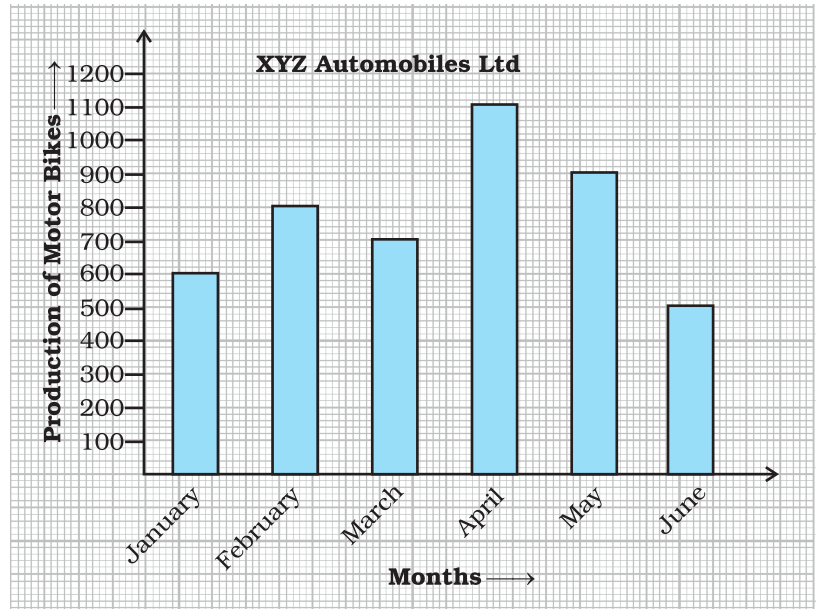
Observe the given bar graph carefully and answer the questions that follow.

$a.$ What information does the bar graph depict?
$b.$ How many motor bikes were produced in the first three months?
$c.$ Calculate the increase in production in May over the production in January.
$d.$ In which month the production was minimum and what was it?
$e.$ Calculate the average $($mean$)$ production of bikes in $6$ months.
Arrange the following rational numbers in descending order: $\frac{-2}{5},\frac{7}{-10},\frac{-11}{15},\frac{19}{-30}$