Question
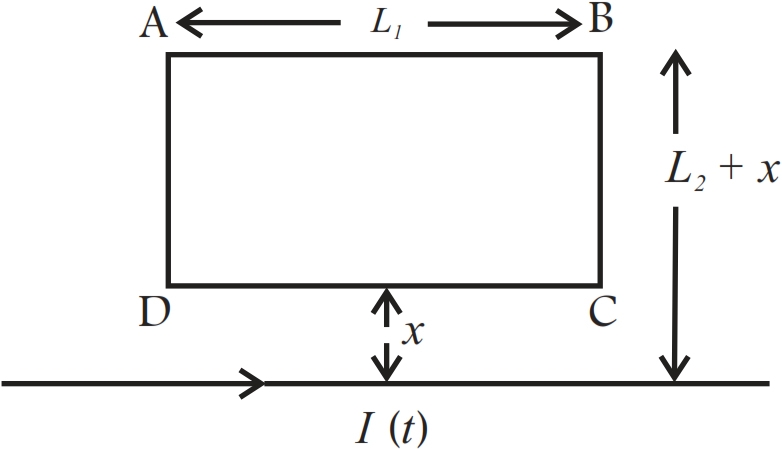
A rectangular loop of wire ABCD is kept close to an infinitely long wire carrying a current $\text{I}(\text{t})=\text{I}_0\Big(1-\frac{\text{t}}{\text{T}}\Big)$ for 0 and I(0) = 0 for t > T (Fig). Find the total charge passing through a given point in the loop, in time T. The resistance of the loop is R.
Answer

To find the charge that passes through the circuit first we have to find the relation between instantaneous current and instantaneous magnetic flux linked with it. The emf induced can be obtained by differentiating the expression of magnetic flux linked w.r.t. t and then applying Ohm's law, we get
$\text{I}=\frac{\text{E}}{\text{R}}=\frac{1}{\text{R}}\frac{\text{d}\phi}{\text{dt}}$
According to the problem electric current is given as a function of time.
$\text{I(t)}=\frac{\text{dQ}}{\text{dt}}\text{ or }\frac{\text{dQ}}{\text{dt}}=\frac{1}{\text{R}}\frac{\text{d}\phi}{\text{dt}}$
Integrating the variable separately in the form of differential equation for finding the charge Q that passed in time t, we have
$\text{Q}(\text{t}_1)=\text{Q}(\text{t}_2)=\frac{1}{\text{R}}\big[\phi(\text{t}_1)-\phi(\text{t}_2)\big]$
$\phi(\text{t}_1)\text{L}_1\frac{\mu_0}{2\pi}\int_\text{x}^{\text{L}_2+\text{x}}\frac{\text{dx}'}{\text{x}'}\text{I}(\text{t}_1)$ [Refer to the Eq. (i) of answer no. 25]
$=\frac{\mu_0\text{L}_1}{2\pi}\text{I}(\text{t}_1)\text{in}\frac{\text{L}_2+\text{x}}{\text{x}}$
Therefore the magnitude of charge is
$\text{Q}=\frac{1}{\text{R}}[\phi(\text{T})-\phi(0)]$
$\text{Q}=\frac{\mu_0\text{L}_1}{2\pi}\text{ in }\frac{\text{L}_2+\text{x}}{\text{x}}[\text{I}(\text{T})-\text{I}(0)]$
Now I(T) = 0 and I(0) = 1.
$\therefore\ \text{Q}=\frac{\mu_0\text{L}_1}{2\pi}\text{I}_0\text{ in }\bigg(\frac{\text{L}_2+\text{x}}{\text{x}}\bigg)$
This is the required expression.

Need a full question paper?

Generate a complete, print-ready paper with questions like this in minutes — across 16+ boards, with answer keys.

Start Generating Free

Similar questions

An ammeter is to be constructed that can read currents up to 2.0A. If the coil has resistance of $25\Omega$ and takes 1mA for full-scale deflection, what should be the resistance of the shunt used?
Find the speed at which the kinetic enei:gy of a particle will differ by 1% from its nonrelativistic value $\frac{1}{2}\text{m}_0\text{v}^2$
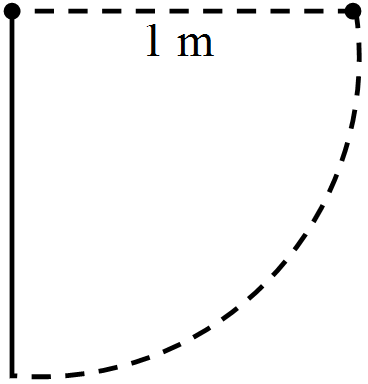
A metre stick weighing 240g is pivoted at its upper end in such a way that it can freely rotate in a vertical plane through this end (figure). A particle of mass 100g is attached to the upper end of the stick through a light string of length 1m. Initially, the rod is kept vertical and the string horizontal when the system is released from rest. The particle collides with the lower end of the stick and sticks there. Find the maximum angle through which the stick will rise.
A uniform disc of radius R is put over another uniform disc of radius 2R of the same thickness and density. The peripheries of the two discs touch each other. Locate the centre of mass of the system.
The plates of a capacitor are 2.00cm apart. An electronproton pair is released somewhere in the gap between the plates and it is found that the proton reaches the negative plate at the same time as the electron reaches the positive plate. At what distance from the negative plate was the pair released?
Using Huygens' principle, draw a diagram to show propagation of a wavefront originating from a monochromatic point source. Explain briefly.
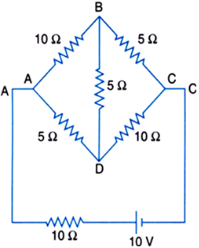
Determine the current in each branch of the network shown in Fig.:
  1. Draw the circuit diagrams of a $p-n$ junction diode in $(i)$ forward bias$, (ii)$ reverse bias. How are these circuits used to study the $V - I$ characteristics of a silicon diode? Draw the typical $V - I$ characteristics.
  2. What is a light emitting diode $\text{(LED)}$? Mention two important advantages of $\text{LEDs}$ over conventional lamps.
If the nucleons of a nucleus are separated from each other, the total mass is increased. Where does this mass come from?
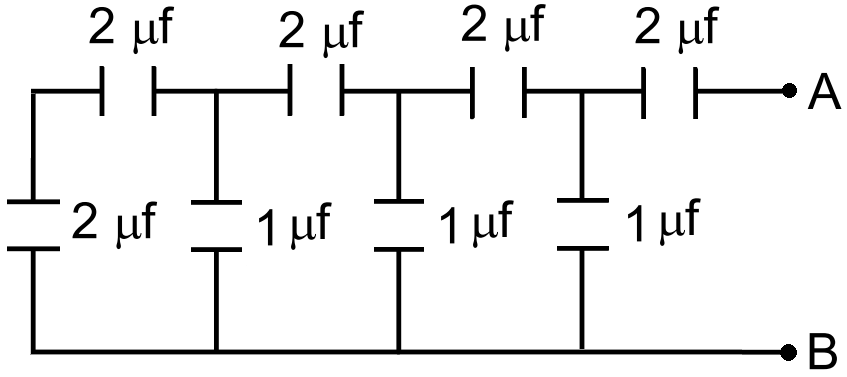
Find the capacitance of the combination shown in figure between $A$ and $B.$