MCQ
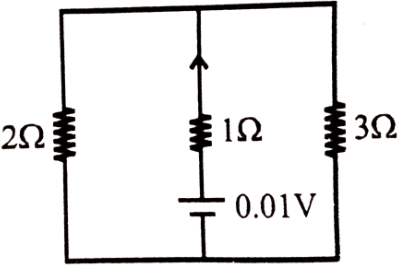
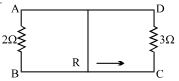
$A$ rectangular loop with a sliding connector of length $10\, cm$ is situated in uniform magnetic field perpendicular to plane of loop. The magnetic induction is $0.1$ tesla and resistance of connector $(R)$ is $1\, ohm$. The sides $AB$ and $CD$ have resistances $2$ $ohm$ and $3$ $ohm$ respectively. Find the current in the connector during its motion with constant velocity one $metre/sec.$
  • A
    $\frac{1}{{110}} A$
  • $\frac{1}{{220}} A$
  • C
    $\frac{1}{{55}} A$
  • D
    $\frac{1}{{440}} A$

Answer

Correct option: B.
$\frac{1}{{220}} A$
b
$e=B l v=0.1 \times 0.1 \times 1$

$e=0.01$ volt

$I=\frac{0.01}{1+\frac{6}{5}}=\frac{0.01}{2.2}=\frac{1}{220} A m p$

Need a full question paper?

Generate a complete, print-ready paper with questions like this in minutes — across 16+ boards, with answer keys.

Start Generating Free

Similar questions

The number of waves contained in unit length of the medium is called
Which of the following conclusion can be drawn from the result

$\oint {\vec B} .d\vec A\, = \,0$

A particle of mass $m$ and charge $q$ enters a magnetic field $B$ perpendicularly with a velocity $v$, The radius of the circular path described by it will be
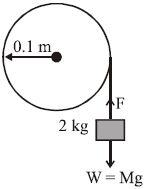
The moment of inertia of a solid flywheel about its axis is $0.1\,kg-m^2$. A tangential force of $2\,kg\,wt$. is applied round the circumference of the flyweel with the help of a string and mass arrangement as shown in the figure. If the radius of the wheel is $0.1\,m,$ find the angular acceleration of the solid fly wheel (in $rad/sec^2$)
Young's double slit experiment is performed with monochromatic light. A thin film is introduced in front of one of the slits
Which of the following colours suffers maximum deviation in a prism
An object of mass $0.2\, kg$ executes simple harmonic along $X-$ axis with frequency of $\frac{{25}}{\pi }Hz$. At the position $x = 0.04m$, the object has kinetic energy of $0.5 \,J$ and potential energy of $0.4\, J$ amplitude of oscillation in meter is equal to
Following statements are given for a stationary wave

$(a)$ Every particle has a fixed amplitude which is different from the amplitude of its nearest particle.

$(b)$ All the particles cross their mean position at the same time.

$(c)$ All the particles are oscillating with same amplitude.

$(d)$ There is no net transfer of energy across any plane.

$(e)$ There are some particles which are always at rest.

Which of the following is correct

If $y$ represents pressure and $x$ represents velocity gradient, then the dimensions of $\frac{d^2 y}{d x^2}$ are
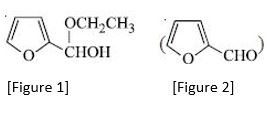
Compound $[Figure\,1]$formed by the reaction of furfural $[Figure\,2]$ with ethanol is