The number of waves contained in unit length of the medium is called
AIIMS 1998, Easy


Download our appand get started for free
Experience the future of education. Simply download our apps or reach out to us for more information. Let's shape the future of learning together!No signup needed.*
Similar Questions
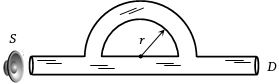
- 1A sound wave of wavelength $32 cm$ enters the tube at $S$ as shown in the figure. Then the smallest radius $r$ so that a minimum of sound is heard at detector $D$ is ... $cm$View Solution
- 2The ratio of intensities between two coherent sound sources is $4: 1$. The difference of loudness in dB between maximum and minimum intensities when they interfere in the space is ..........View Solution
- 3$Assertion :$ A transverse waves are produced in a very long string fixed at one end. Only progressive wave is observed near the free end.View Solution
$Reason :$ Energy of reflected wave does not reach the free end. - 4Two cars $A$ and $B$ are moving away from each other in opposite directions. Both the cars are moving with a speed of $20\, ms^{-1}$ with respect to the ground. If an observer in car $A$ detects a frequency $2000\, Hz$ of the sound coming from car $B$, what is the natural frequency of the sound source of car $B$ .... $Hz$ ? (speed of sound in air $= 340\, ms^{-1}$)View Solution
- 5In a wave motion $y = a\sin (kx - \omega t)$, $y$ can representView Solution
- 6The intensity ratio of two waves is $1 : 16$. The ratio of their amplitudes isView Solution
- 7When an engine passes near to a stationary observer then its apparent frequencies occurs in the ratio $5/3$. If the velocity sound is $340 m/s$, than the velocity of engine is .... $m/s$View Solution
- 8An open tube is in resonance with string (frequency of vibration of tube is $n_0$). If tube is dipped in water so that $75\%$ of length of tube is inside water, then the ratio of the frequency of tube to string now will beView Solution
- 9View SolutionSound velocity is maximum in
- 10An observer moves towards a stationary source of sound with a velocity one-fifth of the velocity of sound. The precentage change in the apparent frequency is ..... $\%$View Solution