Question
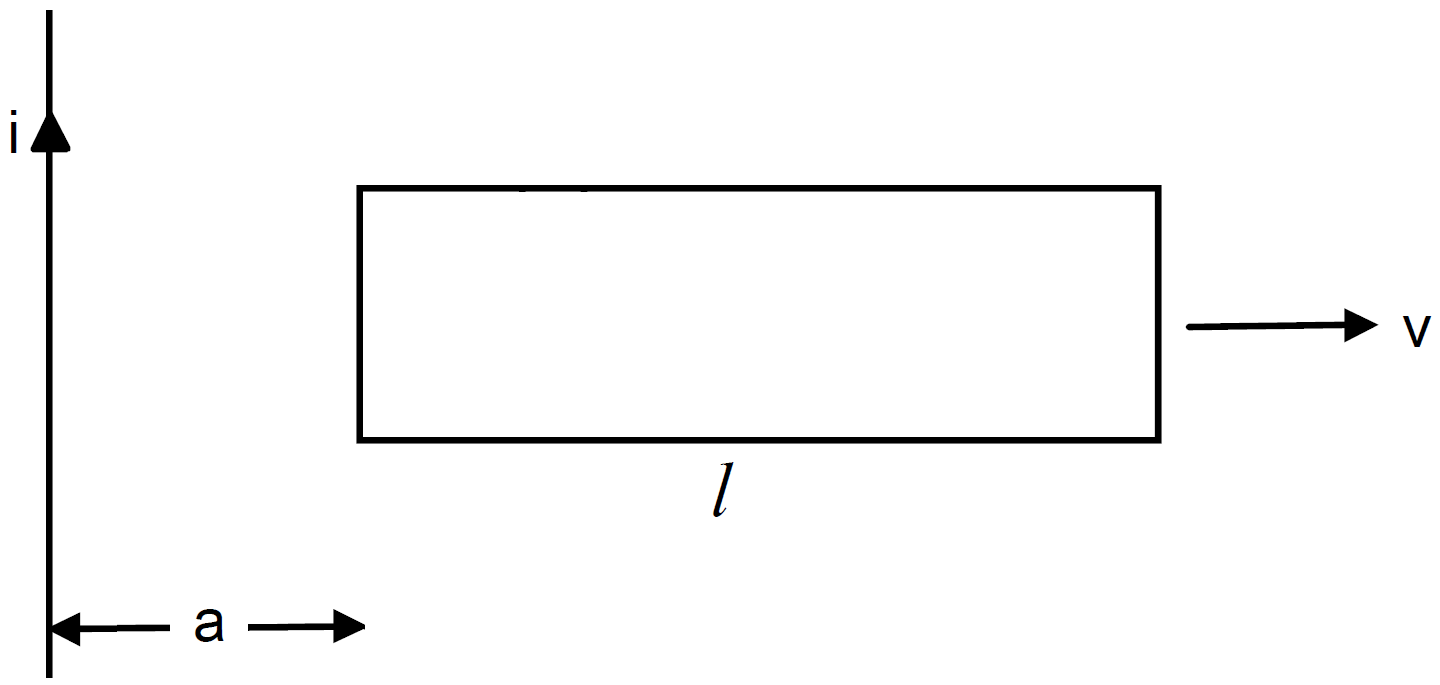
A rectangular metallic loop of length l and width b is placed coplanarly with a long wire carrying a current i. The loop is moved perpendicular to the wire with a speed v in the plane containing the wire and the loop. Calculate the emf induced in the loop when the rear end of the loop is at a distance a from the wire. Solve by using Faraday's law for the flux through the loop and also by replacing different segments with equivalent batteries.
Answer

Using Faraday’' law

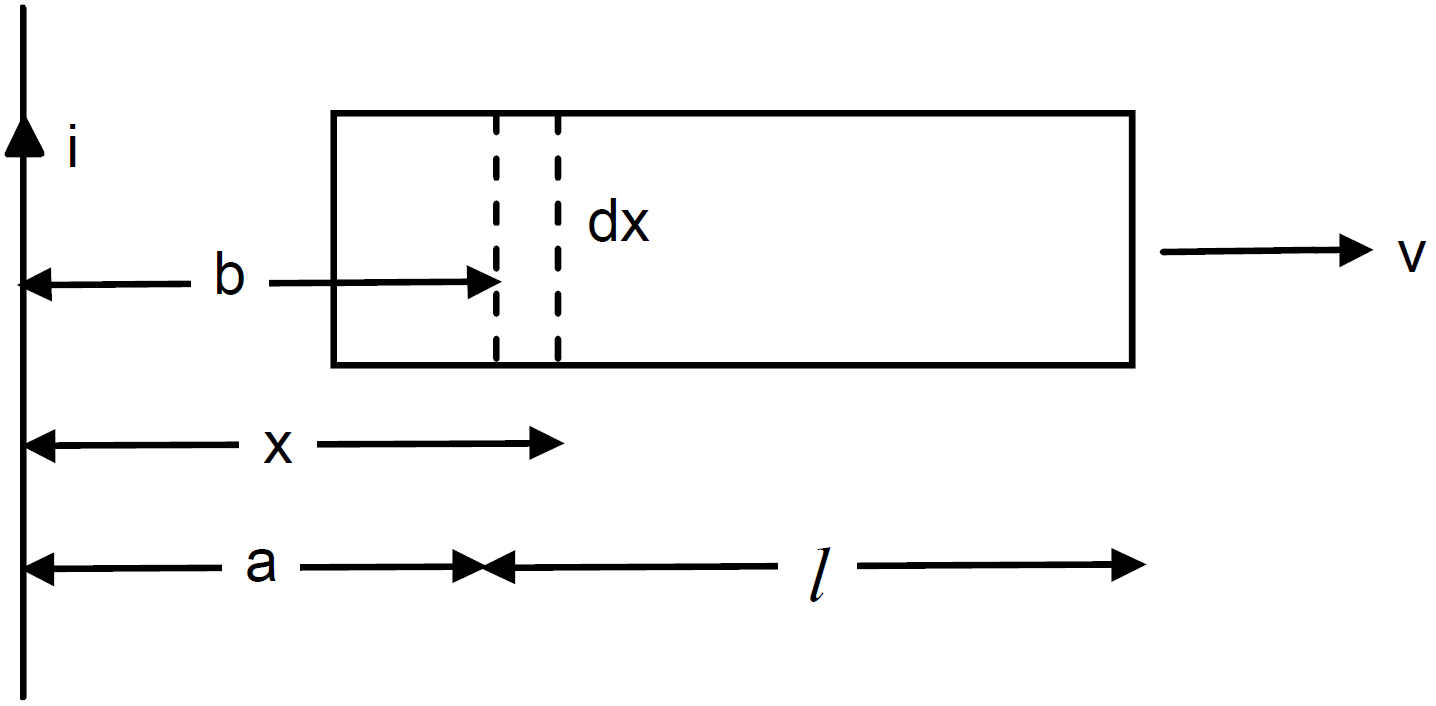
Consider a unit length dx at a distance x
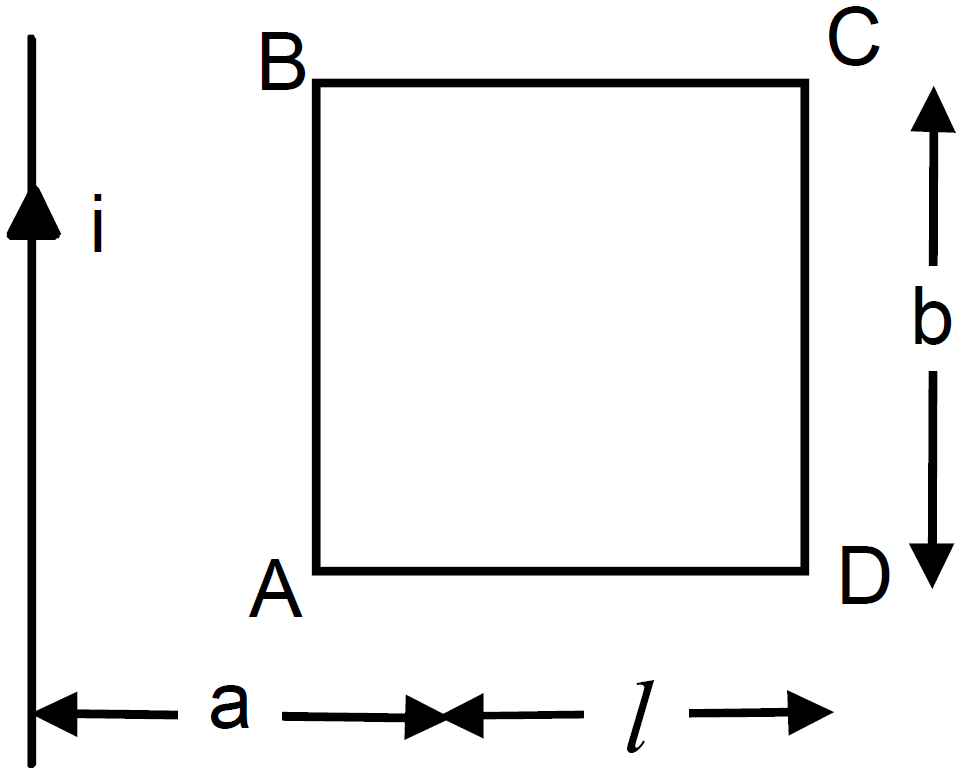
$\text{B}=\frac{\mu_0\text{i}}{2\pi\text{x}}$

Area of strip $=\text{b} \ \text{dx}$

$\text{d}\phi=\frac{\mu_0\text{i}}{2\pi\text{x}}\text{dx}$

$\Rightarrow\phi=\int\limits^{\text{a}+1}_\text{a}\frac{\mu_0\text{i}}{2\pi\text{x}}\text{bdx}$

$=\frac{\mu_o\text{i}}{2\pi}\text{b}\int\limits^{\text{a}+1}_\text{a}\Big(\frac{\text{dx}}{\text{x}}\Big)=\frac{\mu_0\text{ib}}{2\pi}\log\Big(\frac{\text{a}+\text{l}}{\text{a}}\Big)$

$\text{Emf}=\frac{\text{d}\phi}{\text{dt}}=\text{dt}\Big[\frac{\mu_0\text{ib}}{2\pi}\text{log}\Big(\frac{\text{a}+\text{l}}{\text{a}}\Big)\Big]$

$=\frac{\mu_0\text{ib}}{2\pi}\frac{\text{a}}{\text{a}+\text{l}}\Big(\frac{\text{va}-(\text{a}+\text{l})\text{v}}{\text{a}^2}\Big)$ $\Big($ Where $\frac{\text{da}}{\text{dt}}=\text{V}\Big)$

$=\frac{\mu_0\text{ib}}{2\pi}\frac{\text{a}}{\text{a}+\text{l}}\frac{\text{vl}}{\text{a}^2}=\frac{\mu_0\text{ibvl}}{2\pi(\text{a}+\text{l})\text{a}}$

The velocity of AB and CD creates the emf. since the emf due to AD and BC are equal and opposite to each other.

$\text{B}_{\text{AB}}=\frac{\mu_o\text{i}}{2\pi\text{a}} \ \Rightarrow \ \text{E.m.f.} \ \text{AB}=\frac{\mu_0\text{i}}{2\pi\text{a}}\text{bv}$

Length b, velocity v.

$\text{B}_{\text{CD}}=\frac{\mu_0\text{i}}{2\pi(\text{a}+\text{l})}$

$\Rightarrow \text{E.m.f.} \ \text{CD}=\frac{\mu_0\text{ibv}}{2\pi(\text{a}+\text{l})}$

Length b, velocity v.

Net emf $=\frac{\mu_0\text{i}}{2\pi\text{a}}\text{bv}-\frac{\mu_0\text{ibv}}{2\pi\text{a}(\text{a}+\text{l})}=\frac{\mu_0\text{ibvl}}{2\pi\text{a}(\text{a}+\text{l})}$

Need a full question paper?

Generate a complete, print-ready paper with questions like this in minutes — across 16+ boards, with answer keys.

Start Generating Free

Similar questions

A pendulum bob of mass 50g is suspended from the ceiling of an elevator. Find the tension in the string if the elevator:
  1. Goes up with acceleration 1.2m/s2.
  2. Goes up with deceleration 1.2m/s2.
  3. Goes up with uniform velocity.
  4. Goes down with acceleration 1.2m/s2.
  5. Goes down with deceleration 1.2m/s2.
  6. Goes down with uniform velocity.
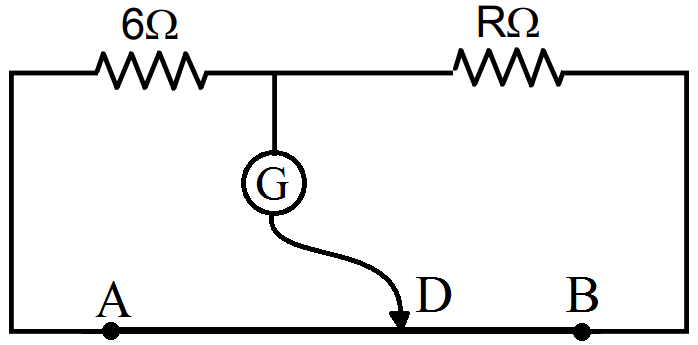
The potentiometer wire AB shown in figure. is 50cm long. When AD = 30cm, no deflection occurs in the galvanometer. Find R.

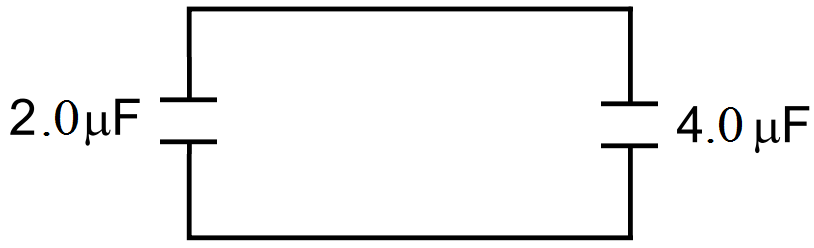
A capacitor of capacitance $2.0\mu\text{F}$ is charged to a potential difference of 12V. It is then connected to an uncharged capacitor of capacitance $4.0\mu\text{F}$ as shown in figure. Find:
  1. The charge on each of the two capacitors after the connection.
  2. The electrostatic energy stored in each of the two capacitors.
  3. The heat produced during the charge transfer from one capacitor to the other.

Draw a simple circuit of a CE transistor amplifier. Explain its working. Show that the voltage gain, AV, of the amplifier is given by $\text{A}_{V} = - \frac{\beta_{ac}\text{R}_{L}}{\text{r}_{i}},\text{ where} \beta_{ac}$is the current gain, RL is the load resistance and ri is the input resistance of the transistor. What is the significance of the negative sign in the expression for the voltage gain?
Two wires of equal length, one of aluminium and the other of copper have the same resistance. Which of the two wires is lighter? Hence explain why aluminium wires are preferred for overhead power cables.
$(\rho_{\text{A}1}=2.63\times10^{-8}\Omega\ \text{m,}\ \text{Relative density of Al}=2.7,\ \text{of Cu}=8.9)$
A small bulb is placed at the bottom of a tank containing water to a depth of 80 cm. What is the area of the surface of water through which light from the bulb can emerge out? Refractive index of water is 1.33. (Consider the bulb to be a point source.)
Two particles A and B having charges q and 2q respectively are placed on a smooth table with a separation d. A third particle C is to be clamped on the table in such a way that the particles A and B remain at rest on the table under electrical forces. What should be the charge on C and where should it be clamped?
A parallel plate capacitor is to be designed with a voltage rating 1kV, using a material of dielectric constant 3 and dielectric strength about 107Vm–1. (Dielectric strength is the maximum electric field a material can tolerate without breakdown, i.e., without starting to conduct electricity through partial ionisation.) For safety, we should like the field never to exceed, say 10% of the dielectric strength. What minimum area of the plates is required to have a capacitance of 50pF?
What is called a capacitor? Explain its principle. Find the formula for combination of capacitors in parallel and series.###Define capacitor. Establish the formula of resultant capacitance in its series and parallel combination. Also draw the necessary circuit diagram.###Define capacitor. How can we increase its capacity? Establish the formula for combining capacitors in parallel and series.
A projectile is fired with a speed u at an angle $\theta$ above a horizontal field. The coefficient of restitution of collision between the projectile and the field is e. How far from the starting point, does the projectile makes its second collision with the field?