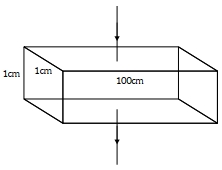
A rectangular parallelopiped is measured as $1\,cm \times 1\,cm \times 100\,cm$. If its specific resistance is $3 \times 10^{-7}\,\Omega\,m$, then the resistance between its two opposite rectangular faces will be $..........x^{-7} \Omega$.
A$2$
B$1$
C$3$
D$4$
JEE MAIN 2023, Easy
Download our app for free and get started
C$3$
c $R =\rho \frac{\ell}{ A }=\frac{3 \times 10^{-7} \times\left(1 \times 10^{-2}\right)}{100 \times 1 \times 10^{-4}}$
$=3 \times 10^{-7} \Omega$
Download our app
and get started for free
Experience the future of education. Simply download our apps or reach out to us for more information. Let's shape the future of learning together!No signup needed.*
Two resistors are connected $(a)$ in series $(b)$ in parallel. The equivalent resistance in the two cases are $9$ $ohm$ and $2$ $ohm$ respectively. Then the resistances of the component resistors are
$n$ identical cells are joined in series with its two cells $A$ and $B$ in the loop with reversed polarities. $EMF$ of each shell is $E$ and internal resistance $r$. Potential difference across cell $A$ or $B$ is (here $n > 4$)
Two sources of equal $emf$ are connected to an external resistance $R$. The internal resistances of the two sources are ${R_1}$ and ${R_2}\,({R_2} > {R_1})$. If the potential difference across the source having internal resistance ${R_2}$ is zero, then