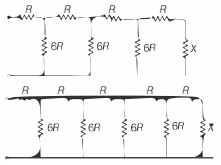
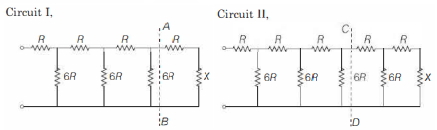
For what value of the resistor $X$ will the equivalent resistance of the two circuits shown be the same?
KVPY 2009, Diffcult


Download our appand get started for free
Experience the future of education. Simply download our apps or reach out to us for more information. Let's shape the future of learning together!No signup needed.*
Similar Questions
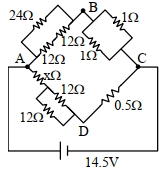
- 1The value of unknown resistance $(x)$ for which the potential difference between $B$ and $D$ will be zero in the arrangement shown, is:View Solution
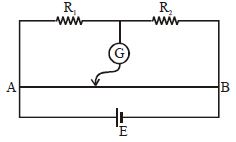
- 2In the fig. shown for given values of $R_1$ and $R_2$ the balance point for jockey is at $40\, cm$ from $A$. When $R_2$ is shunted by a resistance of $10\,\Omega $, balance shifts to $50\, cm. R_1$ and $R_2$ are $(AB = 1\,m)$View Solution
- 3A hot electric iron has a resistance of $80\,\Omega $ and is used on a $200\, V$ source. The electrical energy spent, if it is used for two hours, will be ........... $Wh$View Solution
- 4A $6\,\,V$ battery is connected to the terminals of a $3\, m$ long uniform wire having resistance $100\,\Omega $. The difference in potential between two points on the wire separated by a distance of $50\, cm$ will be ............. $V$View Solution
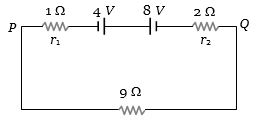
- 5Two batteries of $e.m.f.$ $4\,V$ and $8 \,V$ with internal resistances $1\, \Omega$ and $2\,\Omega$ are connected in a circuit with a resistance of $9 \,\Omega$ as shown in figure. The current and potential difference between the points $P$ and $Q$ areView Solution
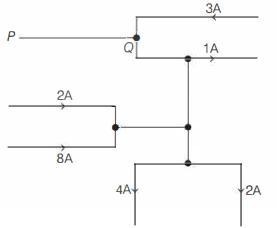
- 6A current $I$ flows through a uniform wire of diameter $d,$ when the mean drift velocity is $v_d.$ The same current will flow through a wire of diameter $d/2$ made of the same material, if the mean drift velocity of the electrons isView Solution
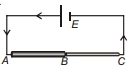
- 7In the following diagram, the lengths of wires $A B$ and $B C$ are equal, but the radius of wire $A B$ is double that of $B C$. The ratio of potential gradient on wires $A B$ and on $B C$ will be (wires are made of same material)View Solution
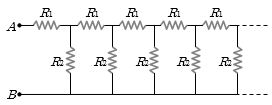
- 8An infinite sequence of resistance is shown in the figure. The resultant resistance between $A$ and $B$ will be, when ${R_1} = 1\,ohm$ and ${R_2} = 2\,ohm$ ............. $\Omega$View Solution
- 9A wire of resistance $R$ is divided in $10$ equal parts. These parts are connected in parallel, the equivalent resistance of such connection will beView Solution
- 10Figure below shows a portion of an electric circuit with the currents in amperes and their directions. The magnitude and direction of the current in the portion $P Q$ isView Solution