Question
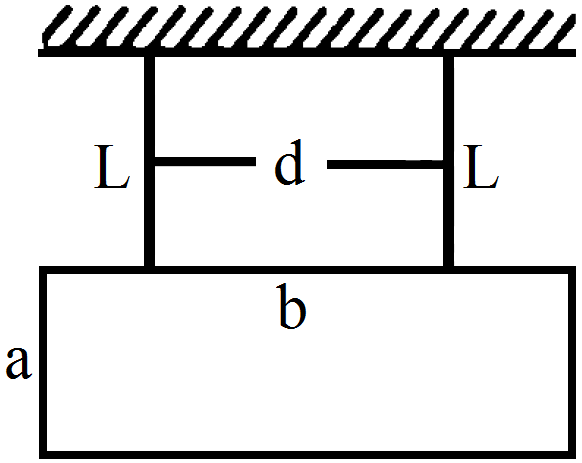
A rectangular plate of sides a and b is suspended from a ceiling by two parallel strings of length L each figure The separation between the strings is d. The plate is displaced slightly in its plane keeping the strings tight. Show that it will execute simple harmonic motion. Find the time period.
Answer

Here we have to consider oscillation of centre of mass, Driving force $\text{F}=\text{mg}\sin\theta.$ Acceleration $=\text{a}=\frac{\text{F}}{\text{m}}=\text{g}\sin\theta.$ For small angle $\theta,\ \sin\theta=\theta.$$\therefore\text{a}=\text{g}\theta=\text{g}\Big(\frac{\text{X}}{\text{L}}\Big)$[where g and L are constant]
$\therefore\text{a}\propto\text{x},$
So the motion is simple Harmonic Time period $\text{T}=2\pi\sqrt{\frac{\text{Displacement}}{\text{Acceleration}}}$$=2\pi\sqrt{\frac{\text{x}}{\Big(\frac{\text{gx}}{\text{L}}\Big)}}$
$=2\pi\sqrt{\frac{\text{L}}{\text{g}}}$

Need a full question paper?

Generate a complete, print-ready paper with questions like this in minutes — across 16+ boards, with answer keys.

Start Generating Free

Similar questions

The elastic limit of a steel cable is $3.0 \times 10^8 N/ m^2$ and the cross-section area is $4cm$ and the maximum upward acceleration that can be given to a $900kg$ elevator supported by the cable if the stress is not to exceed one-third of the elastic limit.
The pulley shown in figure has a radius of 20cm and moment of inertia $0.2kg-m^2$. The string going over it is attached at one end to a vertical spring of spring constant 50N/m fixed from below, and supports a 1kg mass at the other end. The system is released from rest with the spring at its natural length. Find the speed of the block when it has descended through 10cm. Take g $= 10m/s_2$.
Figure, shows a string stretched by a block going over a pulley. The string vibrates in its tenth harmonic in unison with a particular tuning fork. When a beaker containing water is brought under the block so that the block is completely dipped into the beaker, the string vibrates in its eleventh harmonic. Find the density of the material of the block.
Pick out the two scalar quantities in the following list: force, angular momentum, work, current, linear momentum, electric field, average velocity, magnetic moment, relative velocity.
The displacement of a progressive wave is represented by $\text{y} = \text{A} \sin(\omega \text{t} – \text{k x} ),$ where $x$ is distance and $t$ is time. Write the dimensional formula of $(i) \omega$ and $(ii) k.$
A steel wire of length 4.7 m and cross-sectional area $3.0 \times 10^{-5} m^2$ stretches by the same amount as a copper wire of length 3.5 m and cross-sectional area of $4.0 \times 10^{-5} m^2$ under a given load. What is the ratio of the Young's modulus of steel to that of copper?
Compare the velocities of sound in hydrogen $\left( H _2\right)$ and carbon dioxide $\left( CO _2\right)$. The ratio $(\gamma)$ of specific heats of $H _2$ and $CO _2$ are respectively $1.4$ and $1.3 .$
A converging lens and a diverging mirror are placed at a separation of 15cm. The focal length of the lens is 25cm and that of the mirror is 40cm. Where should a point source be placed between the lens and the mirror so that the light, after getting reflected by the mirror and then getting transmitted by the lens, comes out parallel to the principal axis?
A raindrop of mass $1.00g$ falling from a height of $1km$ hits the ground with a speed of $50m s^{-1}$. Calculate:
  1. The loss of $P.E.$ of the drop.
  2. The gain in $K.E$. of the drop.
  3. Is the gain in $K.E$. equal to loss of $P.E$.? If not why.
Take $g = 10m s^{-2}$
What do you mean by the rms speed of the molecules of the gas? Is rms speed same as the average speed at given temperature?