Question
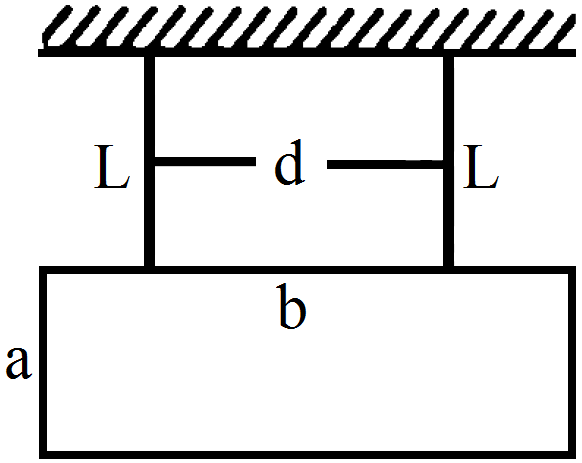
A rectangular plate of sides a and b is suspended from a ceiling by two parallel strings of length L each figure The separation between the strings is d. The plate is displaced slightly in its plane keeping the strings tight. Show that it will execute simple harmonic motion. Find the time period.
Answer

Here we have to consider oscillation of centre of mass,

Driving force $\text{F}=\text{mg}\sin\theta.$

Acceleration $=\text{a}=\frac{\text{F}}{\text{m}}=\text{g}\sin\theta.$

For small angle $\theta,\ \sin\theta=\theta.$

$\therefore\text{a}=\text{g}\theta=\text{g}\Big(\frac{\text{X}}{\text{L}}\Big)$[where g and L are constant]

$\therefore\text{a}\propto\text{x},$

So the motion is simple Harmonic

Time period $\text{T}=2\pi\sqrt{\frac{\text{Displacement}}{\text{Acceleration}}}$

$=2\pi\sqrt{\frac{\text{x}}{\Big(\frac{\text{gx}}{\text{L}}\Big)}}$

$=2\pi\sqrt{\frac{\text{L}}{\text{g}}}$

Need a full question paper?

Generate a complete, print-ready paper with questions like this in minutes — across 16+ boards, with answer keys.

Start Generating Free

Similar questions

  1. Write ideal gas equation in terms of density.
  2. If molar volume is the volume occupied by 1 mole of any (ideal) gas at STP, show that it is 22.4L (take R = 8.313 mol-1 K-1).
Differentiate between average and instantaneous velocity.
A disc of radius 10cm is rotating about its axis at an angular speed of 20rad/s. Find the linear speed of:
  1. A point on the rim.
  2. The middle point of a radius.
A hot gas emits radiation of wavelengths 46.0nm, 82.8nm and 103.5nm only. Assume that the atoms have only two excited states and the difference between consecutive energy levels decreases as energy is increased. Taking the energy of the highest energy state to be zero, find the energies of the ground state and the first excited state.
ls it always true that for two sources of equal intensity, the number of photons emitted in a given time are equal?
The force experienced by a mass moving with a uniform speed v in a circular path of radius experiences a force which depends on its mass, speed and radius. Prove that the relation is $\text{f}=\frac{\text{mv}^2}{\text{r}}$
The force required to just move a body up an inclined plane is double the force required to prevent the body from sliding down. Find the coefficient of friction.
Earth can be thought of as a sphere of radius 6400km. Any object (or a person) is performing circular motion around the axis of earth due to earth’s rotation (period 1 day). What is acceleration of object on the surface of the earth (at equator) towards its centre? what is it at latitude $\theta?$ How does these accelerations compare with g = 9.8m/ s2?
A coil of resistance $100\Omega$ is connected across a battery of emf 6.0V. Assume that the heat developed in the coil is used to raise its temperature. If the heat capacity of the coil is 4.0J/K, how long will it take to raise the temperature of the coil by 15°C?
Calculate the energy released by 1g of natural uranium assuming 200MeV is released in each fission event and that the fissionable isotope 235U has an abundance of 0.7% by weight in natural uranium.