Question types

Simple Harmonic Motion question types

111 questions across 6 question groups — pick any mix to generate a Physics paper with step-by-step answer keys.

111
Questions
6
Question groups
5
Question types
Sample Questions

Simple Harmonic Motion questions

One sample from each question group in this chapter. Select any group above to see the full set with answer keys.

A pendulum clock that keeps correct time on the earth is taken to the moon. It will run:

  1. At correct rate.

  2. 6 times faster.

  3. $\sqrt{6}$ times faster.

  4. $\sqrt{6}$ times slower.

View full solution
A particle is fastened at the end of a string and is whirled in a vertical circle with the other end of the string being fixed. The motion of the particle is:
  1. Periodic.
  2. Oscillatory.
  3. Simple harmonic.
  4. Angular simple harmonic.
View full solution
A particle executes simple harmonic motion with a frequency v. The frequency with which the kinetic energy oscillates is:
  1. $\frac{\text{v}}{2}$
  2. v
  3. 2v
  4. zero
View full solution
Suppose a tunnel is dug along a diameter of the earth. A particle is dropped from a point, a distance h directly above the tunnel. The motion of the particle as seen from the earth is:
  1. Simple harmonic.
  2. Parabolic.
  3. On a straight line.
  4. Periodic.
View full solution
A platoon of soldiers marches on a road in steps according to the sound of a marching band. The band is stopped and the soldiers are ordered to break the steps while crossing a bridge. Why?
View full solution
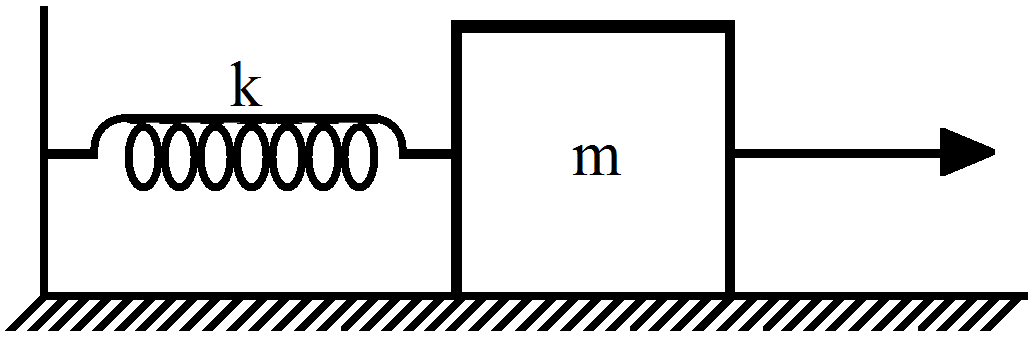
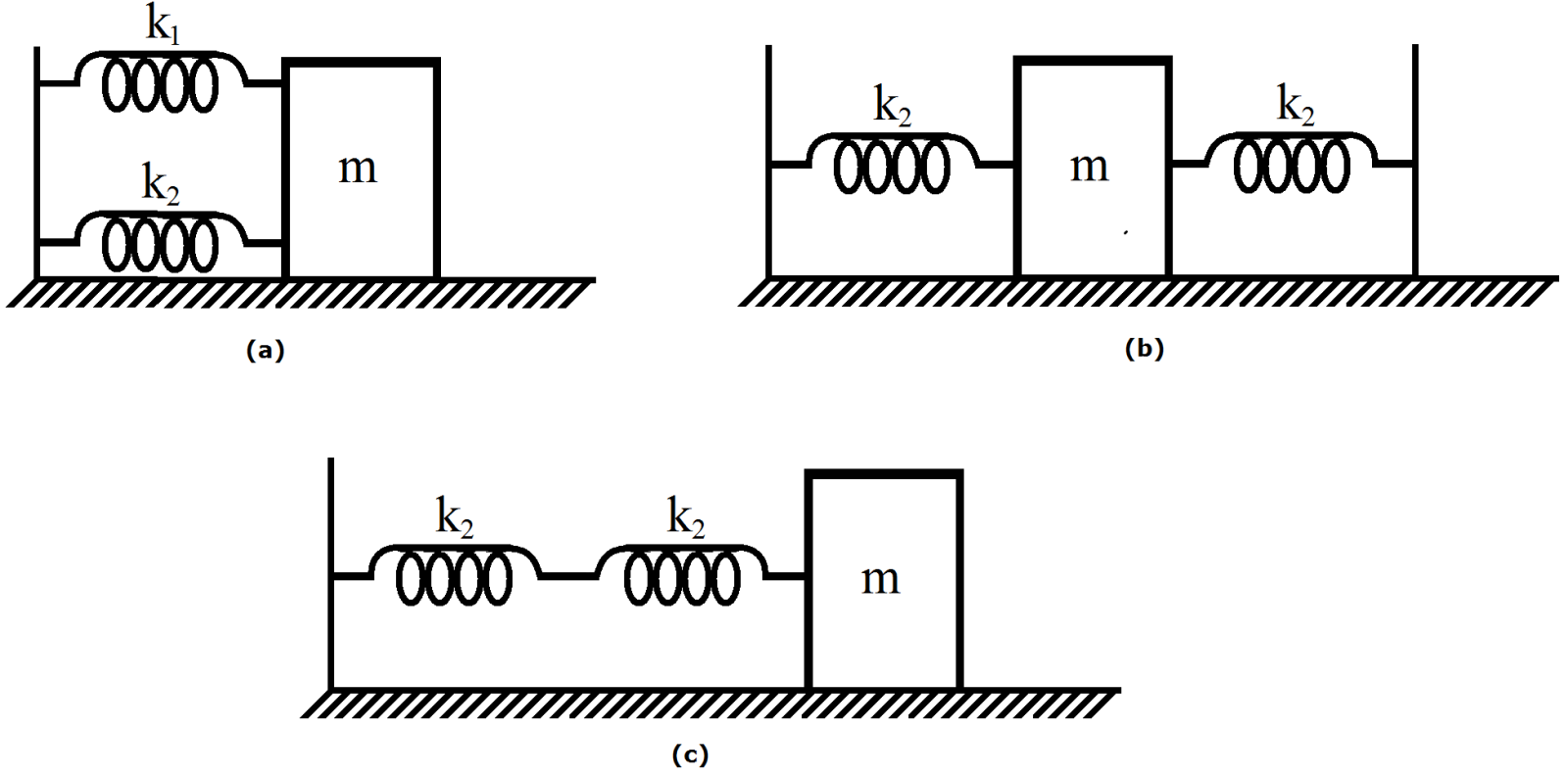
The springs shown in the figure are all unstretched in the beginning when a man starts pulling the block. The man exerts a constant force F on the block. Find the amplitude and the frequency of the motion of the block.

View full solution
A particle executing simple harmonic motion comes to rest at the extreme positions. Is the resultant force on the particle zero at these positions according to Newton's first law?
View full solution
The energy of a system in simple harmonic motion is given by $\text{E}=\frac{1}{2}\text{m }\omega^2\text{A}^2.$ Which of the following two statements is more appropriate?
  1. The energy is increased because the amplitude is increased.
  2. The amplitude is increased because the energy is increased.
View full solution
A pendulum having time period equal to two seconds is called a seconds pendulum. Those used in pendulum clocks are of this type. Find, the length of a seconds pendulum at a place where $\text{g}=\pi^2\text{m/s}^2.$
View full solution
The pendulum of a clock is replaced by a spring-mass system with the spring having spring constant 0.1N/m. What mass should be attached to the spring?
View full solution
It is proposed to move a particle in simple harmonic motion on a rough horizontal surface by applying an external force along the line of motion. Sketch the graph of the applied force against the position of the particle. Note that the applied force has two values for a given position depending on whether the particle is moving in positive or negative direction.
View full solution
The angle made by the string of a simple pendulum with the vertical depends on time as $\theta=\frac{\pi}{90}\sin[(\pi\text{s}^{-1})\text{t}].$ Find the length of the pendulum if $\text{g}=\pi^2\text{m/s}^2.$
View full solution
A pendulum clock giving correct time at a place where g = 9.800m/s2 is taken to another place where it loses 24 seconds during 24 hours. Find the value of g at this new place.
View full solution
Q 163 Marks Question3 Marks
The maximum speed and acceleration of a particle executing simple harmonic motion are 10cm/s and 50cm/s2. Find the position(s) of the particle when the speed is 8cm/s.
View full solution
Q 173 Marks Question3 Marks
A spring stores 5J of energy when stretched by 25cm. It is kept vertical with the lower end fixed. A block fastened to its other end is made to undergo small oscillations. If the block makes 5 oscillations each second, what is the mass of the block?
View full solution
Q 183 Marks Question3 Marks
The spring shown in figure is unstretched when a man starts pulling on the cord. The mass of the block is M. If the man exerts a constant force F, find
  1. The amplitude and the time period of the motion of the block,
  2. The energy stored in the spring when the block passes through the equilibrium position and,
  3. The kinetic energy of the block at this position.

View full solution
Q 193 Marks Question3 Marks
Consider a simple harmonic motion of time period T. Calculate the time taken for the displacement to change value from half the amplitude to the amplitude.
View full solution
Q 203 Marks Question3 Marks
A block of mass 0.5kg hanging from a vertical spring executes simple harmonic motion of amplitude 0.1m and time period 0.314s. Find the maximum force exerted by. the spring on the block.
View full solution
Q 214 Marks Question4 Marks
The ear-ring of a lady shown in has a 3cm long light suspension wire.
  1. Find the time period of small oscillations if the lady is standing on the ground.
  2. The lady now sits in a merry-go-round moving at 4m/s in a circle of radius 2m. Find the time period of small oscillations of the ear-ring.

View full solution
Q 224 Marks Question4 Marks
A simple pendulum of length I is suspended from the ceiling of a car moving with a speed v on a circular horizontal road of radius r.
  1. Find the tension in the string when it is at rest with respect to the car.
  2. Find the time period of small oscillation.
View full solution
Q 234 Marks Question4 Marks
A simple pendulum fixed in a car has a time period of 4 seconds when the car is moving uniformly on a horizontal road. When the accelerator is pressed, the time period changes to 3.99 seconds. Making an approximate analysis, find the acceleration of the car.
View full solution
The equation of motion of a particle started at t = 0 is given by $\text{x}=5\sin\big(20\text{t}+\frac{\pi}{3}\big)$ where x is in centimetre and t in second. When does the particle.
  1. First come to rest.
  2. First have zero acceleration.
  3. First have maximum speed?
View full solution
A simple pendulum is constructed by hanging a heavy ball by a 5.0m long string. It undergoes small oscillations.
  1. How many oscillations does it make per second?
  2. What will be the frequency if the system is taken on the moon where acceleration due to gravitation of the moon is 1.67m/s2.
View full solution
Consider a particle moving in simple harmonic motion according to the equation $\text{x}=2.0\cos(50\pi\text{t}+\tan^{-1}0.75)$ where x is in centimetre and t in second. The motion is started at t = 0.
  1. When does the particle come to rest for the first time?
  2. When does the acceleration have its maximum magnitude for the first time?
  3. When does the particle come to rest for the second time?
View full solution
Assume that a tunnel is dug along a chord of the earth, at a perpendicular distance $\frac{\text{R}}{2}$ from the earth's centre where R is the radius of the earth. The wall of the tunnel is frictionless.
  1. Find the gravitational force exerted by the earth on a particle of mass m placed in the tunnel at a distance x from the centre of the tunnel.
  2. Find the component of this force along the tunnel and perpendicular to the tunnel.
  3. Find the normal force exerted by the wall on the particle.
  4. Find the resultant force on the particle.
  5. Show that the motion of the particle in the tunnel is simple harmonic and find the time period.
View full solution

Generate a Simple Harmonic Motion paper free

Pick question groups from the list above, set marks and difficulty, and export a branded PDF with step-by-step answer keys. First 3 chapters free — no signup.

Download App