Question
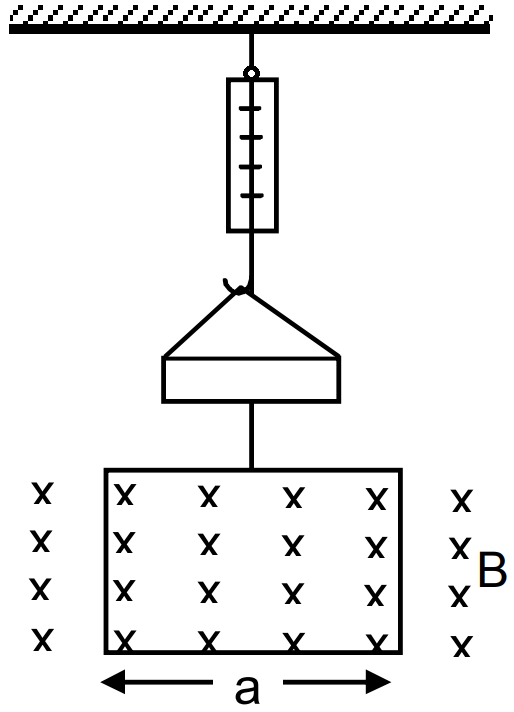
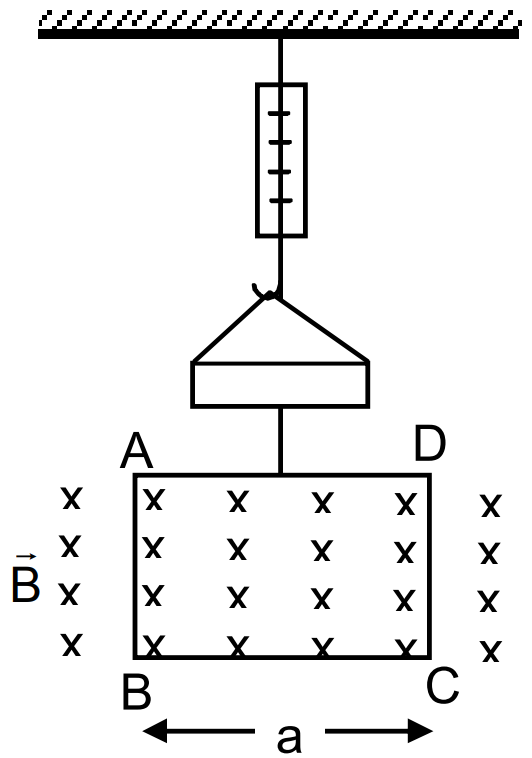
A rectangular wire loop of width a is suspended from the insulated pan of a spring balance, as shown in A current i exists in the anti-clockwise direction in the loop. A magnetic field Bexists in the lower region. Find the change in the tension of the spring if the current in the loop is reversed.
Answer


Current anticlockwise
Since the horizontal Forces have no effect.
Let us check the forces for current along AD & BC [Since there is no $\overrightarrow{\text{B}}$ ]
In AD, F = 0
For BC
F = iaB upward
Current clockwise
Similarly, F = - iaB downwards
Hence change in force = change in tension
= iaB - (-iaB) = 2 iaB

Need a full question paper?

Generate a complete, print-ready paper with questions like this in minutes — across 16+ boards, with answer keys.

Start Generating Free

Similar questions

Obtain the resonant frequency $ωr$ of a series $\text{LCR}$ circuit with $L = 2.0H, C = 32\mu F$ and $R = 10\Omega .$ What is the $Q-$value of this circuit?
The magnifying power of a converging lens used as a simple microscope is $\Big(1+\frac{\text{D}}{\text{f}}\Big).$ A compound microscope is a combination of two such converging lenses. Why don't we have magnifying power $\Big(1+\frac{\text{D}}{\text{f}_\text{o}}\Big) \Big(1+\frac{\text{D}}{\text{f}_\text{o}}\Big)?$ In other words, why can the objective not be treated as a simple microscope but the eyepiece can?
Define critical angle and write the conditions of total internal reflection.
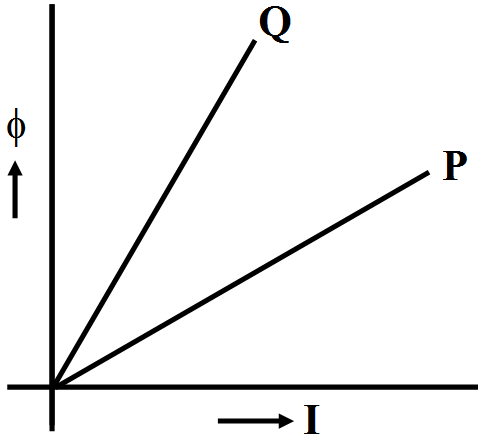
The given graph shows a plot of magnetic flux $(\phi)$ and the electric current (I) flowing through two inductors P and Q. Which of the two inductors has smaller value of self-inductance?
Is $\text{p}=\frac{\text{E}}{\text{c}}$ valid for electrons?
A converging lens and a diverging mirror are placed at a separation of 15cm. The focal length of the lens is 25cm and that of the mirror is 40cm. Where should a point source be placed between the lens and the mirror so that the light, after getting reflected by the mirror and then getting transmitted by the lens, comes out parallel to the principal axis?
A cell of emf E and internal resistance r is connected across an external resistance R. Plot a graph showing the variation of P.D. across R, verses R.
Two charged conducting spheres of radii $a$ and $b$ are connected to each other by a wire. What is the ratio of electric fields at the surfaces of the two spheres? Use the result obtained to explain why charge density on the sharp and pointed ends of a conductor is higher than on its flatter portions.
Solve the previous problem if the paperweight is inverted at its place so that the spherical surface touches the paper.
Two prisms of identical geometrical shape are combined with their refracting angles oppositely directed. The materials of the prisms have refractive indices 1.52 and 1.62 for violet light. A violet ray is deviated by 1.0° when passes symmetrically through this combination. What is the angle of the prisms?