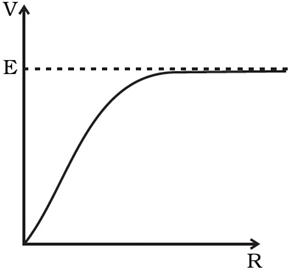
A cell of emf E and internal resistance r is connected across an external resistance R. Plot a graph showing the variation of P.D. across R, verses R.
Download our app for free and get started
When the cell of emf E and internal resistance r is connected across an external resistance R, the relationship between the voltage across R is given by
$\text{V}=\frac{\text{E}}{\big[1+\big(\frac{\text{r}}{\text{R}}\big)\big]}$
From the above relation,
Now, as $\text{R}=0\Rightarrow\ \text{V}=0\ \&\ \text{R}=\infty\Rightarrow\ \text{V}=\text{E}.$ So, this variation is shown in the figure given below.
$\text{V}=\frac{\text{E}}{\big[1+\big(\frac{\text{r}}{\text{R}}\big)\big]}$
From the above relation,
Now, as $\text{R}=0\Rightarrow\ \text{V}=0\ \&\ \text{R}=\infty\Rightarrow\ \text{V}=\text{E}.$ So, this variation is shown in the figure given below.

Download our appand get started for free
Experience the future of education. Simply download our apps or reach out to us for more information. Let's shape the future of learning together!No signup needed.*
Similar Questions
- 1View SolutionYou are given n resistors each of resistance r. They are first connected to get the minimum possible resistance. In the second case, these are again connected differently to get the maximum possible resistance. Calculate the ratio between minimum and maximum values of resistance so obtained.
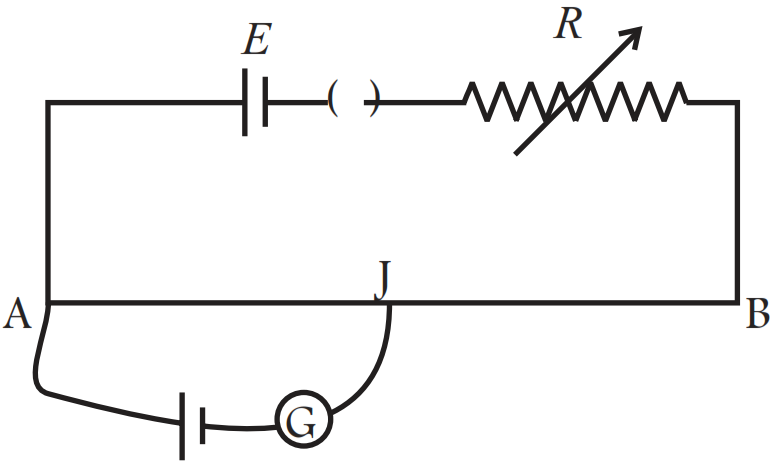
- 2View SolutionAB is a potentiometer wire (Fig). If the value of R is increased, in which direction will the balance point J shift?
- 3View SolutionThe following circuit shows the use of potentiometer to measure the internal resistance of a cell:
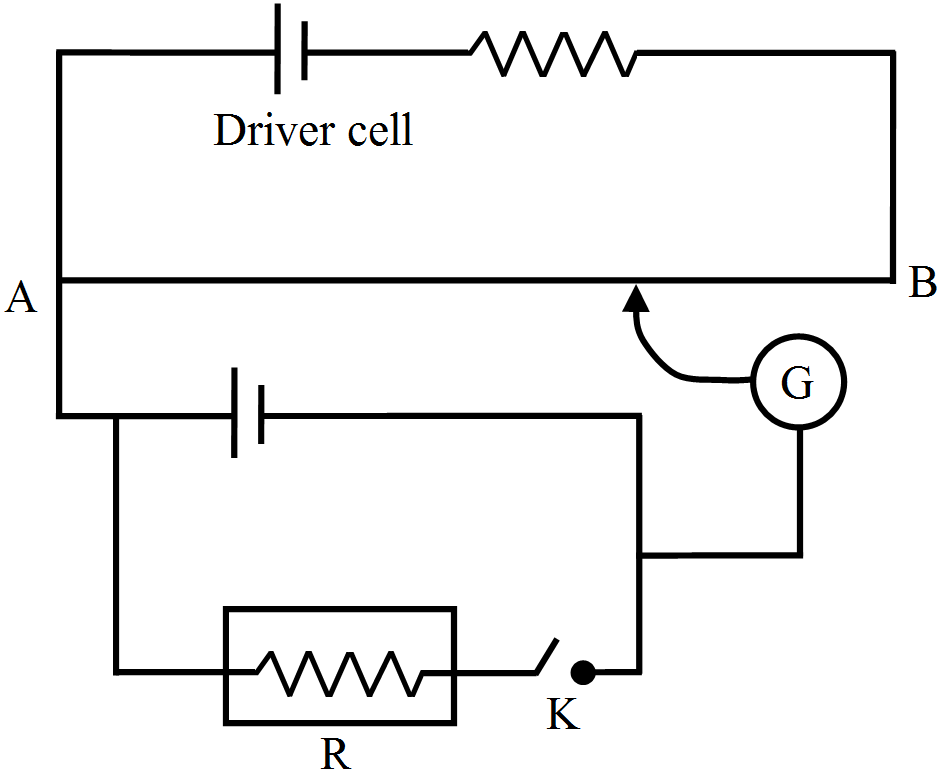
- When the key is open, how does the balance point change, if the current from the driver cell decreases?
- When the key K is closed, how does the balance point change if R is increased keeping current from the driver cell constant?
- 4What are the advantages of the null$-$point method in a Wheatstone bridge? What additional measurements would be required to calculate $R_{unknown}$ by any other method?View Solution
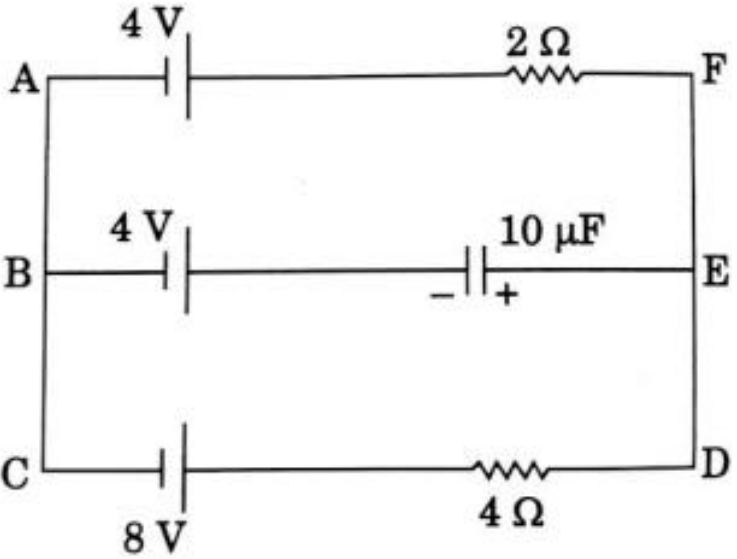
- 5View SolutionIn the given circuit, with steady current, calculate the potential drop across the capacitor and the charge stored in it.
- 6A capacitance C charged to a potential difference V is discharged by connecting its plates through a resistance R. Find the heat dissipated in one time constant after the connections are made. Do this by calculating $\int\text{i}^2\text{R}$ dt and also by finding the decrease in the energy stored in the capacitor.View Solution
- 7The current through a wire depends on time as $\text{i}=\text{i}_0+\alpha\text{t},$View Solution
Where $\text{i}_0=10\text{A}$ and $\alpha=4\text{A/ s}.$ Find the charge that crosses through a section of the wire in 10 seconds. - 8Two heating elements of resistances $R_{1}$ and $R_{2}$ when operated at a constant supply of voltage, $V$, Consume power $P_1$ and $P_2$ respectively. Deduce the expressions for the power of their combination when they are, in turn, connected in $(i)$ series and $(ii)$ parallel across the same voltage supply.View Solution
- 9View SolutionThe graph shown here shows the variation of terminal potential difference V, across a combination of three cells in series to a resistor, versus current i:
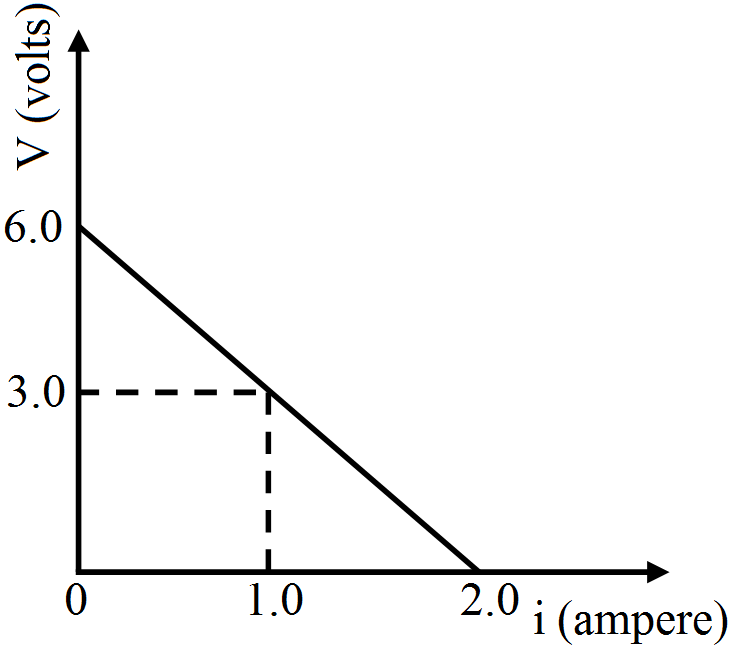
- Calculate the emf of each cell.
- For what current i, will the power dissipation of the circuit be maximum?
- 10A capacitor of capacitance $10\mu\text{F}$ is connected across a battery of emf 6.0V through a resistance of $20\text{k}\Omega$ for 4.0s. The battery is then replaced by a thick wire. What will be the charge on the capacitor 4.0s after the battery is disconnected?View Solution