MCQ
A reference frame attached to earth cannot be an inertial frame because
  • A
    earth is revolving around the sun
  • B
    earth is rotating about its axis
  • both (a) and (b)
  • D
    Newton's laws are applicable in this frame

Answer

Correct option: C.
both (a) and (b)
c
(c)

If earth is revolving around the sun or earth is rotating about its axis, then forces are acting on the earth and hence there will be acceleration of earth due to these forces. That is why earth can not be an inertial frame of reference.

Need a full question paper?

Generate a complete, print-ready paper with questions like this in minutes — across 16+ boards, with answer keys.
Start Generating Free

Similar questions

When a particle executes $SHM$ the nature of graphical representation of velocity as a function of displacement is :
A stone dropped from the top of a tower is found to travel $\left(\frac{5}{9}\right)$ of the height of the tower during the last second of its fall. The time of fall is ....... $s$
Resistance of a given wire is obtained by measuring the current flowing in it and the voltage difference applied across it. If the percentage errors in the measurement of the current and the voltage difference are $3\%$ each, then error in the value of resistance of the wire is ........ $\%$
A ball is thrown vertically downwards from a height of  $20\, m$ with an initial velocity $v_0$, It collides with the ground, loses $50$ percent of its energy in collision and rebounds same height. The initial velocity $v_0$ .................... $\mathrm{ms}^{-2}$ (Take $g=10 \,ms^{-2}$)
Two spherical stars $A$ and $B$ have densities $\rho_A$ and $\rho_B$, respectively. $A$ and $B$ have the same radius, and their masses $M_A$ and $M_B$ are related by $M_B=2 M_A$. Due to an interaction process, star $A$ loses some of its mass, so that its radius is halved, while its spherical shape is retained, and its density remains $\rho_A$. The entire mass lost by $A$ is deposited as a thick spherical shell on $B$ with the density of the shell being $\rho_4$. If $v_A$ and $v_B$ are the escape velocities from $A$ and $B$ after the interaction process, the ratio $\frac{v_B}{v_A}=\sqrt{\frac{10 n}{15^{1 / 3}}}$. The value of $n$ is. . . . .
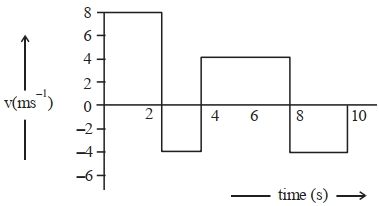
The velocity time graph of a body moving in a straight line is shown in figure.The ratio of displacement to distance travelled by the body in time $0$ to $10\,s$ is
Mass $M$ is lowered by the help of a string at constant acceleration $\frac{g}{2}$ for distance $x$. Work done by string will be :-
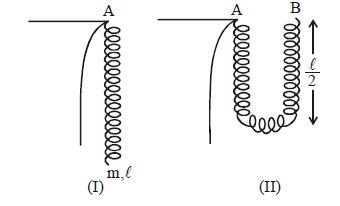
A chain of mass $m$ and length $l$ is hanging freely from edge $A$ (as shown in diagram $I$ ). Calculate the work done to fold it as shown in diagram $(II)$ 
Thermal capacity of a body depends on
For a particle performing uniform circular motion, choose the correct statement(s) from the following:
  1. Magnitude of particle velocity (speed) remains constant.
  2. Particle velocity remains directed perpendicular to radius vector.
  3. Direction of acceleration keeps changing as particle moves.
  4. Angular momentum is constant in magnitude but direction keeps changing.