MCQ
A reflecting telescope has a large mirror as its objective with radius of curvature equal to $80\,cm$. The magnifying power of this telescope if eye piece used has a focal length of $1.6\, cm$ is 
  • A
    $100$
  • B
    $50$
  • $25$
  • D
    $5$

Answer

Correct option: C.
$25$
c
$\mathrm{f}_{0}=\frac{\mathrm{R}}{2}=\frac{80}{2}=40 \mathrm{\,f}_{\mathrm{e}}=1.6$

$\mathrm{m}=\frac{\mathrm{f}_{0}}{\mathrm{f}_{\mathrm{e}}}=\frac{40}{1.6}=25$

Need a full question paper?

Generate a complete, print-ready paper with questions like this in minutes — across 16+ boards, with answer keys.
Start Generating Free

Similar questions

In a coil of self inductance 0.5 henry, the current varies at a constant rate from zero to 10 amperes in 2 seconds. The e.m.f. generated in the coil is
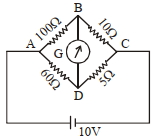
The four arms of a Wheatstone bridge have resistances as shown in the figure. A  galvanometer of $15\, \Omega$ resistance is connected across $BD$. Calculate the current through the galvanometer when a potential difference of $10\, V$ is maintained across $AC.$
Two point charges $q_1\,(\sqrt {10}\,\,\mu C)$ and $q_2\,(-25\,\,\mu C)$ are placed on the $x-$ axis at $x = 1\,m$ and $x = 4\,m$ respectively. The electric field (in $V/m$ ) at a point $y = 3\,m$ on $y-$ axis is, [ take ${\mkern 1mu} {\mkern 1mu} \frac{1}{{4\pi {\varepsilon _0}}} = 9 \times {10^9}{\mkern 1mu} {\mkern 1mu} N{m^2}{C^{ - 2}}{\rm{ }}$ ]
Assertion : For a perfectly diamagnetic substance permeability is always one.
Reason : The ability of a material of permit the passage of magnetic lines of force through it is called magnetic permeability.
How does the potential difference change with the effect of the dielectric when the battery remains connected across the capacitor?
The output of a NAND gate is 0
A laser beam can be focussed on an area equal to the square of its wavelength A $He-Ne$  laser radiates energy at the rate of $1\,mW$ and its wavelength is $632.8 \,nm$. The intensity of focussed beam will be
The wavelength of $X-$ rays is of the order of
In a Young’s double slit experiment with slit separation $0.1\, mm$, one observes a bright fringe at angle $\frac{1}{{40}}\, rad$ by using light of wavelength ${\lambda _1}$. When the light of wavelength $\lambda _2$ is used a bright fringe is seen at the same angle in the same set up. Given that ${\lambda _1}$ and ${\lambda _2}$ are in visible range ($380\, nm$ to $740\, nm$), their values are
The graph which depicts the results of Rutherform gold foil experiment with $\alpha$ -particales is

$\theta:$ Scattering angle

$\mathrm{Y}:$ Number of scattered $\alpha$ -particles detected

(Plots are schematic and not to scale)