A resistance of $2\,\Omega $ is connected across one gap of a meter-bridge and unknown resistance, greater than $2\,\Omega $ , is connected a cross the other gap. When these resistances are interchanged, the balance point shifts by $20\ cm$ , neglecting any end correction, the unknown resistance is ................ $\Omega$
Diffcult
Download our app for free and get started
$\frac{x}{2} = \frac{\ell }{{1 - \ell }}$
$\frac{2}{x}=\frac{\ell+0.2}{1-(\ell-0.2)}=\frac{\ell+0.2}{0.8-\ell}$
$\frac{\ell(\ell+0.2)}{(1-\ell)(0.8-\ell)}=1$
$\ell^{2}+0.2 \ell=0.8+\ell^{2}-0.8 \,\ell-\ell$
$2\, \ell=0.8$
$\ell=0.4 \mathrm{\,m}$
$\frac{x}{2}=\frac{0.4}{0.6} \Rightarrow x=\frac{4}{3}$
$\frac{2}{x}=\frac{\ell-0.2}{1-(\ell-0.2)}=\frac{\ell-0.2}{1.2-\ell}$
$1=\frac{\ell(\ell-0.2)}{(1-\ell)(1.2-\ell)}$
$\ell-0.2\, \ell=1.2+\ell^{2}-2.2\, \ell$
$2 \ell=1.2$
$\ell=0.6$
$\Rightarrow x=\frac{2 \times 0.6}{0.4}=3\, \Omega$

Download our appand get started for free
Experience the future of education. Simply download our apps or reach out to us for more information. Let's shape the future of learning together!No signup needed.*
Similar Questions
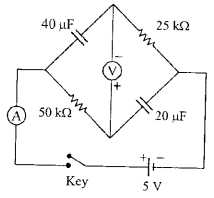
- 1In the circuit shown below, the key is pressed at time $t=0$. Which of the following statement(s) is(are) true?View Solution
($A$) The voltmeter displays $-5 \mathrm{~V}$ as soon as the key is pressed, znd displays $+5 \mathrm{~V}$ after a long time
($B$) The voltmeter will display $0 \mathrm{~V}$ at time $t=\ln 2$ seconds
($C$) The current in the ammeter becomes $1 / e$ of the initial value after $1$ second
($D$) The current in the ammeter becomes zero after a long time
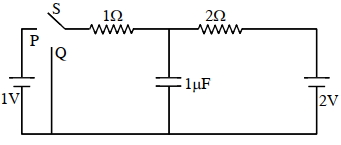
- 2In the circuit shown below, the switch $S$ is connected to position $P$ for a long time so that the charge on the capacitor becomes $q _1 \mu C$. Then $S$ is switched to position $Q$. After a long time, the charge on the capacitor is $q _2 \mu C$.View Solution
($1$) The magnitude of $q_1$ is
($2$) The magnitude of $q _2$ is
Give the answer of question ($1$) and ($2$)
- 3Give colors of the ring in sequence marked on a resistance of $56 \ k\Omega$ with tolerance $\pm 5\%$View Solution
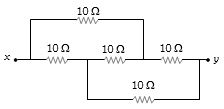
- 4The equivalent resistance between $x$ and $y$ in the circuit shown is ............. $\Omega$View Solution
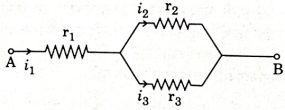
- 5Three resistors having resistances $\mathrm{r}_{1}, \mathrm{r}_{2}$ and $\mathrm{r}_{3}$ are connected as shown in the given circuit. The ratio $\frac{i_{3}}{i_{1}}$ of currents in terms of resistances used in the circuit is :View Solution
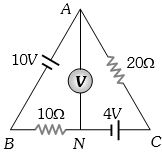
- 6The reading of the ideal voltmeter in the adjoining diagram will be ................. $V$View Solution
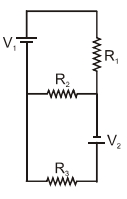
- 7Two ideal batteries of emf $V _1$ and $V _2$ and three resistances $R _1, R _2$ and $R _3$ are connected as shown in the figure.View Solution
The current in resistance $R _2$ would be zero if
$(A)$ $V_1=V_2$ and $R_1=R_2=R_3$
$(B)$ $V_1=V_2$ and $R_1=2 R_2=R_3$
$(C)$ $V_1=2 V_2$ and $2 R_1=2 R_2=R_3$
$(D)$ $2 V _1= V _2$ and $2 R _1= R _2= R _3$
- 8A solenoid is at potential difference $60\, V$ and current flows through it is $15$ ampere, then the resistance of coil will be ............ $\Omega$View Solution
- 9When three identical bulbs of $60 \;W, 200\;V$ rating are connected in series to a $200 \;V$ supply, the power drawn by them will be ....... $Watt$View Solution
- 10If $2.2\,kW$ power is transmitted through a $100\,\Omega $ line at $22,000\,V,$ the power loss in the form of heat will be ............. $W$View Solution