When three identical bulbs of $60 \;W, 200\;V$ rating are connected in series to a $200 \;V$ supply, the power drawn by them will be ....... $Watt$
AIPMT 2004, Easy
Download our app for free and get started
In series $P' = \frac{P}{n} = \frac{{60}}{3} = 20\,watts$

Download our appand get started for free
Experience the future of education. Simply download our apps or reach out to us for more information. Let's shape the future of learning together!No signup needed.*
Similar Questions
- 1In a potentiometer experiment, the galvanometer shows no deflection when a cell is connected across $60\, cm$ of the potentiometer wire. If the cell is shunted by a resistance of $6\,\Omega $, the balance is obtained across $50\, cm$ of the wire. The internal resistance of the cell is .............. $\Omega $View Solution
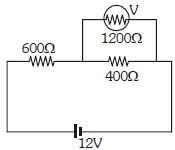
- 2Find the error in reading of voltmeter ................ $\%$View Solution
- 3A wire of resistance $R$ is divided in $10$ equal parts. These parts are connected in parallel, the equivalent resistance of such connection will beView Solution
- 4Two coils require $20$ minutes and $60$ minutes respectively to produce same amount of heat energy when connected separately to the same source. If they are connected in parallel arrangement to the same source; the time required to produce same amount of heat by the combination of coils, will be________ $min$View Solution
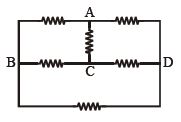
- 5View SolutionIn the following circuit composed of identical resistors, across which terminals would you connect a battery in order to dissipate energy in all resistors
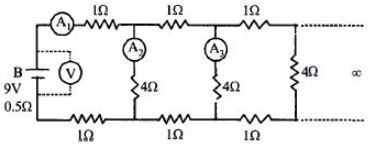
- 6A $9\, V$ battery with internal resistance of $0.5\,\Omega $ is connected across an infinite network as shown in the figure. All ammeters $A_1 , A_2, A_3$ and voltmeter $V$ are ideal. Choose correct statementView Solution
- 7By what percentage will the illumination of the lamp decrease if the current drops by $20 \%$ ?View Solution
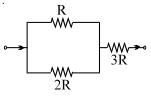
- 8The ratio of powers dissipatted respectively in $R$ and $3R$, as shown is:View Solution
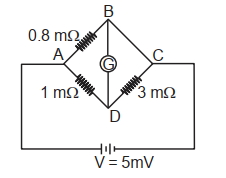
- 9To measure the temperature coefficient of resistivity $\alpha$ of a semiconductor, an electrical arrangement shown in the figure is prepared. The arm BC is made up of the semiconductor. The experiment is being conducted at $25^{\circ} \mathrm{C}$ and resistance of the semiconductor arm is $3 \mathrm{~m} \Omega$. Arm BC is cooled at a constant rate of $2^{\circ} \mathrm{C} / \mathrm{s}$. If the galvanometer $\mathrm{G}$ shows no deflection after $10 \mathrm{~s}$, then $\alpha$ is :View Solution
- 10View SolutionThe maximum current that flows through a fuse wire before it blows out varies with its radius as