A resistance of $4\,\Omega $ and a wire of length $5\,m$ and resistance $5\,\Omega $ are joined in series and connected to a cell of $e.m.f.$ $10\, V$ and internal resistance $1\,\Omega $. A parallel combination of two identical cells is balanced across $300\, cm$ of the wire. The $e.m.f.$ $E$ of each cell is ........... $V$
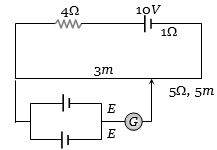
Medium


Download our appand get started for free
Experience the future of education. Simply download our apps or reach out to us for more information. Let's shape the future of learning together!No signup needed.*
Similar Questions
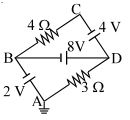
- 1The figure shows a network of resistances in which the point $A$ is earthed. The current through the $4\,\Omega$ resistor isView Solution
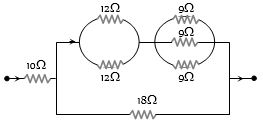
- 2In the following circuit, $18\,\Omega $ resistor develops $2\,J/sec$ due to current flowing through it. The power developed across $10\,\Omega $ resistance is .............. $W$View Solution
- 3If the current through a resistor in a circuit increases by $3 \%$, then the power dissipated by the resistorView Solution
- 4View SolutionAssertion : Kirchoff 's junction rule follows from conservation of charge.
Reason : Kirchoff 's loop rule follows from conservation of momentum.
- 5Potentiometer wire of length $1 \,m$ is connected in series with $490\,\Omega $ resistance and $2\,V$ battery. If $0.2\, mV/cm $ is the potential gradient, then resistance of the potentiometer wire is ................ $\Omega$View Solution
- 6In a potentiometer arrangement, a cell gives a balancing point at $75\, cm$ length of wire. This cell is now replaced by another cell of unknown emf. If the ratio of the emf's of two cells respectively is $3: 2$, the difference in the balancing length of the potentiometer wire in above two cases will be.........$cm .$View Solution
- 7Current density in a cylindrical wire of radius $R$ is given as $J =$ $\left\{ {\begin{array}{*{20}{c}}View Solution
{{J_0}\left( {\frac{x}{R} - 1} \right)\,\,for\,\,0 \leqslant x < \frac{R}{2}} \\
{{J_0}\frac{x}{R}\,\,\,\,for\,\,\,\frac{R}{2} \leqslant x \leqslant R}
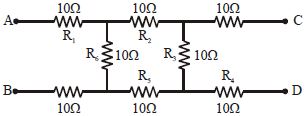
\end{array}} \right.$The current flowing in the wire is: - 8The equivalent resistance between the points $A$ and $D$ ................ $\Omega$View Solution
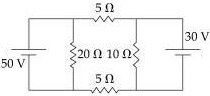
- 9In the circuit shown, current (in $A$) through $50\; V$ and $30\; V$ batteries are, respectivelyView Solution
- 10A cylindrical conductor has uniform cross-section. Resistivity of its material increase linearly from left end to right end. If a constant current is flowing through it and at a section distance $x$ from left end, magnitude of electric field intensity is $E$, which of the following graphs is correctView Solution