Question
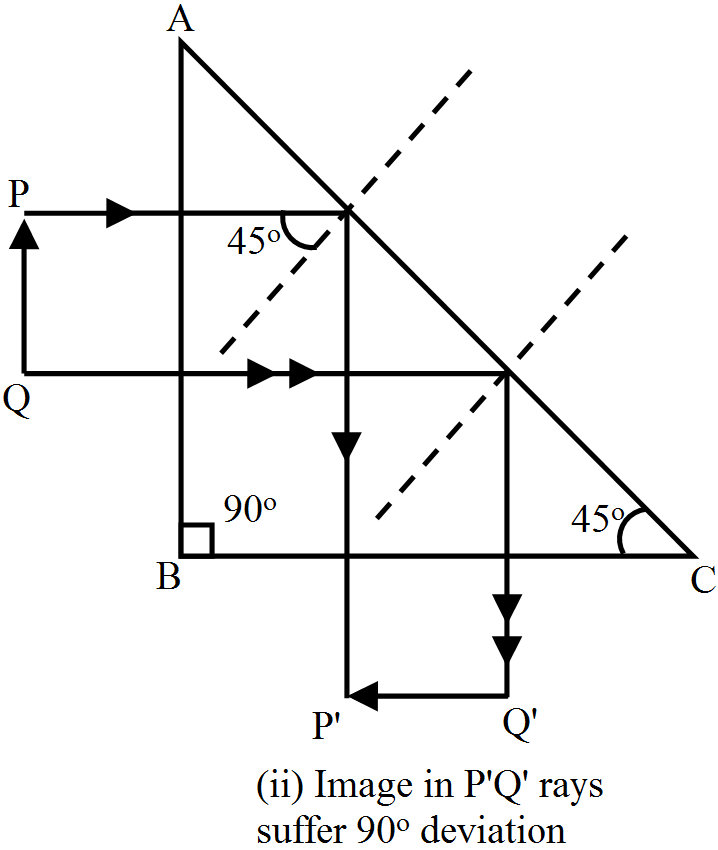
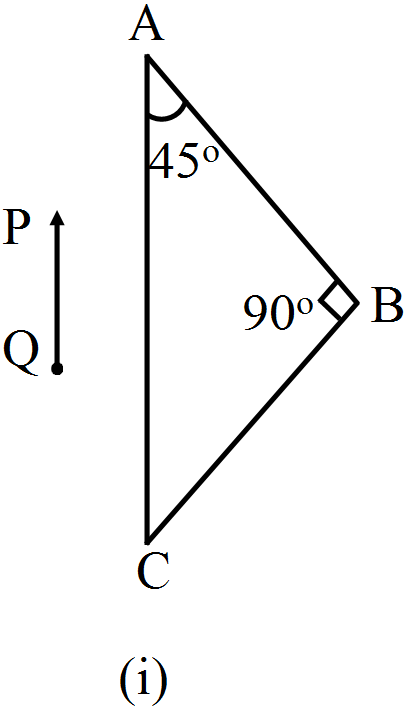
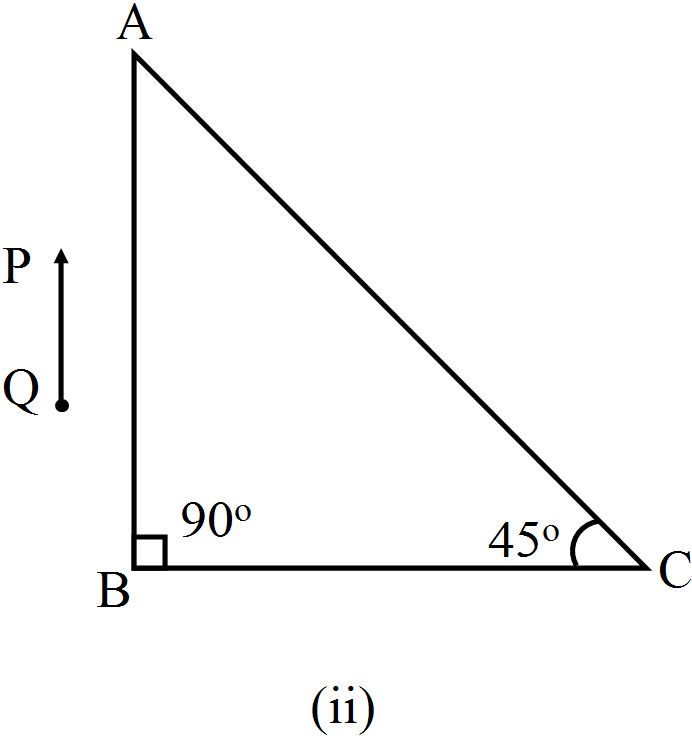
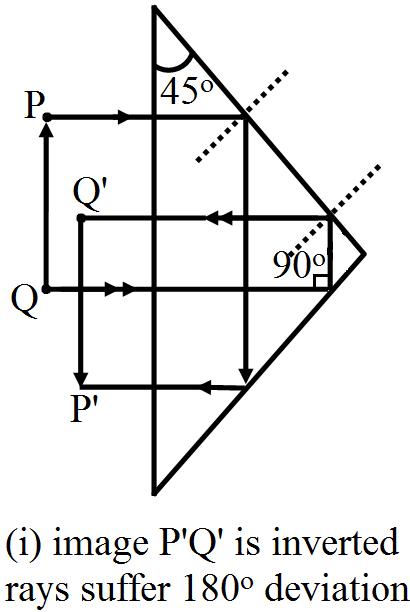
A right-angled crown glass prism with critical angle 41° is placed before an object, PQ in two positions as shown in the figures (i) and (ii). Trace the paths of the rays from P and Q passing through the prisms in the two cases.
Answer

The formation of images is shown in figures (i) and (ii).

Need a full question paper?

Generate a complete, print-ready paper with questions like this in minutes — across 16+ boards, with answer keys.

Start Generating Free

Similar questions

The internal resistance of an accumulator battery of emf 6V is $10\Omega$ when it is fully discharged. As the battery gets charged up, its internal resistance decreases to $1\Omega.$
The battery in its completely discharged state is connected to a charger that maintains a constant potential difference of 9V. Find the current through the battery (a) just after the connections are made and (b) after a long time when it is completely charged.
Provide the classification of solids on the basis of the relative values of electrical conductivity $(\sigma)$ or resistivity $(\rho).$
When a capacitor is charged by a battery; is the energy stored in the capacitor same as energy supplied by the battery?
Find the maximum kinetic energy of the photoelectrons ejected when light of wavelength 350nm is incident on a cesium surface. Work function of cesium = 1.9eV
Why cannot longitudinal waves be polarized?
Derive an expression for (i) induced emf and (ii) induced current when a conductor of length l is moved with a uniform velocity, normal to a uniform magnetic field B. Assume the resistance of conductor to be R.
If work function of caesium metal is $2.14\ eV ,$ then calculate its threshold frequency.
The instantaneous voltage from an ac source is given by $\text{E}=300\sin314\text{t};$ what is the rms voltage of the source.
Answer the following question:
Magnifying power of a simple microscope is inversely proportional to the focal length of the lens. What then stops us from using a convex lens of smaller and smaller focal length and achieving greater and greater magnifying power?
Explain : Static electric field inside a conductor is zero.