Question
A right circular cone and a right circular cylinder have equal base and equal height. If the radius of the base and height are in the ratio 5 : 12, write the ratio of the total surface area of the cylinder to that of the cone.

Answer

Let r = 5x and h = 12x be the base radius and height of the cone and cylinder respectively.
Slant height of the cone
$\text{l}=\sqrt{\text{r}^2+\text{h}^2}$
$=\sqrt{(5\text{x})^2+(12\text{x}^2)^2}$
$=\sqrt{25\text{x}^2+144\text{x}^2}$
$\Rightarrow\text{l}=13\text{x}$
The total surface area of cylinder
$\text{S}_1=2\pi\text{r}(\text{h}+\text{r})$
The total surface area of cone
$\text{s}_2=2\pi\text{r}(\text{l}+\text{r})$
Now,
$\Rightarrow\frac{\text{S}_1}{\text{S}_2}=\frac{2\pi\text{r}(\text{h}+\text{r})}{\pi\text{r}(\text{l}+\text{r})}$
$=\frac{2(\text{h}+\text{r})}{(\text{l}+\text{r})}$
$\Rightarrow\frac{\text{S}_1}{\text{S}_2}=\frac{2(12\text{x}+5\text{x})}{13\text{x}+5\text{x}}$
$\Rightarrow\frac{\text{S}_1}{\text{S}_2}=\frac{2\times17\text{x}}{18\text{x}}$
$\Rightarrow\text{S}_1:\text{S}_2=17:9$
Hence, the required ratio are 17 : 9

Need a full question paper?

Generate a complete, print-ready paper with questions like this in minutes — across 16+ boards, with answer keys.
Start Generating Free

Similar questions

A(6, 1), B(8, 2) and C(9, 4) are three vertices of a parallelogram ABCD. If E is the mid-point of DC, find the area of $\triangle\text{ADE.}$
If $2 x+y=23$ and $4 x-y=19,$ find the value of $(5 y-2 x)$ and $\left(\frac{y}{x}-2\right)$.
A lot consists of 144 ball pens of which 20 are defective and others good. Nutri will buy a pen if it is good, but will not buy if it is defective. the shopkeeper draws one pen at random and gives it to her. What is the probability that:
  1. She will buy it?
  2. She will not buy it?
The sum of first $n$ terms of an A.P. is $3 n^2+4 n$. Find the $25^{\text {th }}$ term of this A.P.
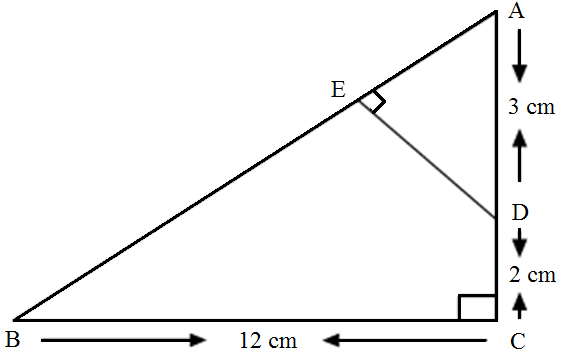
In the given figure, $\triangle\text{ABC}$ is right angled at C and $\text{DE}\perp\text{AB.}$ Prove that $\triangle\text{ABC}\sim\triangle\text{ADE}$ and hence find the length of AE and DE.
Find that non$-$zero value of $k$, for which the quadratic equation $k x^2+1-2(k-1) x+x^2=0$ has equal roots. Hence find the roots of the equation.
The largest sphere is to be curved out of a right circular cylinder of radius $7\ cm$ and height $14\ cm$. Find the volume of the sphere.
I toss three coins together. The possible outcomes are no heads, $1$ head, $2$ heads and $3$ heads. So, I say that probability of no heads is $\frac{1}{4}.$ What is wrong with this conclusion?
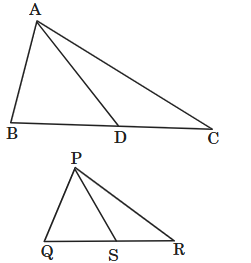
In the given figure $\triangle A B D \sim \triangle P Q S$ when $A D$ and $P S$ are medians. Prove that $\triangle A B C \sim \triangle P Q R$.
Image
Prove that: $\frac{1+\sec A}{\sec A}=\frac{\sin ^2 A}{1-\cos A}$