Question
Prove that: $\frac{1+\sec A}{\sec A}=\frac{\sin ^2 A}{1-\cos A}$

Answer

Using the Left hand side of the equation
$\Rightarrow \frac{1+\sec A}{\sec A}$
Putting sec $A=\frac{1}{\cos A}$
$\frac{1+\frac{1}{\cos A}}{\frac{1}{\cos A}}$
$=\frac{\frac{\cos A+1}{\cos A}}{\frac{1}{\cos A}}$
$=\cos A+1$
Using the Right hand side of the equation
$\Rightarrow \frac{\sin ^2 A}{1-\cos A}$
We know $\sin 2 A=1-\cos ^2 A$
$\Rightarrow \frac{1-\cos ^2 A}{1-\cos A}$
$\frac{(\cos A+1)(1-\cos A)}{1-\cos A}$
$\Rightarrow 1+\cos A$
Hence, proved.

Need a full question paper?

Generate a complete, print-ready paper with questions like this in minutes — across 16+ boards, with answer keys.

Start Generating Free

Similar questions

If the squared difference of the zeroes of the quadratic polynomial $f(x) = x^2 + px + 45$ is equal to $144$, find the value of$ p$.
The weights $($in $kg)$ of $50$ wild animals of a National Park were recorded and the following data was obtained:
Weight $($in $kg)$ Number of animals
$100 - 110$ $4$
$110 - 120$ $12$
$120 - 130$ $23$
$130 - 140$ $8$
$140 - 150$ $3$
Find the mean weight $($in $kg)$ of animals, using assumed mean method.
If $\tan\theta+\sec\theta=\text{l},$ then prove that $\sec\theta=\frac{\text{l}^2+1}{2\text{l}}.$
Very-Short and Short-Answer Questions:
Write the number of solutions of the following pair of linear equations:
$2x + 3y = 7$
$(k - 1)x + (k + 2)y = 3k$
If $\alpha$ and $\beta$ are the zeroes of the quadratic polynomial $p(y) = 5y^2 - 7y + 1$, find the value of $\frac{1}{\alpha}+\frac{1}{\beta}$
$504$ cones, each of diameter $3.5 \ cm$ and height $3 \ cm ,$ are melted and recast into a metallic sphere. Find the diameter of the sphere and hence find its surface area. $[$Use $=\frac{22}{7} ]$
If the sum of the zeros of the quadratic polynomial $f(t) = kt^2 + 2t + 3k$ is equal to their product, find the value of k.
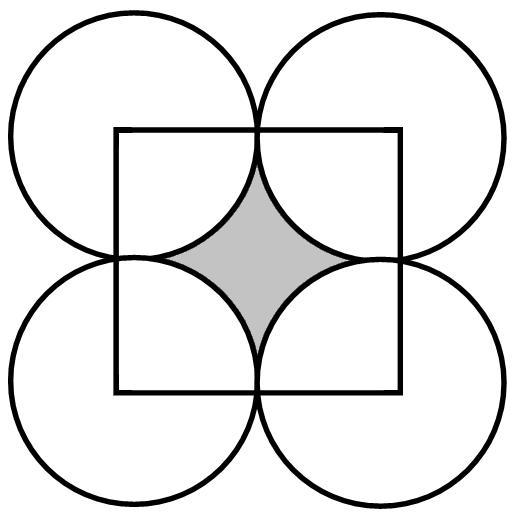
The diameter of a coin is $1\ cm$ (in the following figure). If four such coins be placed on a table so that the rim of each touches that of the other two, find the area of the shaded region $\big(\text{Take }\pi = 3.1416\big). $
Find the sum of two middle terms of the $\text{A.P.:}-\frac{4}{3},-1,\frac{-2}{3},-\frac{1}{3}, .....\ ,4\frac{1}{3}.$
For the following arithmetic progressions write the first term a and the common difference d:
$0.3, 0.55, 0.80, 1.05, ....$