MCQ
A ring has a total mass M but non-uniformly distributed over its circumference. The radius of the ring is R. A point mass m is placed at the centre of the ring. Work done in taking away this point mass from centre to infinity is:
  • A
    $-\frac{\text{GMm}}{\text{R}}$
  • B
    $\frac{\text{GMm}}{\text{R}}$
  • C
    $-\frac{\text{GMm}}{2\text{R}}$
  • D
    $\frac{\text{GMm}}{\text{R}^2}$

Answer

  1. $\frac{\text{GMm}}{\text{R}}$

Need a full question paper?

Generate a complete, print-ready paper with questions like this in minutes — across 16+ boards, with answer keys.

Start Generating Free

Similar questions

The $r.m.s.$ speed of the molecules of a gas in a vessel is $400$ $m{s^{ - 1}}$. If half of the gas leaks out, at constant temperature, the $r.m.s.$ speed of the remaining molecules will be ..... $ms^{-1}$
A block slides down an inclined plane of slope of angle $\theta $ with a constant velocity. It is then projected up the plane with an initial velocity $u$. The distance upto which it will rise before coming to rest is
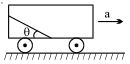
A smooth rod of length $l$ is kept inside a trolley at an angle $\theta$ as shown in the figure. What should be the acceleration a of the trolley so that the rod remains in equilibrium with respect to it?
A particle moves on a straight line with a uniform velocity. The angular momentum of the particle is:
A symmetric double convex lens is cut in two equal parts by a plane perpendicular to the principal axis. If the power of the original lens was 4D, the power of a cutlens will be:
  1. 2D
  2. 3D
  3. 4D
  4. 5D.
The pressure p and volume V of an ideal gas both increase in a process.
  1. Such a process is not possible.
  2. The work done by the system is positive.
  3. The temperature of the system must increase.
  4. Heat supplied to the gas is equal to the change in internal energy.
The Working of an atomizer depends upon
A boy ties a stone of mass $100 \,g$ to the end of a $2$ $m$ long string and whirls it around in a horizontal plane. The string can withstand the maximum tension of $80 \,N$. If the maximum speed with which the stone can revolve is $\frac{ K }{\pi} rev$. / $min$. The value of $K$ is (Assume the string is massless and unstretchable)
$A$ source $S$ of frequency $f_0$ and an observer $O$, moving with speeds $v_1$ and $v_2$ respectively, are movinng away from each other. When they are separated by distance a $(t =0)$, a pulse is emitted by the source. This pulse is received by $O$ at time $t_1$ then $t_1$, is equal to
Spherical balls of radius $ 'r'$  are falling in a viscous fluid of viscosity '$\eta$' with a velocity $ 'v'. $ The retarding viscous force acting on the spherical ball is