Question types

Gravitation question types

509 questions across 6 question groups — pick any mix to generate a Physics paper with step-by-step answer keys.

509
Questions
6
Question groups
5
Question types
Sample Questions

Gravitation questions

One sample from each question group in this chapter. Select any group above to see the full set with answer keys.

According to Kepler's law of planetary motion, if T represents time period and r is orbital radius, then for two planets these are related as:
  • A
    $\Big(\frac{\text{T}_1}{\text{T}_2}\Big)^3=\Big(\frac{\text{r}_1}{\text{r}_2}\Big)^2$
  • B
    $\Big(\frac{\text{T}_1}{\text{T}_2}\Big)^\frac32=\frac{\text{r}_1}{\text{r}_2}$
  • C
    $\Big(\frac{\text{T}_1}{\text{T}_2}\Big)^2=\Big(\frac{\text{r}_1}{\text{r}_2}\Big)^3$
  • D
    $\Big(\frac{\text{T}_1}{\text{T}_2}\Big)=\Big(\frac{\text{r}_1}{\text{r}_2}\Big)^\frac23$
View full solution
A planet has twice the density of earth but the acceleration due to gravity on its surface is exactly the same as on the surface of earth. It radius in terms of radius of earth R will be:
  • A
    $\frac{\text{R}}{4}$
  • B
    $\frac{\text{R}}{2}$
  • C
    $\frac{\text{R}}{3}$
  • D
    $\frac{\text{R}}{8}$
View full solution
The escape velocity of a body from the earth is ve. If the radius of earth contracts to $\frac{1}{4}\text{th}$ of its value, keeping the mass of the earth constant, escape velocity will be:
  • A
    Doubled.
  • B
    Halved.
  • C
    Tripled.
  • D
    Unaltered.
View full solution
The orbital velocity of a satellite orbiting near the surface of the earth is given by:
  • A
    $\text{v}\sqrt{\text{gR}_\text{e}},$ where $\text{g}=\frac{\text{GM}_\text{e}}{\text{R}^2_\text{e}}$
  • B
    $\text{v}=\sqrt{\text{gR}_\text{e}},$ where $\text{g}=\frac{\text{GM}_\text{e}}{\text{R}_\text{e}}$
  • C
    $\text{v}=\sqrt{\frac{\text{gh}}{\text{R}_\text{e}}},$ where $\text{g}=\frac{\text{GM}_\text{e}}{\text{R}^2_\text{e}}$
  • D
    $\text{v}=\sqrt{\text{gh}},$ where $\text{g}=\frac{\text{GM}_\text{e}}{\text{R}_\text{e}}$
View full solution
An artificial earth satellite of mass m is circling round the earth in an orbit of radius R. If the mass of the earth is M, then the total energy of the satellite is:
  • A
    $\frac{3\text{GMm}}{2\text{R}}$
  • B
    $\frac{-\text{GMm}}{2\text{R}}$
  • C
    $\frac{\text{GMm}}{\text{R}}$
  • D
    $\frac{-\text{GMm}}{\text{R}}$
View full solution
Choose the correct alternative:
Acceleration due to gravity increases/ decreases with increasing depth (assume the earth to be a sphere of uniform density).
View full solution
Choose the correct alternative:
The formula $-\text{G Mm}\Big(\frac{1}{\text{r}_2}-\frac{1}{\text{r}_1}\Big)$ is more/ less accurate than the formula mg(r2 - r1) for the difference of potential energy between two points r2 and r1 distance away from the centre of the earth.
View full solution
A comet orbits the sun in a highly elliptical orbit. Does the comet have a constant (a) linear speed, (b) angular speed, (c) angular momentum, (d) kinetic energy, (e) potential energy, (f) total energy throughout its orbit? Neglect any mass loss of the comet when it comes very close to the Sun.
View full solution
Choose the correct alternative:
If the zero of potential energy is at infinity, the total energy of an orbiting satellite is negative of its kinetic/ potential energy.
View full solution
Answer the following:
If you compare the gravitational force on the earth due to the sun to that due to the moon, you would find that the Sun’s pull is greater than the moon’s pull. (you can check this yourself using the data available in the succeeding exercises). However, the tidal effect of the moon’s pull is greater than the tidal effect of sun. Why?
View full solution
Answer the following:
An astronaut inside a small space ship orbiting around the earth cannot detect gravity. If the space station orbiting around the earth has a large size, can he hope to detect gravity?
View full solution
Answer the following:
You can shield a charge from electrical forces by putting it inside a hollow conductor. Can you shield a body from the gravitational influence of nearby matter by putting it inside a hollow sphere or by some other means?
View full solution
An astronaut inside a small space ship orbiting around the earth cannot detect gravity. If the space station orbiting around the earth has a large size, can he hope to detect gravity?
View full solution
Q 163 Marks Question3 Marks
Two stars each of one solar mass (= 2 × 1030kg) are approaching each other for a head on collision. When they are a distance 109km, their speeds are negligible. What is the speed with which they collide? The radius of each star is 104km. Assume the stars to remain undistorted until they collide. (Use the known value of G).
View full solution
Q 173 Marks Question3 Marks
As you have learnt in the text, a geostationary satellite orbits the earth at a height of nearly 36,000km from the surface of the earth. What is the potential due to earth’s gravity at the site of this satellite? (Take the potential energy at infinity to be zero). Mass of the earth = 6.0 × 1024kg, radius = 6400km.
View full solution
Q 183 Marks Question3 Marks
Two heavy spheres each of mass 100kg and radius 0.10m are placed 1.0m apart on a horizontal table. What is the gravitational force and potential at the mid point of the line joining the centres of the spheres? Is an object placed at that point in equilibrium? If so, is the equilibrium stable or unstable?
View full solution
Q 203 Marks Question3 Marks
A rocket is fired from the earth towards the sun. At what distance from the earth’s centre is the gravitational force on the rocket zero? Mass of the sun = 2 × 1030kg, mass of the earth = 6×1024kg. Neglect the effect of other planets etc. (orbital radius = 1.5 × 10¹¹m).
View full solution
Q 214 Marks Question4 Marks
Read the passage given below and answer the following questions from 1 to 5.
If a stone is thrown by hand, we see it falls back to the earth. Of course using machines we can shoot an object with much greater speeds and with greater and greater initial speed, the object scales higher and higher heights. A natural query that arises in our mind is the following: can we throw an object with such high initial speeds that it does not fall back to the earth ?
Thus minimum speed required to throw object to infinity away from earth’s gravitational field is called escape velocity.
$\text{V}_{\text{e}}=\sqrt{(2\text{gr})}$
Where g is acceleration due to gravity and r is radius of earth and after solving ve 11.2 km/s. This is called the escape speed, sometimes loosely called the escape velocity. This applies equally well to an object thrown from the surface of the moon with g replaced by the acceleration due to Moon’s gravity on its surface and r replaced by the radius of the moon. Both are smaller than their values on earth and the escape speed for the moon turns out to be 2.3 km/s, about five times smaller. This is the reason that moon has no atmosphere. Gas molecules if formed on the surface of the moon having velocities larger than this will escape the gravitational pull of the moon.
Earth satellites are objects which revolve around the earth. Their motion is very similar to the motion of planets around the Sun and hence Kepler’s laws of planetary motion are equally applicable to them. In particular, their orbits around the earth are circular or elliptic. Moon is the only natural satellite of the earth with a near circular orbit with a time period of approximately 27.3 days which is also roughly equal to the rotational period of the moon about its own axis.
  1. Time period of moon is:
  1. 27.3 days
  2. 20 days
  3. 85 days
  4. None of these
  1. Escape velocity from earth is given by:
  1. 20 km/s
  2. 11.2 km/s
  3. 2 km/s
  4. None of these
  1. Define escape velocity. Give its formula.
  1. Why moon don’t Have any atmosphere?
  1. What is satellite? Which law governs them?
View full solution
Q 224 Marks Question4 Marks
Read the passage given below and answer the following questions from 1 to 5.
Satellites in a circular orbits around the earth in the equatorial plane with T = 24 hours are called Geostationary Satellites. Clearly, since the earth rotates with the same period, the satellite would appear fixed from any point on earth. It takes very powerful rockets to throw up a satellite to such large heights above the earth but this has been done in view of the several benefits of many practical applications. Thus radio waves broadcast from an antenna can be received at points far away where the direct wave fails to reach on account of the curvature of the earth. Waves used in television broadcast or other forms of communication have much higher frequencies and thus cannot be received beyond the line of sight. A Geostationery satellite, appearing fixed above the broadcasting station can however receive these signals and broadcast them back to a wide area on earth. The INSAT group of satellites sent up by India is one such group of geostationary satellites widely used for telecommunications in India.
Another class of satellites is called the Polar satellites. These are low altitude (500 to 800 km) satellites, but they go around the poles of the earth in a north-south direction whereas the earth rotates around its axis in an east-west direction. Since its time period is around 100 minutes it crosses any altitude many times a day. However, since its height h above the earth is about 500-800 km, a camera fixed on it can view only small strips of the earth in one orbit. Adjacent strips are viewed in the next orbit, so that in effect the whole earth can be viewed strip by strip during the entire day. These satellites can view polar and equatorial regions. at close distances with good resolution. Information gathered from such satellites is extremely useful for remote sensing, meterology as well as for environmental studies of the earth.
  1. Time period of geospatial satellite is:
  1. 24 hours
  2. 48 hours
  3. 72 hours
  4. None of these
  1. Polar satellites are approximately revolving at height of
  1. 500 to 800km
  2. 1500 to 2000km
  3. 3000 to 4000km
  4. None of these
  1. Which satellite used to view polar and equatorial regions?
  1. Write note on polar satellites
  1. Write a note on geostationary satellite. Give its applications.
View full solution
Q 234 Marks Question4 Marks
Read the passage given below and answer the following questions from 1 to 5.
Satellites in a circular orbits around the earth in the equatorial plane with T = 24 hours are called Geostationary Satellites. Clearly, since the earth rotates with the same period, the satellite would appear fixed from any point on earth. It takes very powerful rockets to throw up a satellite to such large heights above the earth but this has been done in view of the several benefits of much practical application. Weight of an object is the force with which the earth attracts it. We are conscious of our own weight when we stand on a surface, since the surface exerts a force opposite to our weight to keep us at rest. The same principle holds good when we measure the weight of an object by a Spring balance hung from a fixed point e.g. the ceiling. The object would fall down unless it is subject to a force opposite to gravity. This is exactly what the spring exerts on the object. This is because the spring is pulled down a little by the gravitational pull of the object and in turn the spring exerts a force on the object vertically upwards. Now, imagine that the top end of the balance is no longer held fixed to the top ceiling of the room. Both ends of the spring as well as the object move with identical acceleration g. The spring is not stretched and does not exert any upward force on the object which is moving down with acceleration g due to gravity. The reading recorded in the spring balance is zero since the spring is not stretched at all. If the object were a human being, he or she will not feel his weight since there is no upward force on him. Thus, when an object is in free fall, it is weightless and this phenomenon is usually called the phenomenon of weightlessness. In a satellite around the earth, every part and parcel of the satellite has acceleration towards the centre of the earth which is exactly the value of earth’s acceleration due to gravity at that position. Thus in the satellite everything inside it is in a state of free fall. This is just as if we were falling towards the earth from a height. Thus, in a manned satellite, people inside experience no gravity. Gravity for us defines the vertical direction and thus for them there are no horizontal or vertical directions, all directions are the same.
  1. Astronaut experiences weightlessness in space because:
  1. Acceleration due to gravity is zero.
  2. Actual weight of astronaut is zero.
  3. They are going with same acceleration due to gravity.
  4. None of these.
  1. Weighing machine measures:
  1. Mass of the person.
  2. Normal reaction exerted by machine on person.
  3. Both a and b.
  4. None of these.
  1. What is geostationary satellite?
  1. What is weight? How it is measured?
  1. What is weightlessness astronaut in satellite experienced by ?
View full solution
Q 244 Marks Question4 Marks
Read the passage given below and answer the following questions from 1 to 5.
Earth’s Satellite:
Earth satellites are objects which revolve around the earth. Their motion is very similar to the motion of planets around the Sun. In particular, their orbits around the earth are circular or elliptic. Moon is the only natural satellite of the earth with a near circular orbit with a time period of approximately 27.3 days which is also roughly equal to the rotational period of the moon about its own axis. Also,  the speed that a satellite needs to be travelling to break free of a planet or moon’s gravity well and leave it without further propulsion is known as escape velocity. For example, a spacecraft leaving the surface of earth needs to be going 7 miles per second or nearly 25000 miles per hour to leave without falling back to the surface or falling into orbit.
  1. Gas escapes from the surface of a planet because it acquires an escape velocity. The escape velocity will depend on which of the following factors?
  1. Mass of the planet
  2. Mass of the particle escaping
  3. Temperature of the planet
  4. None of the above
  1. The escape velocity of a satellite from the earth is ve If the radius of earth contracts to $(\frac{1}{4})$ th of its value, keeping the mass of the earth constant, escape velocity will be:
  1. doubled
  2. halved
  3. tripled
  4. unaltered
  1. The ratio of escape velocity at earth (ve) to the escape velocity at a planet (v p), whose radius and mean density are twice as that of earth is:
  1. $1:2\sqrt{2}$
  2. 1 : 4
  3. $1:\sqrt{2}$
  4. 1 : 2
  1. A satellite S is moving in an elliptical orbit around the earth. The mass of the satellite is very small as compared to the mass of the earth, then:
  1. the angular momentum of S about the centre of the earth changes in direction, but its magnitude remains constant
  2. the total mechanical energy of S varies periodically with time
  3. the linear momentum of S remains constant in magnitude
  4. the acceleration of S is always directed towards the centre of the earth
  1. The orbital velocity of an artificial satellite in a circular orbit just above the earth’s surface is vo The orbital velocity of a satellite orbiting at an altitude of half of the radius, is:
  1. $\frac{3}{2}\text{v}_\circ$
  2. $\frac{2}{3}\text{v}_\circ$
  3. $\sqrt{\frac{3}{2}\text{v}_\circ}$
  4. $\sqrt\frac{2}{3}\text{v}_\circ$
View full solution
Q 254 Marks Question4 Marks
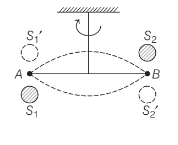
Read the passage given below and answer the following questions from 1 to 5.
Cavendish’s Experiment
The figure shows the schematic drawing of Cavendish’s experiment to determine the value of the gravitational constant. The bar AB has two small lead spheres attached at its ends. The bar is suspended from a rigid support by a fine wire. Two large lead spheres are brought close to the small ones but on opposite sides as shown. The value of G from this experiment came to be $6.67\times10^{-11}\frac{\text{N-m}^2}{\text{Kg}^2}$

  1. The big spheres attract the nearby small ones by a force which is:
  1. equal and opposite
  2. equal but in same direction
  3. unequal and opposite
  4. None of the above
  1. The net force on the bar is:
  1. non-zero
  2. zero
  3. Data insufficient
  4. None of these
  1. The net torque on the bar is:
  1. zero
  2. non-zero
  3. F times the length of the bar, where F is the force of attraction between a big sphere and its neighbouring
  4. Both (b) and (c)
  1. The torque produces twist in the suspended wire. The twisting stops when:
  1. restoring torque of the wire equals the gravitational torque
  2. restoring torque of the wire exceeds the gravitational torque
  3. the gravitational torque exceeds the restoring torque of the wire
  4. None of the above
  1. After Cavendish’s experiment, there have been given suggestions that the value of the gravitational constant G becomes smaller when considered over very large time period (in billions of years) in the future. If that happens, for our earth:
  1. nothing will change
  2. we will become hotter after billions of years
  3. we will be going around but not strictly in closed orbits
  4. None of the above
View full solution
Does the escape speed of a body from the earth depend on (a) the mass of the body, (b) the location from where it is projected, (c) the direction of projection, (d) the height of the location from where the body is launched?
View full solution
Assuming the earth to be a sphere of uniform mass density, how much would a body weigh half way down to the centre of the earth if it weighed 250N on the surface?
View full solution
Which of the following symptoms is likely to afflict an astronaut in space (a) swollen feet, (b) swollen face, (c) headache, (d) orientational problem.
View full solution
A satellite orbits the earth at a height of 400km above the surface. How much energy must be expended to rocket the satellite out of the earth’s gravitational influence? Mass of the satellite = 200kg; mass of the earth = 6.0 × 1024kg; radius of the earth = 6.4 × 10⁶m; G = 6.67 × 10⁻¹¹N m2 kg-2.
View full solution

Generate a Gravitation paper free

Pick question groups from the list above, set marks and difficulty, and export a branded PDF with step-by-step answer keys. First 3 chapters free — no signup.

Download App