MCQ
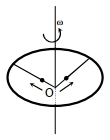
A ring of mass $M$ and radius $R$ is rotating with angular speed $\omega$ about a fixed vertical axis passing through its centre $O$ with two point masses each of mass $\frac{ M }{8}$ at rest at $O$. These masses can move radially outwards along two massless rods fixed on the ring as shown in the figure. At some instant the angular speed of the system is $\frac{8}{9} \omega$ and one of the masses is at a distance of $\frac{3}{5} R$ from $O$. At this instant the distance of the other mass from $O$ is
- A$\frac{2}{3} R$
- B$\frac{1}{3} R$
- C$\frac{3}{5} R$
- ✓$\frac{4}{5} R$