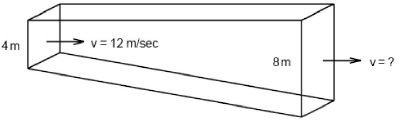
A river gradually deepens, from a depth of $4 \ m$ to a depth of $8\ m$ as shown. The width, $W$, of the river does not change. At the depth of $4 \ m$, the river's speed is $12\ m/sec.$ Its elocity at the $8\ m$ depth is ......... $m/sec$
Easy


Download our appand get started for free
Experience the future of education. Simply download our apps or reach out to us for more information. Let's shape the future of learning together!No signup needed.*
Similar Questions
- 1A Spherical ball of radius $1 mm$ and density $10.5 g / cc$ is dropped in glycerine of coefficient of viscosity $9.8$ poise and density $1.5 g / cc$. Viscous force on the ball when it attains constant velocity is $3696 \times 10^{-x} N$. The value of $x$ is $\text { (Given, } g =9.8 m / s ^2 \text { and } \pi=\frac{22}{7} \text { ) }$View Solution
- 2An open glass tube is immersed in mercury in such a way that a length of $8\ cm$ extends above the mercury level. The open end of the tube is then closed and sealed and the tube is raised vertically up by additional $46\ cm$. What will be length of the air column above mercury in the tube now ....... $cm$ ?View Solution
( Atmospheric pressure = $76\ cm$ of $Hg$)
- 3An aeroplane of mass $3 \times 10^4\,kg$ and total wing area of $120\,m^2$ is in a level flight at some height. The difference in pressure between the upper and lower surfaces of its wings in kilopascals is........... $kPa$ $(g=10\,m/s^2)$View Solution
- 4A hydraulic automobile lift is designed to lift cars with a maximum mass of $3000\, kg$. The area of cross section a of piston carrying the load is $425\, cm ^{2}$. What is the maximum pressure () would smaller piston have to bear ?View Solution
- 5If the terminal speed of a sphere of gold ( density $= 19.5 kg/m^3$) is $0.2\ m/s$ in a viscous liquid (density $= 1.5\ kg/m^3$ ), find the terminal speed (in $m/s$) of a sphere of silver (density $= 10.5\ kg/m^3$) of the same size in the same liquid ...... $m/s$View Solution
- 6A glass tube of uniform internal radius ( $\mathrm{r}$ ) has a valve separating the two identical ends. Initially, the valve is in a tightly closed position. End $1$ has a hemispherical soap bubble of radius $\mathrm{r}$. End $2$ has sub-hemispherical soap bubble as shown in figure. Just after opening the valve,View Solution
Figure: $Image$
- 7Asphere of radius $R$ and made of material of relative density $\sigma$ has a concentric cavity of radius $r$. It just floats when placed in a tank full of water. The value of the ratio $R/r$ will beView Solution
- 8A stream-lined body falls through air from a height $h$ on the surface of liquid. Let $d$ and $D$ denote the densities of the materials of the body and the liquid respectively. If $D > d$, then the time after which the body will be instantaneously at rest, isView Solution
- 9A spherical body of radius $R$ consists of a fluid of constant density and is in equilibrium under its own gravity. If $P ( r )$ is the pressure at $r ( r < R )$, then the correct option$(s)$ is(are)View Solution
$(A)$ $P ( I =0)=0$ $(B)$ $\frac{ P ( r =3 R / 4)}{ P ( r =2 R / 3)}=\frac{63}{80}$
$(C)$ $\frac{ P ( r =3 R / 5)}{ P ( r =2 R / 5)}=\frac{16}{21}$ $(D)$ $\frac{ P ( r = R / 2)}{ P ( r = R / 3)}=\frac{20}{27}$
- 10In the following fig. is shown the flow of liquid through a horizontal pipe. Three tubes $A, B$ and $ C$ are connected to the pipe. The radii of the tubes $A, B $ and $C$ at the junction are respectively $ 2 cm, 1 cm$ and $2 cm.$ It can be said that theView Solution