Question
A rocket accelerates straight up by ejecting gas downwards. In a small time interval $\Delta\text{t},$ it ejects a gas of mass $\Delta\text{m}$ at a relative speed u. Calculate KE of the entire system at $\text{t}+\Delta\text{t}$ and t and show that the device that gas does work $=\Big(\frac{1}{2}\Big)\Delta\text{mu}^2$ in this time interval (neglect gravity).

Answer

Let mass of rocket at any time t = M

Velocity of rocket at any time t = v

$\Delta\text{m}$ is the mass of gas ejected in time interval $\Delta\text{t}$

$(\text{KE})_{\text{t}+\Delta\text{t}}=\frac{1}{2}(\text{M}-\Delta\text{m})(\text{v}+\Delta\text{v})^2+\frac{1}{2}\Delta\text{m}(\text{v}-\text{u})^2$

$=\frac{1}{2}\Big[(\text{M}-\Delta\text{M})(\text{v}+\Delta\text{v})^2+\frac{1}{2}\Delta\text{m}(\text{v}-\text{u})^2\Big]$

$(\text{KE})_{\text{t}+\Delta\text{t}}=\frac{1}{2}\begin{bmatrix}\text{Mv}^2+\text{M}\Delta\text{v}^2+2\text{Mv}\Delta\text{v}-\Delta\text{Mv}^2\\-\Delta\text{m}\Delta\text{v}^2-2\text{v}\Delta\text{m}\Delta\text{v}+\Delta\text{mv}^2+\\\Delta\text{mu}^2-2\text{uv}\Delta\text{m}\end{bmatrix}$

$(\text{KE})_{\text{t}+\Delta\text{t}}=\frac{1}{2}\text{Mv}^2+\text{Mv}\Delta\text{v}+\frac{1}{2}\Delta\text{mu}^2-\text{uu}\Delta\text{m}$

$\big[$neglecting the very small terms $\text{M}\Delta\text{v}^2,\Delta\text{m}\Delta\text{v}^2,2\text{v}\Delta\text{m}\Delta\text{v}$ contains $\Delta\text{v}^2$ and $\Delta\text{m}\Delta\text{v}\big]$

$(\text{KE})_\text{t}=\frac{1}{2}\text{Mv}^2$

$(\text{KE)}_{\text{t}+\Delta\text{t}}-(\text{KE})_\text{t}=\frac{1}{2}\text{Mv}^2+\text{Mv}\Delta\text{v}+\frac{1}{2}\Delta\text{mu}^2-\text{uu}\Delta\text{m}-\frac{1}{2}\text{Mv}^2$

$\Delta\text{K}=\frac{1}{2}\Delta\text{mv}^2+\text{v}(\text{M}\Delta\text{v}-\text{v}\Delta\text{m})$

By Newton’s third law,

Reaction force on Rocket (upward) = Action force by burnt gases (downward)

$\text{M}\frac{\text{dv}}{\text{dt}}=\frac{\text{dm}}{\text{dt}}|\text{u}|\ (\because\text{ F}=\text{ma})$

Or $\text{M}\Delta\text{v}=\Delta\text{mu}$

$\text{M}\Delta\text{v}-\text{u}\Delta\text{m}=0$

Substitute this value in (i)

$\text{K}=\frac{1}{2}\text{u}^2\Delta\text{m}$

By work energy theorem $\Delta(\text{KE})=\text{WD}$

Or $\text{W}=\Delta\text{K}=\frac{1}{2}\Delta\text{mu}^2$
Need a full question paper?

Generate a complete, print-ready paper with questions like this in minutes — across 16+ boards, with answer keys.

Start Generating Free

Similar questions

Find the compoenents along the x, y, z axes of the angular momentum $l$ of a particle, whose position vector is $r$ with components $x, y, z$ and momentum is p with components $p_x, p_y$, and $p_z$. Show that if the particle moves only in the $x-y$ plane the angular momentum has only a $z$-component.
How many is energy states are present in one mole of sodium vapour? Are they all filled in normal conditions? "How many 3s energy states are present in one mole of sodium vapour? Are they all filled in normal conditions?
A faulty barometer contains certain amount of air and saturated water vapour. It reads 74.0cm when the atmospheric pressure is 76.0cm of mercury and reads 72.10cm when the atmospheric pressure is 74.0cm of mercury. Saturation vapour pressure at the air temperature = 1.0cm of mercury. Find the length of the barometer tube above the mercury level in the reservoir
A brass boiler has a base area of 0.15m2 and thickness 1.0cm. It boils water at the rate of 6.0kg/ min when placed on a gas stove. Estimate the temperature of the part of the flame in contact with the boiler. Thermal conductivity of brass = 109J s–1 m–1 K–1 ; Heat of vaporisation of water = 2256 × 103J kg–1.
Answer the following:

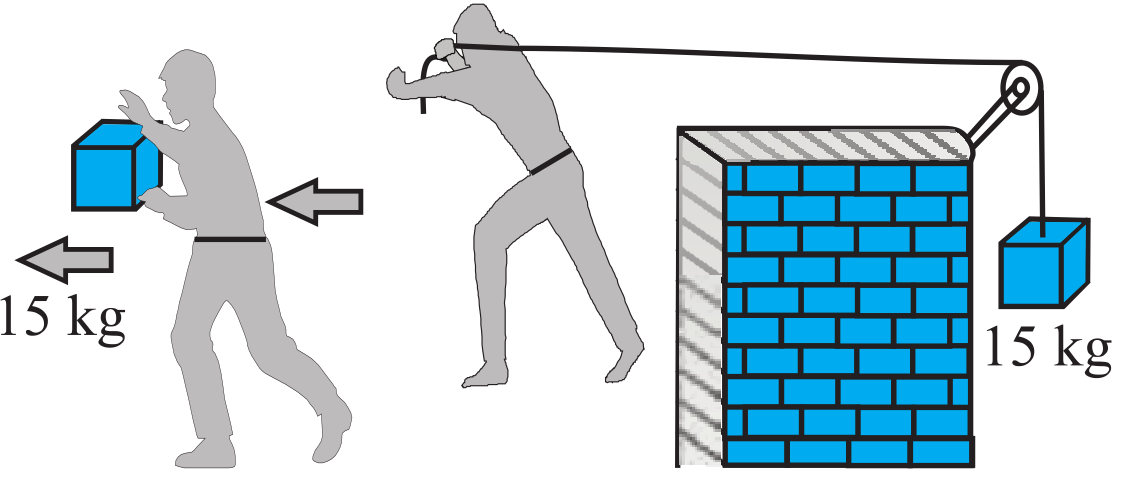
In the man walks 2m carrying a mass of 15kg on his hands. In he walks the same distance pulling the rope behind him. The rope goes over a pulley, and a mass of 15kg hangs at its other end. In which case is the work done greater?

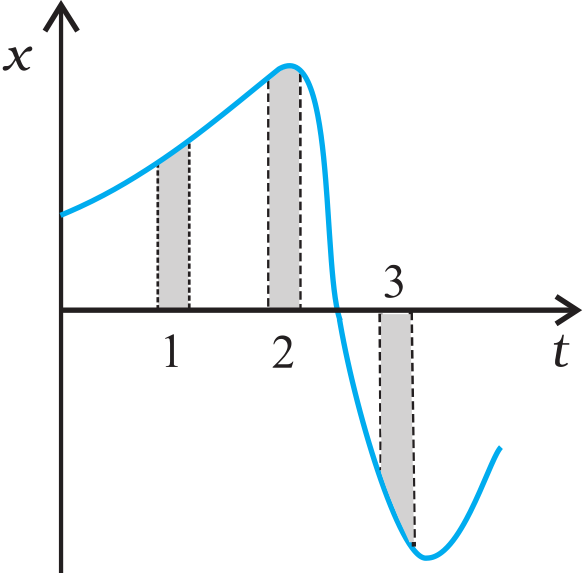
Gives the x-t plot of a particle in one-dimensional motion. Three different equal intervals of time are shown. In which interval is the average speed greatest, and in which is it the least? Give the sign of average velocity for each interval.

10kg mass is attached to one end of a copper wire 3m long and 1mm in diameter. Calculate the lateral compression produced in it (Poisson's ratio is 0.25 and Young's modulus of the material of the wire is 12.5 × 10¹⁰N/ m2).
Explain free simple harmonic oscillation. Taking any one example, explain that the period and frequency of free oscillation depend only on the ratio of mass and stiffness of the objects.
Give example of a motion where x > 0, v < 0, a > 0 at a particular instant.
  1. Define viscosity. Write SI units of coefficient of viscosity.
  2. Define terminal velocity. Establish an expression for it.