Question types
Work, Energy, and Power question types
49 questions across 5 question groups — pick any mix to generate a Physics paper with step-by-step answer keys.
49
Questions
5
Question groups
5
Question types
01
M.C.Q (1 Marks)
21 Q→021 Marks Question
1 Q→032 Marks Questions
5 Q→043 Marks Question
12 Q→055 Marks Questions
10 Q→Sample Questions
Work, Energy, and Power questions
One sample from each question group in this chapter. Select any group above to see the full set with answer keys.
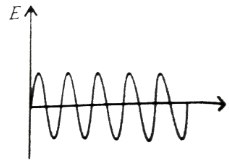
Which of the diagrams shown in represents variation of total mechanical energy of a pendulum oscillating in air as function of time?
- A
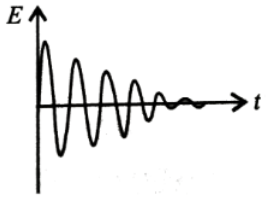
- B
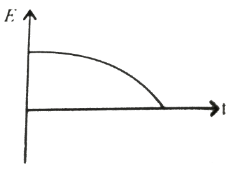
- C
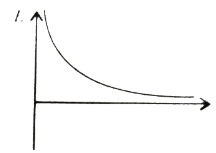
- D
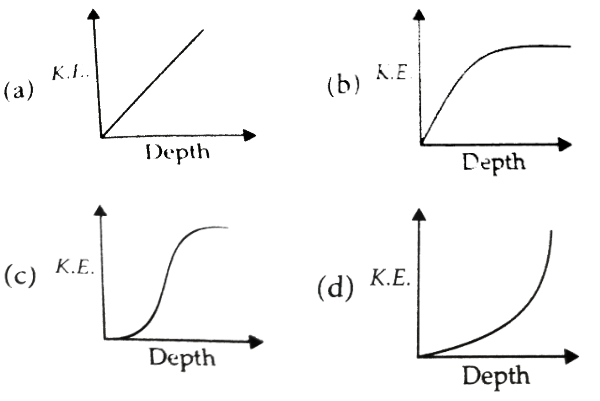
A body is falling freely under the action of gravity alone in vacuum. Which of the following quantities remain constant during the fall?
- Kinetic energy.
- Potential energy.
- Total mechanical energy.
- Total linear momentum.
A man squatting on the ground gets straight up and stand. The force of reaction of ground on the man during the process is:
- Constant and equal to mg in magnitude.
- Constant and greater than mg in magnitude.
- Variable but always greater than mg.
- At first greater than mg, and later becomes equal to mg.
A graph of potential energy V(x) verses x is shown in a particle of energy E0 is executing motion in it. Draw graph of velocity and kinetic energy versus x for one complete cycle AFA.

Calculate the work done by a car against gravity in moving along a straight horizontal road. The mass of the car is 400kg and the distance moved is 2m.
A body is being raised to a height h from the surface of earth. What is the sign of work done by
- Applied force.
- Gravitational force?
Calculate the power of a crane in watts, which lifts a mass of 100kg to a height of 10 m in 20s.
Two bodies of unequal mass are moving in the same direction with equal kinetic energy. The two bodies are brought to rest by applying retarding force of same magnitude. How would the distance moved by them before coming to rest compare?
The average work done by a human heart while it beats once is 0.5J. Calculate the power used by heart if it beats 72 times in a minute.
A raindrop of mass 1.00g falling from a height of 1km hits the ground with a speed of 50m s-1. Calculate:
- The loss of P.E. of the drop.
- The gain in K.E. of the drop.
- Is the gain in K.E. equal to loss of P.E.? If not why.
Take g = 10m s-2
An engine is attached to a wagon through a shock absorber of length 1.5m. The system with a total mass of 50,000kg is moving with a speed of 36km h-1 when the brakes are applied to bring it to rest. In the process of the system being brought to rest, the spring of the shock absorber gets compressed by 1.0m. If 90% of energy of the wagon is lost due to friction, calculate the spring constant.
An adult weighing 600N raises the centre of gravity of his body by 0.25m while taking each step of 1m length in jogging. If he jogs for 6km, calculate the energy utilised by him in jogging assuming that there is no energy loss due to friction of ground and air. Assuming that the body of the adult is capable of converting 10% of energy intake in the form of food, calculate the energy equivalents of food that would be required to compensate energy utilised for jogging.
Suppose the average mass of raindrops is 3.0 × 10⁻⁵kg and their average terminal velocity 9m s-1. Calculate the energy transferred by rain to each square metre of the surface at a place which receives 100 cm of rain in a year.
A rough inclined plane is placed on a cart moving with a constant velocity u on horizontal ground. A block of mass M rests on the incline. Is any work done by force of friction between the block and incline? Is there then a dissipation of energy?
Two pendulums with identical bobs and lengths are suspended from a common support such that in rest position the two bobs are in contact. One of the bobs is released after being displaced by 10° so that it collides elastically head-on with the other bob.

- Describe the motion of two bobs.
- Draw a graph showing variation in energy of either pendulum with time, for
where T is the period of each pendulum.
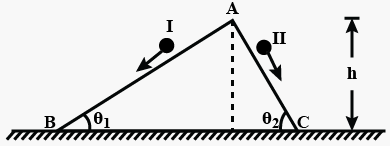
A curved surface is shown in. The portion BCD is free of friction. There are three spherical balls of identical radii and masses. Balls are released from rest one by one from A which is at a slightly greater height than C.

- For which balls is total mechanical energy conserved?
- Which ball (s) can reach D?
- For balls which do not reach D, which of the balls can reach back A?
A bob of mass m suspended by a light string of length L is whirled into a vertical circle as shown in what will be the trajectory of the particle if the string is cut at:
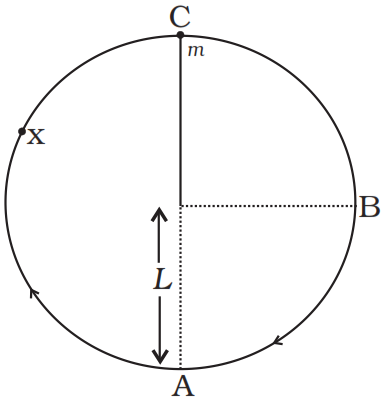
- Point B?
- Point C?P
- oint X?
Two identical steel cubes (masses 50g, side 1cm) collide head-on face to face with a speed of 10cm/ s each. Find the maximum compression of each. Young’s modulus for steel = Y = 2 × 10¹¹ N/ m2.
Consider a one-dimensional motion of a particle with total energy E. There are four regions A, B, C and D in which the relation between potential energy V, kinetic energy (K) and total energy E is as given below:
Region A : V > E
Region B : V < E
Region C : K > E
Region D : V > K
State with reason in each case whether a particle can be found in the given region or not.
Region A : V > E
Region B : V < E
Region C : K > E
Region D : V > K
State with reason in each case whether a particle can be found in the given region or not.
Generate a Work, Energy, and Power paper free
Pick question groups from the list above, set marks and difficulty, and export a branded PDF with step-by-step answer keys. First 3 chapters free — no signup.