MCQ
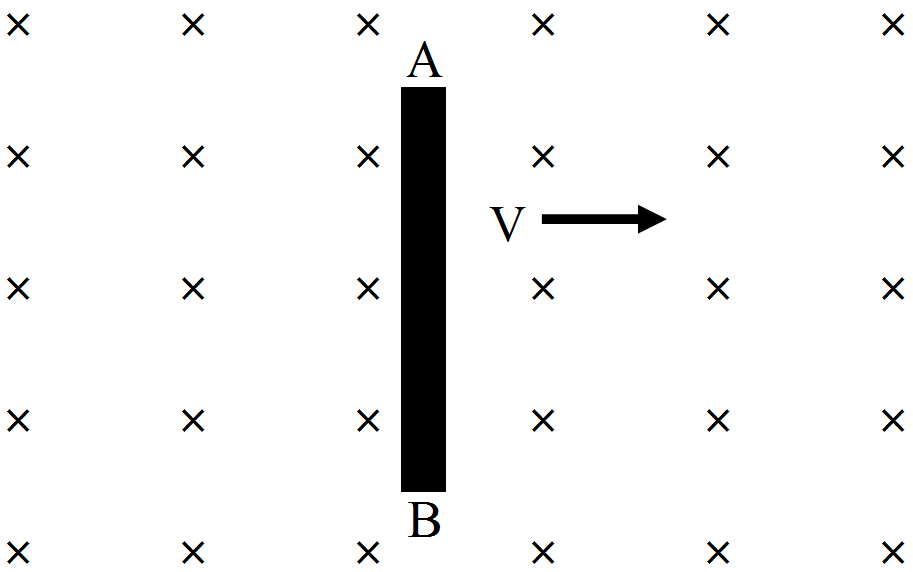
A rod $AB$ moves with a uniform velocity $v$ in a uniform magnetic field as shown in figure.
  • A
    The rod becomes electrically charged.
  • The end $A$ becomes positively charged.
  • C
    The end $B$ becomes positively charged.
  • D
    The rod becomes hot because of Joule heating.
Answer

Correct option: B.
The end $A$ becomes positively charged.
The end $'A\ '$ becomes, positively charged. Because magnetic field exerts an average Force $\overrightarrow{\text{F}}_0=\text{q}\vec{\text{v}}\times\vec{\text{B} } n$ each free electron where $q = 1. 6 \times 10^{19}C$ is the charge on the electron. This Force is towards $AB$ and hence the free electrons will move towareds $B$. Negative charge is accumulated at $'B\ '$ and positive charge appears at $A.$

Need a full question paper?

Generate a complete, print-ready paper with questions like this in minutes — across 16+ boards, with answer keys.

Start Generating Free

Similar questions

A tuning fork of frequency 480Hz is used to vibrate a sonometer wire having natural frequency 240Hz. The wire will vibrate with a frequency of:
A $2 \,{kg}$ steel rod of length $0.6\, {m}$ is clamped on a table vertically at its lower end and is free to rotate in vertical plane. The upper end is pushed so that the rod falls under gravity, Ignoring the friction due to clamping at its lower end, the speed of the free end of rod when it passes through its lowest position is $\ldots \ldots \ldots \ldots \,{ms}^{-1}$. (Take $g = 10\, {ms}^{-2}$ )
The bob of a simple pendulum of mass m and total energy $E$ will have maximum linear momentum equal to
Which of the processes described below are irreversible?
A ball of mass $m$ is thrown upward and another ball of same mass is thrown downward so as to move freely under gravity. The acceleration of centre of mass is .........
A uniform sphere is placed on a smooth horizontal surface and a horizontal force $F$ is applied on it at a distance h above the surface. The acceleration of the centre:
Two friends $A$ and $B$ are waiting for another friend for tea. $A$ took the tea in a cup and mixed the cold milk and then waits. $B$ took the tea in the cup and then mixed the cold milk when the friend comes. Then the tea will be hotter in the cup of
The velocities of three particles of masses $20\ g$, $30\ g$ and $50\ g$ are $10 \vec i,\,10\vec j,\,{\rm{and}}\,10\vec k$ respectively. The velocity of the centre of mass of the three particles is
With what minimum velocity should block be projected from left end $A$ towards end $B$ such that it reaches the other end $B$ of conveyer belt moving with constant velocity $v$. Friction coefficient between block and belt is $\mu$ .
This is the position time graph of a mass on spring. What can you say about the velocity and force at the instant indicated by dashed line ? (positive direction is to the right)