MCQ
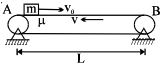
With what minimum velocity should block be projected from left end $A$ towards end $B$ such that it reaches the other end $B$ of conveyer belt moving with constant velocity $v$. Friction coefficient between block and belt is $\mu$ .
  • A
    $\sqrt {\mu gL} $
  • $\sqrt {2\mu gL} $
  • C
    $\sqrt {3\mu gL} $
  • D
    $2\sqrt {\mu gL} $

Answer

Correct option: B.
$\sqrt {2\mu gL} $
b
$a=\mu g$

$0^{2}=v_{0}^{2}-2 \mu g L$ or $v_{0}^{2}=2 \mu g L$

$\therefore V_{0}=\sqrt{2 \mu g L}$

Need a full question paper?

Generate a complete, print-ready paper with questions like this in minutes — across 16+ boards, with answer keys.

Start Generating Free

Similar questions

The thermal conductivity of a material in $CGS$ system is $0.4$ . In steady state, the rate of flow of heat $10 cal/sec-cm2$ , then the thermal gradient will be ....... $^oC/cm$
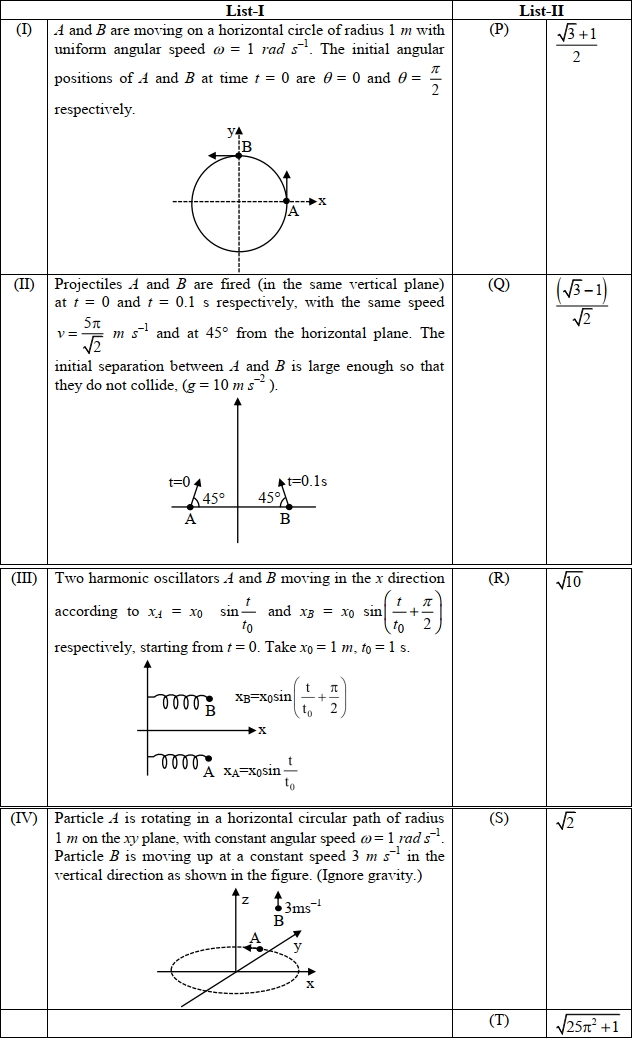
$List I$ describes four systems, each with two particles $A$ and $B$ in relative motion as shown in figure. $List II$ gives possible magnitudes of then relative velocities (in $ms ^{-1}$ ) at time $t=\frac{\pi}{3} s$.

Which one of the following options is correct?

A projectile is hurled into air from a point on the horizontal ground at an angle with the vertical. If the air exerts a constant resistive force,
Which of the following pairs of physical quantities does not have same dimensional formula?
The position of a particle moving along $x$-axis given by $x=\left(-2 t^3+3 t^2+5\right) m$. The acceleration of particle at the instant its velocity becomes zero is ....... $m / s ^2$
Consider the following two statements:
$A.$ Linear momentum of the system remains constant.
$B.$ Centre of mass of the system remains at rest.
A particle is moving with uniform speed along the circumference of a circle of radius $R$ under the action of a central fictitious force $F$ which is inversely proportional to $R ^{3}$. Its time period of revolution will be given by
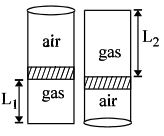
An ideal gas is trapped inside a test tube of cross-sectional area $20 \times 10^{-6} \,\,m^2$ as shown in the figure. The gas occupies a height $L_1$ at the bottom of the tube and is separated from air at atmospheric pressure by a mercury column of mass $0.002\,\, kg$. If the tube is quickly turned isothermally, upside down so that $L_2$ mercury column encloses the gas from below. The gas now occupies height $L_1$ in the tube. The ratio $L_1$ is [Take atmospheric pressure $= 10^5 Nm^{-2}]$ 
Let $\triangle\text{W}_\text{a}$ and $\triangle\text{W}_\text{b}$ be the work done by the systems A and B, respectively, in the previous question.
$Assertion$ : The magnitude of velocity of two boats relative to river is same. Both boats start simultaneously from same point on one bank may reach opposite bank simultaneously moving along different paths.
$Reason$ : For boats to cross the river in same time. The component of their velocity relative to river in direction normal to flow should be same.