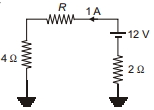
A rod of a certain metal is $1.0\, m$ long and $0.6\, cm$ in diameter. Its resistance is $3.0 × {10^{ - 3}}\, ohm$. Another disc made of the same metal is $2.0\, cm$ in diameter and $1.0\, mm$ thick. What is the resistance between the round faces of the disc
Diffcult
Download our app for free and get started
(b) Resistivity of the material of the rod $\rho = \frac{{RA}}{l} = \frac{{3 \times {{10}^{ - 3}}\pi {{(0.3 \times {{10}^{ - 2}})}^2}}}{1}$= $27 \times {10^{ - 9}}\pi \,\Omega \times m$
Resistance of disc $R = \frac{{({\rm{Thickness}})}}{{({\rm{Area\, of \,cross }}\,{\rm{section}})}}$
= $27 \times {10^{ - 9}}\pi \times \frac{{({{10}^{ - 3}})}}{{\pi \times {{(1 \times {{10}^{ - 2}})}^2}}}$$ = 2.7 \times {10^{ - 7}}\,\Omega .$
Resistance of disc $R = \frac{{({\rm{Thickness}})}}{{({\rm{Area\, of \,cross }}\,{\rm{section}})}}$
= $27 \times {10^{ - 9}}\pi \times \frac{{({{10}^{ - 3}})}}{{\pi \times {{(1 \times {{10}^{ - 2}})}^2}}}$$ = 2.7 \times {10^{ - 7}}\,\Omega .$

Download our appand get started for free
Experience the future of education. Simply download our apps or reach out to us for more information. Let's shape the future of learning together!No signup needed.*
Similar Questions
- 1A heater of $220\, V$ heats a volume of water in $5\,\min$ time. A heater of $110\, V$ heats the same volume of water in ............... $min$View Solution
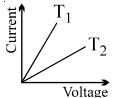
- 2The current in a metallic conductor is plotted against voltage at two different temperatures $T_1$ and $T_2$. Which is correctView Solution
- 3Kirchhoff's first law $i.e.$ $\Sigma i = 0$ at a junction is based on the law of conservation ofView Solution
- 4An electric iron draws $5\, amp$, a $TV$ set draws $3\, amp$ and refrigerator draws $2\, amp$ from a $220\, volt$ main line. The three appliances are connected in parallel. If all the three are operating at the same time, the fuse used may be of ............. $amp$View Solution
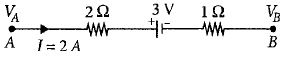
- 5The potential difference $(V_A - V_B)$ between the points $A$ and $B$ in the given figure is ............ $V$View Solution
- 6It is preferable to measure the $e.m.f.$ of a cell by potentiometer than by a voltmeter because of the following possible reasons.View Solution
$(i)$ In case of potentiometer, no current flows through the cell.
$(ii)$ The length of the potentiometer allows greater precision.
$(iii)$ Measurement by the potentiometer is quicker.
$(iv)$ The sensitivity of the galvanometer, when using a potentiometer is not relevant.
Which of these reasons are correct? - 7Three $60\, W$ light bulbs are mistakenly wired in series and connected to a $120\,V$ power supply. Assume the light bulbs are rated for single connection to $120\,V$. With the mistaken connection, the power dissipated by each bulb is: .................. $W$View Solution
- 8In the experiment of $Ohm's law,$ a potential difference of $5.0\, V$ is applied across the end of a conductor of length $10.0\, cm$ and diameter of $5.00\, mm .$ The measured current in the conductor is $2.00\, A$. The maximum permissible percentage error in the resistivity of the conductor isView Solution
- 9A galvanometer of resistance, $G,$ is connected in a circuit. Now a resistance $R$ is connected in series of galvanometer. To keep the main current in the circuit unchanged, the resistance to be put in parallel with the series combination of $G$ and $R$ isView Solution
- 10Value of the resistance $R$ in the figure is .......... $\Omega$View Solution