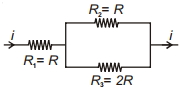
A galvanometer of resistance, $G,$ is connected in a circuit. Now a resistance $R$ is connected in series of galvanometer. To keep the main current in the circuit unchanged, the resistance to be put in parallel with the series combination of $G$ and $R$ is
Medium
Download our app for free and get started
$\mathrm{G}^{\prime}=\mathrm{G}$
$\frac{(\mathrm{G}+\mathrm{R}) \mathrm{S}}{\mathrm{G}+\mathrm{R}+\mathrm{S}}=\mathrm{G} \quad$ or $\mathrm{S}=\frac{\mathrm{G}^{2}}{\mathrm{R}}+\mathrm{G}$

Download our appand get started for free
Experience the future of education. Simply download our apps or reach out to us for more information. Let's shape the future of learning together!No signup needed.*
Similar Questions
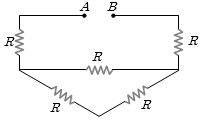
- 1What is the equivalent resistance between $A$ and $B$ in the figure below if $R = 3\,\Omega $View Solution
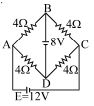
- 2The given figure shows $a$ network of resistances and $a$ battery. Identify the correct statement $(s)$View Solution
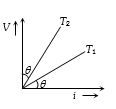
- 3The $V-i$ graph for a conductor at temperature ${T_1}$ and ${T_2}$ are as shown in the figure. $({T_2} - {T_1})$ is proportional toView Solution
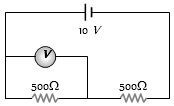
- 4A voltmeter of resistance $1000\,\Omega$ is connected across a resistance of $500\, \Omega$ in the given circuit. What will be the reading of voltmeter .............. $V$View Solution
- 5A cell sends a current through a resistance $R$ for time $t$. Now the same cell sends current through another resistance $r$ for the same time. If same amount of heat is developed in both the resistance, then the internal resistance of cell isView Solution
- 6If $n,\,e,\,\tau $ and $m$ respectively represent the density, charge relaxation time and mass of the electron, then the resistance of a wire of length $l$ and area of cross-section $A$ will beView Solution
- 7View SolutionIf in the experiment of Wheatstone's bridge, the positions of cells and galvanometer are interchanged, then balance points will
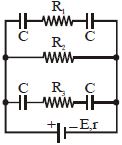
- 8In the circuit diagram of figure, $E = 5\, volt, r = 1\, \Omega ,$$ R_2 = 4\, \Omega , R_1 = R_3 = 1 \Omega$ and $C = 3\, μF.$ Then the magnitude of the charge on each capacitor plate is......$\mu C$View Solution
- 9View SolutionWhich of the following is vector quantity
- 10In the circuit shown, the thermal power dissipated in $R_1$ is $P$. The thermal power dissipated in $R_2$ isView Solution