MCQ
A rod of length $L$ and uniform cross-sectional area has varying thermal conductivity which changes linearly from $2K$ at endAto $K$ at the other end $B$. The endsA and $B$ of the rod are maintained at constant temperature $100^o C$ and $0^o C$, respectively. At steady state, the graph of temperature : $T = T(x)$ where $x =$ distance from end $A$ will be
  • A


  • C

  • D

Answer

Correct option: B.

b

Need a full question paper?

Generate a complete, print-ready paper with questions like this in minutes — across 16+ boards, with answer keys.

Start Generating Free

Similar questions

If the compressibility of water is $\sigma $ per unit atmospheric pressure, then the decrease in volume $V$ due to $P$ atmospheric pressure will be
The surface tension of a liquid is $5\, N/m$. If a thin film of the area $0.02\, m^2$ is formed on a loop, then its surface energy will be
Infinite number of bodies, each of mass $2\, kg$ are situated on $x-$ axis at distances $1\, m, 2\, m, 4 \,m, 8\, m, ... ,$ respectively, from the origin. The resulting gravitational potential due to this system at the origin will be 
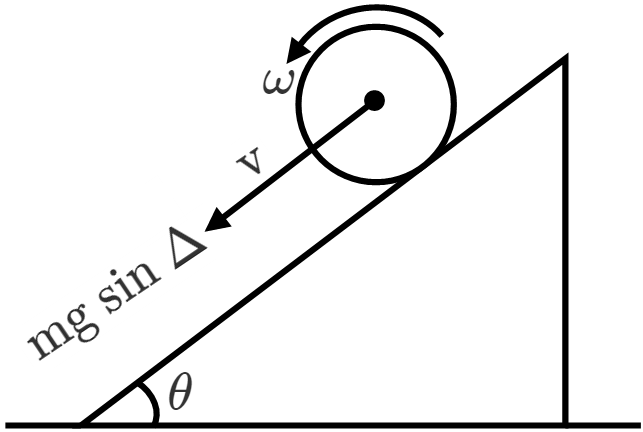
Sphere is in pure accelerated rolling motion in the figure shown,

Choose the correct option:
 
The position of a particle moving along $x$-axis given by $x=\left(-2 t^3+3 t^2+5\right) m$. The acceleration of particle at the instant its velocity becomes zero is ....... $m / s ^2$
A block of mass $m$ is pulled along a horizontal surface by applying a force at an angle $\theta $ with the horizontal. The friction coefficient between the block and surface is $\mu$. If the block travels at a uniform velocity , then work-done during its displacement $d$ is
Why it is more hotter for same distance over the top of a candle than it in the side of its flame?
The focal length of a converging lens are $f_v$ and $f_r$ for violet and red light respectively:
The angular momentum of a particle rotating with an angular velocity $\omega$ distant $r$ from a given origin is $I$. If the origin is shifted by $2r$, then the new angular momentum of the particle with same angular velocity will be:
During which of the following thermodynamic process represented by $P V$ diagram the heat energy absorbed by system may be equal to area under $P V$ graph?