MCQ
A block of mass $m$ is pulled along a horizontal surface by applying a force at an angle $\theta $ with the horizontal. The friction coefficient between the block and surface is $\mu$. If the block travels at a uniform velocity , then work-done during its displacement $d$ is
  • A
    $\frac{{\mu \,mg\,d}}{{\sin\, \theta }}$
  • B
    $\frac{{\mu \,mg\,d}}{{\cos \,\theta }}$
  • C
    $\frac{{\mu \,mg\,d}}{{\cos \,\theta  - \mu \sin \,\theta }}$
  • $\frac{{\mu \,mg\,d}}{{\cos\, \theta  + \mu \sin \,\theta }}$
Answer

Correct option: D.
$\frac{{\mu \,mg\,d}}{{\cos\, \theta  + \mu \sin \,\theta }}$
d
$\mathrm{N}=\mathrm{mg}-\mathrm{Fsin} \theta$

The motion will be uniform if

$\mathrm{F} \cos \theta=\mu(\mathrm{mg}-\mathrm{F} \sin \theta)$

$\therefore \mathrm{F}=\frac{\mu \mathrm{mg}}{\cos \theta+\mu \sin \theta}$

$w=F \times d=F=\frac{\mu \mathrm{mgd}}{\cos \theta+\mu \sin \theta}$

Need a full question paper?

Generate a complete, print-ready paper with questions like this in minutes — across 16+ boards, with answer keys.

Start Generating Free

Similar questions

Which of the following sets of factors will affect the horizontal distance covered by an athlete in a long-jump event
A large tank is filled with water to a height $H$. A small hole is made at the base of the tank. It takes ${T_1}$ time to decrease the height of water to $\frac{H}{\eta }\,(\eta > 1)$; and it takes ${T_2}$ time to take out the rest of water. If ${T_1} = {T_2}$, then the value of $\eta $ is
The fundamental frequency is n of both open end of argon pipe. Keep in vertical and dip in water half length of tubes. So it will full with half water the fundamental frequency of air column.
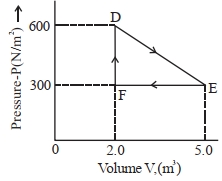
A thermodynamic system is taken from an original state $D$ to an intermediate state $E$ by the linear process shown in the figure. Its volume is then reduced to the original volume from $E$ to $F$ by an isobaric process. The total work done by the gas from $D$ to $E$ to $F$ will be $......J$
If two soap bubbles of equal radii $r$ coalesce then the radius of curvature of interface between two bubbles will be
A car is travelling with linear velocity $v$ on a circular road of radius $r$. If it is increasing its speed at the rate of $'a'$ $meter/{\sec ^2}$, then the resultant acceleration will be
A car is moving on a circular path of radius $500\ m$ with speed $30\ m/s$ and speed is increasing at rate $2\ m/s^2$ net acceleration will be    ......... $m/s^2$
Two interfering waves have the same wavelength, frequency, and amplitude. They are traveling in the same direction but are $90^o$ out of phase. Compared to the individual waves, the resultant wave will have the same.
A stone of mass of $16\, kg$ is attached to a string $144 \,m$ long and is whirled in a horizontal circle. The maximum tension the string can withstand is $16$ Newton. The maximum velocity of revolution that can be given to the stone without breaking it, will be ....... $ms^{-1}$
The ratio of the coefficient of volume expansion of a glass container to that of a viscous liquid kept inside the container is $1 : 4$. What fraction of the inner volume of the container should the liquid occupy so that the volume of the remaining vacant space will be same at all temperatures ?