A rod of length $L$ at room temperature and uniform area of cross section $A$, is made of a metal having coefficient of linear expansion $\alpha {/^o}C$. It is observed that an external compressive force $F$, is applied on each of its ends, prevents any change in the length of the rod, when it temperature rises by $\Delta \,TK$. Young’s modulus, $Y$, for this metal is
JEE MAIN 2019, Medium


Download our appand get started for free
Experience the future of education. Simply download our apps or reach out to us for more information. Let's shape the future of learning together!No signup needed.*
Similar Questions
- 1A $2\, m$ long rod of radius $1\, cm$ which is fixed from one end is given a twist of $0.8$ radians. The shear strain developed will beView Solution
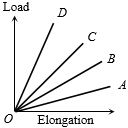
- 2View SolutionThe load versus elongation graph for four wires of the same material is shown in the figure. The thickest wire is represented by the line
- 3On increasing the length by $0.5\, mm$ in a steel wire of length $2\, m$ and area of cross-section $2\,m{m^2}$, the force required is $[Y$ for steel$ = 2.2 \times {10^{11}}\,N/{m^2}]$View Solution
- 4If a spring is extended to length $l,$ then according to Hook's lawView Solution
- 5When a pressure of $100$ atmosphere is applied on a spherical ball, then its volume reduces to $0.01\%$. The bulk modulus of the material of the rubber in $dyne/c{m^2}$ isView Solution
- 6If one end of a wire is fixed with a rigid support and the other end is stretched by a force of $10 \,N,$ then the increase in length is $0.5\, mm$. The ratio of the energy of the wire and the work done in displacing it through $1.5\, mm$ by the weight isView Solution
- 7Two wire $A$ and $B$ are stretched by same force. If, for $A$ and $B, Y_A: Y_B=1: 2, r_A: r_B=3: 1$ and $L_A: L_B=4: 1$, then ratio of their extension $\left(\frac{\Delta L_A}{\Delta L_B}\right)$ will be .............View Solution
- 8$Assertion :$ Hollow shaft is found to be stronger than a solid shaft made of same equal material.View Solution
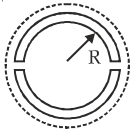
$Reason :$ Torque required to produce a given twist in hollow cylinder is greater than that required to twist a solid cylinder of same length and material. - 9A wooden wheel of radius $R$ is made of two semicircular part (see figure). The two parts are held together by a ring made of a metal strip of cross section area $S$ and length $L$. $L$ is slighly less than $2\pi R$. To fit the ring on the wheel, it is heated so that its temperature rises by $\Delta T$ and it just steps over the wheel.As it cools down to surronding temperature, it presses the semicircular parts together. If the coefficint of linear expansion of the metal is $\alpha$, and its young's modulus is $Y$, the force that one part of wheel applies on the other part isView Solution
- 10Calculate the work done, if a wire is loaded by $'Mg'$ weight and the increase in length is $'l'$View Solution