$Assertion :$ Hollow shaft is found to be stronger than a solid shaft made of same equal material.
$Reason :$ Torque required to produce a given twist in hollow cylinder is greater than that required to twist a solid cylinder of same length and material.
$Reason :$ Torque required to produce a given twist in hollow cylinder is greater than that required to twist a solid cylinder of same length and material.
AIIMS 2016, Medium
Download our app for free and get started
Torque required to produce a given twist in hollow cylinder is greater than solid cylinder thus both are correct.

Download our appand get started for free
Experience the future of education. Simply download our apps or reach out to us for more information. Let's shape the future of learning together!No signup needed.*
Similar Questions
- 1On all the six surfaces of a unit cube, equal tensile force of $F$ is applied. The increase in length of each side will be ($Y =$ Young's modulus, $\sigma $= Poission's ratio)View Solution
- 2View SolutionShear modulus is zero for
- 3The upper end of a wire of radius $4\, mm$ and length $100\, cm$ is clamped and its other end is twisted through an angle of $30°$. Then angle of shear is ..... $^o$View Solution
- 4The elongation of a wire on the surface of the earth is $10^{-4} \; m$. The same wire of same dimensions is elongated by $6 \times 10^{-5} \; m$ on another planet. The acceleration due to gravity on the planet will be $\dots \; ms ^{-2}$. (Take acceleration due to gravity on the surface of earth $=10 \; m / s ^{-2}$ )View Solution
- 5The length of a metal wire is $l_1$, when the tension in it is $T_1$ and is $l_2$ when the tension is $T_2$. The unstretched length of the wire isView Solution
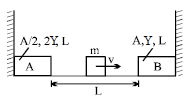
- 6In the given figure, two elastic rods $A$ & $B$ are rigidly joined to end supports. $A$ small mass $‘m’$ is moving with velocity $v$ between the rods. All collisions are assumed to be elastic & the surface is given to be frictionless. The time period of small mass $‘m’$ will be : [$A=$ area of cross section, $Y =$ Young’s modulus, $L=$ length of each rod ; here, an elastic rod may be treated as a spring of spring constant $\frac{{YA}}{L}$ ]View Solution
- 7Longitudinal stress of $1\,kg/m{m^2}$ is applied on a wire. The percentage increase in length is $(Y = {10^{11}}\,N/{m^2})$View Solution
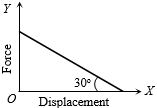
- 8The value of force constant between the applied elastic force $F$ and displacement will beView Solution
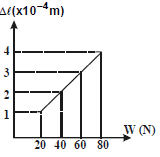
- 9The adjacent graph shows the extension $(\Delta l)$ of a wire of length $1\, m$ suspended from the top of a roof at one end and with a load $W$ connected to the other end. If the cross-sectional area of the wire is $10^{-6}\, m^2$, calculate the Young’s modulus of the material of the wire.View Solution
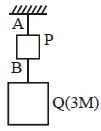
- 10Wires $A$ and $B$ are connected with blocks $P$ and $Q$ as shown. The ratio of lengths, radii and Young's modulus of wires $A$ and $B$ are $r, 2r$ and $3r$ respectively ($r$ is a constant). Find the mass of block $P$ if ratio of increase in their corresponding lengths is $1/6r^2$. The mass of block $Q$ is $3M$.View Solution