Question
 A rod of length $L$ is placed along the $X-$axis between $x = 0$ and $x = L$. The linear density $($mass$/$ length$) \rho$ of the rod varies with the distance x from the origin as $\rho=\text{a + bx.}$
  1. Find the $SI$ units of $a$ and $b.$
  2. Find the mass of the rod in terms of $a, b$ and $L.$
Answer

$\rho=\frac{\text{mass}}{\text{length}}=\text{a + bx}$
  1. $S.I$. unit of $‘a’ = \ kg/m$ and $SI$ unit of $‘b’ = kg/m^2 ($from principle of homogeneity of dimensions$)$
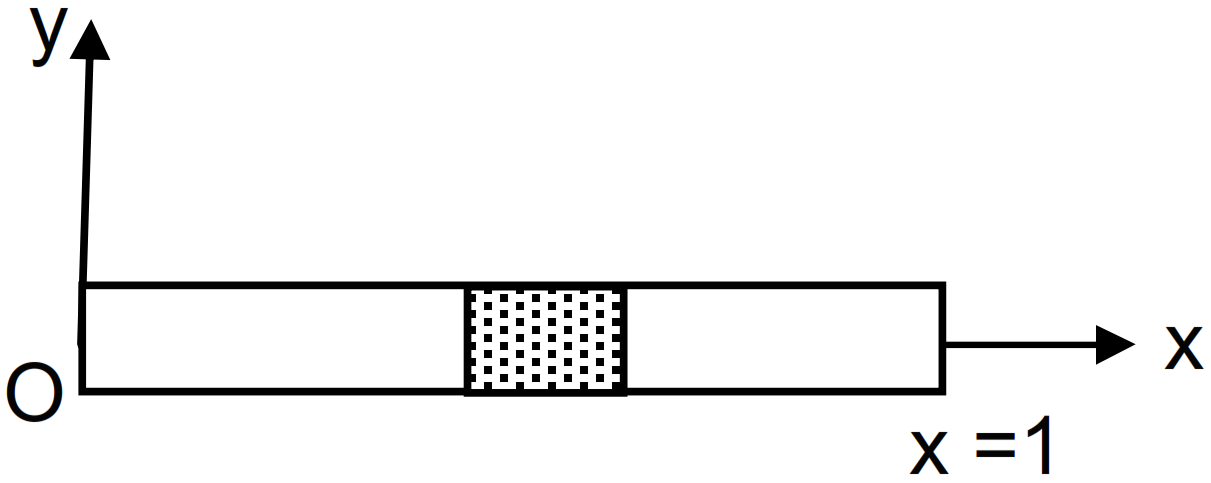
  2. Let us consider a small element of length $‘dx\ ’$ at a distance $x$ from the origin as shown in the figure.
$\therefore\ dm =$ mass of the element $=\rho\text{ dx = (a + bx)dx}$ So, mass of the rod $= m$ $\int\text{dm}=\int\limits^{\text{L}}_0(\text{a + bx)dx}$
$=\Big[\text{ax}+\frac{\text{bx}^2}{2}\Big]^{\text{L}}_0=\text{aL}+\frac{\text{bL}^2}{2}$

Need a full question paper?

Generate a complete, print-ready paper with questions like this in minutes — across 16+ boards, with answer keys.

Start Generating Free

Similar questions

Three moles of an ideal diatomic gas is taken at a temperature of $300K$. Its volume is doubled keeping its pressure constant. Find the change in internal energy of gas.
Plot the corresponding reference circle for each of the following simple harmonic motions. Indicate the initial (t = 0) position of the particle, the radius of the circle, and the angular speed of the rotating particle. For simplicity, the sense of rotation may be fixed to be anticlockwise in every case: (x is in cm and t is in s).$\text{x}=\cos\Big(\frac{\pi}{6}-\text{t}\Big)$
Find the charge appearing on each of the three capacitors shown in figure.
Find the angle between force $\vec{\text{F}}=(3\vec{\text{i}}+4\vec{\text{j}}-5\vec{\text{k}})$ unit and displacement $\vec{\text{d}}=(5\vec{\text{i}}+4\vec{\text{j}}+3\vec{\text{k}})$ unit. Also find the projection of $\vec{\text{F}}$ on $\vec{\text{d}}.$
A diver having a moment of inertia of $6.0kg-m^2$ about an axis through its centre of mass rotates at an angular speed of $2rad/s$ about this axis. If he folds his hands and feet to decrease the moment of inertia to $5.0kg-m^2​​​​​​​$, what will be the new angular speed?
What is an elastic collision? What will happen, when
  1. A heavy body collides with a light mass at rest.
  2. A light body collides with a heavy mass at rest.
When a block of mass M is suspended by a long wire of length L, the elastic potential energy stored in the wire is $\frac{1}{2}\times$ stress × strain × volume. Show that it is equal to $\frac{1}{2}\text{Mgl}$ where l is the extension. The loss in gravitational potential energy of the Mass-earth sustem is Mgl. does the remaining $\frac{1}{2}\text{Mgl}$ energy go?
Define 'Radius of Gyration'. Derive an expression for it.
The displacement of a progressive wave is represented by $\text{y} = \text{A} \sin(\omega \text{t} – \text{k x} ),$ where $x$ is distance and $t$ is time. Write the dimensional formula of $(i) \omega$ and $(ii) k.$
A particle located at x = 0 at t = 0 starts moving along the positive x-direction with a velocity v that varies as $\text{v}=\alpha\sqrt{\text{x}}.$ How does the displacement of the particle vary with time?