MCQ
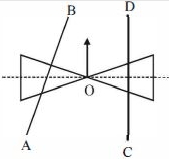
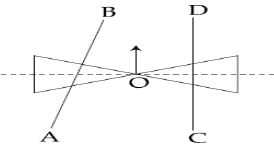
A roller is mad e by joining  together two cones at their vertices $O$. It is kept on two rails $AB$ and $CD$, which are placed asymmetrically (see figure) , with its axis perpendicular to $CD  $ and its centre $O$ at the centre ofline joining $AB$ and $CD$ (see figure) . It is given a light push so that it $A$ starts rolling with its centre $O$ moving parallel to $CD$ in the direction shown. As it moves, the roller will tend to
  • A
    go straight
  • B
    tum left and right alternately
  • turn left
  • D
    turn right

Answer

Correct option: C.
turn left
c
As shown in the diagram, the normal reaction of $AB$ on roller will shift towards $O$. 

This will lead to tending of the system of cones to trun left.

Need a full question paper?

Generate a complete, print-ready paper with questions like this in minutes — across 16+ boards, with answer keys.

Start Generating Free

Similar questions

A ball is dropped vertically from a height $d$ above the ground. It hits the ground and bounces up vertically to a height $d/2$. Neglecting subsequent motion and air resistance, its velocity $v$ varies with the height $h$ above the ground is
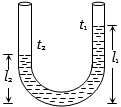
In a vertical $U-$tube containing a liquid, the two arms are maintained at different temperatures ${t_1}$ and ${t_2}$. The liquid columns in the two arms have heights ${l_1}$ and ${l_2}$ respectively. The coefficient of volume expansion of the liquid is equal to
At a given temperature the root mean square velocities of oxygen and hydrogen molecules are in the ratio
If $\overrightarrow {\rm A} = 2\hat i + 3\hat j - \hat k$ and $\overrightarrow B = - \hat i + 3\hat j + 4\hat k$ a unit vector perpendicular to both $\overrightarrow A $ and $\overrightarrow B $ will be
$Assertion$ : Moment of inertia depends on the axis of rotation and the nature of distribution of the mass of the body.
$Reason$ : Moment of inertia is the rotational inertia of the body
Which force can possibly act on a body moving in a straight line?
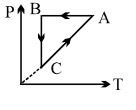
A cyclic process $ABCA$ is shown in $PT$ diagram. When presented on $PV$, it would
A bullet of mass m fired at 30° to the horizontal leaves the barrel of the gun with a velocity v. The bullet hits a soft target at a height h above the ground while it is moving downward and emerges out with half the kinetic energy it had before hitting the target. Which of the following statements are correct in respect of bullet after it emerges out of the target?
  1. The velocity of the bullet will be reduced to half its initial value.
  2. The velocity of the bullet will be more than half of its earlier velocity.
  3. The bullet will continue to move along the same parabolic path.
  4. The bullet will move in a different parabolic path.
  5. The bullet will fall vertically downward after hitting the target.
  6. The internal energy of the particles of the target will increase.The internal energy of the particles of the target will increase.
Angular displacement $(\theta )$ of a flywheel varies with time as $\theta  = at + b{t^2} + c{t^3}$ then angular acceleration is given by  
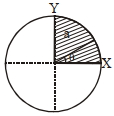
The disc of mass $M$ with uniform surface mass density $\sigma$ is shown in the figure. The centre of mass of the quarter disc (the shaded area) is at the position $\frac{x}{3} \frac{a}{\pi}, \frac{x}{3} \frac{a}{\pi}$ where $x$ is ....... .

(Round off to the Nearest Integer) $[ a$ is an area as shown in the figure $]$