MCQ
Which force can possibly act on a body moving in a straight line?
  • A
    Tangential force
  • B
    Friction force
  • C
    Centrifugal force
  • D
    Centripetal force

Answer

  1. Friction force

Explanation:

In the physical world, no surface is frictionless. Hence whenever a body moves, the force of friction acts on it. Rest all forces act on the body only when it moves along a curve and not along a straight line.

Need a full question paper?

Generate a complete, print-ready paper with questions like this in minutes — across 16+ boards, with answer keys.

Start Generating Free

Similar questions

A mass of $M\ kg$ is suspended by a weightless string. The horizontal force that is displace it until the string makes an angle of $45^o $ with the initial vertical direction is
A uniform heavy rod of mass $20\,kg$. Cross sectional area $0.4\,m ^{2}$ and length $20\,m$ is hanging from a fixed support. Neglecting the lateral contraction, the elongation in the rod due to its own weight is $x \times 10^{-9} m$. The value of $x$ is

(Given. Young's modulus $Y =2 \times 10^{11} Nm ^{-2}$ અને $\left.g=10\, ms ^{-2}\right)$
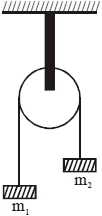
A uniformly thick wheel with moment of inertia $I$ and radius $R$ is free to rotate about its centre of mass (see fig). A massless string is wrapped over its rim and two blocks of masses $\mathrm{m}_{1}$ and $\mathrm{m}_{2}\left(\mathrm{m}_{1}>\mathrm{m}_{2}\right)$ are attached to the ends of the string. The system is released from rest. The angular speed of the wheel when $\mathrm{m}_{1}$ descents by a distance $h$ is
The equation of projectile is $y = 16x\, - \,\frac{{5{x^2}}}{4}$, The horizontal range is .......... $m$
A body of mass $0.5 \,kg$ is projected under gravity with a speed of $98 \,m/s$ at an angle of ${30^o}$ with the horizontal. The change in momentum (in magnitude) of the body is ......... $N-s$
A particle has a velocity u towards east at t = 0. Its acceleration is towards west and is constant. Let xA and xB be the magnitude of displacements in the first 10 seconds and the next 10 seconds:
A whistle of frequency $500 Hz$ tied to the end of a string of length $1.2 m$ revolves at $400 \,rev/min$. A listener standing some distance away in the plane of rotation of whistle hears frequencies in the range (speed of sound $= 340 m/s$)
$Y $ component of velocity is $20$ and $X$ component of velocity is $10$. The direction of motion of the body with the horizontal at this instant is
Position $x$ of a particle at any instant is related with velocity as $v = \sqrt {2x + 9}$ . The particle starts from origin. Then initial acceleration and velocity are
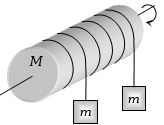
A uniform solid cylinder of mass $M$ and radius $R$ rotates about a frictionless horizontal axle. Two similar masses suspended with the help two ropes wrapped around the cylinder. If the angular velocity of the cylinder, after the masses fall down through distance $h$, will be