MCQ
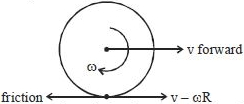
A round body is given translational velocity and released on a surface that has friction. Then
  • Body will move forward before pure rolling
  • B
    Body will move backward before pure rolling
  • C
    Body will start pure rolling immediately
  • D
    None of these

Answer

Correct option: A.
Body will move forward before pure rolling
a
Initially $\omega=0,$ as $\omega$ increases

after sometime it body start pure rolling.
Need a full question paper?

Generate a complete, print-ready paper with questions like this in minutes — across 16+ boards, with answer keys.
Start Generating Free

Similar questions

The only elastic modulus that applies to fluids is
The escape velocities of two planets $A$ and $B$ are in the ratio $1: 2$. If the ratio of their radii respectively is $1: 3$, then the ratio of acceleration due to gravity of planet $A$ to the acceleration of gravity of planet $B$ will be:
Consider diffraction of light through a rectangular slit which is twice as wide as it is high. Which of the following is statements is true ?
A body of area $1\, cm^2$ is heated to a temperature $1000\, K$. The amount of energy radiated by the body in $1\, second$ is .......... $Joule$ (Stefan's constant $\sigma  = 5.67 \times 10^{-8}\, W\, m^{-2}K^{-4}$)
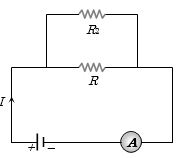
If a resistance ${R_2}$ is connected in parallel with the resistance $R$ in the circuit shown, then possible value of current through $R$ and the possible value of ${R_2}$ will be
The average value of electric energy density in an electromagnetic wave is :
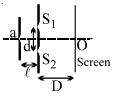
The figure shows a schematic diagram showing the arrangement of Young's Double Slit Experiment If the distance $D$ is varied, then choose the correct statement $(s)$
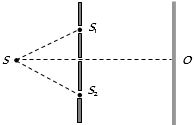
In the set up shown in Fig the two slits, ${S_1}$ and ${S_2}$ are not equidistant from the slit $S$. The central fringe at $O$ is then
The length of the second pendulum on the surface of earth is $1\, m$. The length of seconds pendulum on the surface of moon, where g is 1/6th value of $g$ on the surface of earth, is
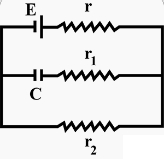
In the given circuit diagram when the current reaches steady state in the circuit, the charge on the capacitor of capacitance $C$ will be